
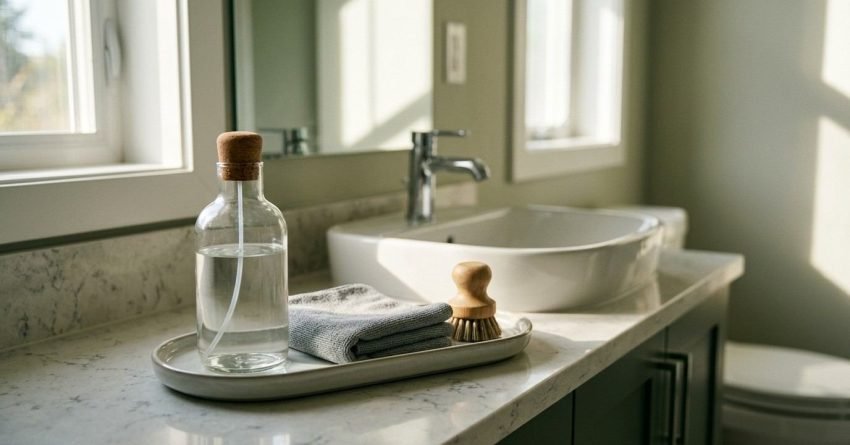
Start with the bathroom. This high-traffic, moisture-prone space harbours the most bacteria and needs the strongest products, so tackling it first stops cross-contamination spreading through the rest of your home. It also gives disinfectants proper dwell time while you move on.
I have watched this one decision change how long a whole-house clean takes. The order you work in decides whether you clean once or clean twice.
Below is the sequence we use, why each step sits where it does, and how to bend it around your own layout.
Before You Start: Supplies And A Declutter Pass
Two things happen before I touch a single surface. I load one caddy with everything I need, and I walk the house putting stray items away.
The caddy carries disinfectant, glass cleaner, bathroom spray, degreaser, microfibre cloths, and a scrubbing pad. Carrying it room to room removes the twenty small trips back to the cupboard that quietly eat half an hour.
The declutter pass matters just as much. Wiping around objects takes longer than wiping an empty bench, so we clear first and clean second.
Why Cleaning Order Matters
The sequence is not arbitrary. It comes from a simple physical reality: dirt falls, water spreads, and germs travel on whatever you carry between rooms.
Gravity Decides The Direction
Cleaning in a logical order stops you from undoing your own work. Dust a bedroom before vacuuming, and the particles land on the floor you are about to collect them from.
Reverse it, and you mop debris into wet streaks. The top-to-bottom, back-to-front approach puts gravity on your side, catching everything in one pass.
Moving from the furthest point toward your exit keeps you off surfaces you have already finished.
Cross-Contamination And Dwell Time
Bathrooms and kitchens hold different bacteria loads. Using the same cloth across both spreads germs instead of removing them, which is why sequence and fresh cloths matter together.
Dwell time is the other half of the equation. Most sprays need contact time to break down soap scum and kill bacteria, so we apply them, walk away, and return.
That waiting period is free cleaning. It replaces scrubbing you would otherwise do by hand.

The Expert-Recommended Room Cleaning Order
Professional cleaners follow a consistent sequence built around contamination risk, dwell time, and a sensible path through the house.
Order | Room | Why Here | Typical Time |
1 | Bathrooms | Highest bacteria load, longest dwell time | 20–30 minutes |
2 | Kitchen | Food safety, benefits from dwell time | 25–35 minutes |
3 | Bedrooms | Dry rooms, furthest from the exit | 15 minutes each |
4 | Living areas | Dry rooms, closest to the exit | 20 minutes |
5 | All floors | Everything falls down | 20–30 minutes |
Start With Bathrooms: The Dirtiest Spaces First
Bathrooms earn first place on two counts. They hold the highest concentration of harmful bacteria, and they reward dwell time more than any other room.
Apply toilet cleaner, shower spray, and basin disinfectant the moment you walk in. These products need 5–10 minutes of contact to kill germs and dissolve buildup, so leave them working and move on.
Inside the bathroom, work top to bottom. Mirrors and light fixtures, then benches and tapware, then the toilet exterior, then the floor.
Move To The Kitchen: High-Traffic Hygiene Zones
Kitchens come second for food safety reasons and because they respond to the same dwell-time trick. Spray the oven interior, degrease the stovetop, and treat the sink before you go elsewhere.
Then work the surfaces in order:
- Clear and wipe benchtops, lifting appliances to clean underneath
- Cabinet fronts, which collect grease and fingerprints
- Appliance exteriors, splashback, then sink and tapware
- Floor last
High-touch points deserve separate attention. Fridge handles, microwave buttons, and tap handles carry real bacterial loads and need disinfecting, not just wiping.
Bedrooms And Living Areas
With the wet rooms done, we move into dry spaces. Bedrooms come before living areas because they usually sit further from the entrance, which keeps the back-to-front principle intact.
Strip and remake beds first when linen is changing. Then dust highest to lowest: ceiling fans, light fittings, wardrobe tops, dressers, nightstands, skirting boards.
Living rooms follow the same top-down path. Dust fittings, shelving, and entertainment units, then sort cushions and surface clutter before the floor.
Finish With Floors In Every Room
Floors come last everywhere, for the obvious reason that everything falls down.
The floor sequence has its own rule, though. Vacuum or sweep every room before you mop any of them, so you never track dust from an unfinished room across a wet floor.
Mop from the room furthest from your exit and work backwards toward the door. Give floors 15–30 minutes to dry before furniture goes back.
Adapting The Cleaning Order To Your Home
The standard sequence suits most homes. Your layout and your reason for cleaning shift the details.
Single-Level And Multi-Storey Homes
In single-level homes, work from the back of the house toward the front door. That usually means the ensuite, then bedrooms, then the main bathroom, kitchen, and living areas near the entry.
Multi-storey homes are cleaner to handle one level at a time. Start on the top floor and work down, so dust falls into rooms you have not finished yet, and you carry the caddy up the stairs once.
Open-Plan Living
Open-plan designs erase the walls but not the zones. Treat the kitchen as its own area and finish it before the dining and living space beside it.
Furniture gives you the boundaries. The back of a sofa or the edge of a dining table marks where one zone ends and the next begins.
Cleaning Order After A Renovation
Post-renovation cleaning breaks the normal rules, and this is where most people go wrong. Construction dust is finer than household dust; it stays airborne for hours, and wiping too early just moves it around.
We let the air settle first, ideally overnight with windows open. Then we vacuum with a HEPA filter from the ceiling down, walls included, before any wet cleaning starts.
Only after the dry pass do we bring water in. Damp-wiping first turns fine gypsum dust into a paste that smears into new grout, fresh paint, and tile joints.
Floors get vacuumed, then mopped, then vacuumed again a day later once settled dust reappears. This is the sequence we run on every handover, and it is the difference between a finished renovation and one that looks dusty for a fortnight.
Adjusting For Your Reason To Clean
Different goals reorder the priorities. Pre-guest cleaning puts visible living areas and the guest bathroom ahead of private bedrooms, because that is what gets seen.
Rental turnovers concentrate on bathroom and kitchen hygiene for compliance. Routine weekly cleaning follows the standard order exactly.
Whatever the reason, the two anchors hold: top to bottom, wet rooms first.

Common Cleaning Order Mistakes
Good intentions still produce wasted effort. Two habits cause most of it.
Starting With The Floors
Vacuuming or mopping first feels productive because floors show instant improvement. Every bit of dusting you do afterwards drops debris straight back onto them.
Making the bed before dusting the bedroom does the same thing in miniature. The satisfaction of a made bed does not survive dust settling on fresh linen.
Skipping Dwell Time And Working At Random
Spraying and immediately wiping removes the product before it does its job, which wastes both the spray and your forearms. Build the wait into the sequence instead.
Random room selection costs just as much. Jumping between spaces produces forgotten tasks, repeated trips, and no clear sense of what is actually finished.
A fixed order feels rigid for about two weeks. Then it becomes muscle memory, and the deciding stops.
Conclusion
The room you clean first sets up everything after it. Bathrooms, then the kitchen, then bedrooms and living areas, then every floor at the end, gives you one clean pass instead of two and results that hold longer between sessions.
At Sydney Home Renovation, we deal with the harder version of this problem constantly. A freshly renovated bathroom or kitchen only looks finished once the construction dust has been sequenced out properly, and that is a different job from a weekly tidy.
We build spaces that stay easy to maintain, from surface choices through to how a room drains and ventilates. Talk to us about your bathroom, kitchen, or whole-home renovation, and we will plan it around how you actually live in it.
Frequently Asked Questions
Should I clean the dirtiest room first or last?
First. The bathroom holds the heaviest bacteria load, so cleaning it early stops you from carrying germs into other rooms and gives strong products their full dwell time.
How often should I deep clean each room?
Bathrooms and kitchens suit weekly deep cleaning because of moisture and food contamination. Bedrooms and living areas hold up for two to four weeks with light maintenance in between.
Does the cleaning order change for spring cleaning?
The sequence stays the same; the task list grows. Declutter the whole house first, then run the normal room order and add wardrobes, window tracks, and behind furniture.
Should I dust or vacuum first?
Dust first, always. Dusting knocks particles onto the floor where the vacuum collects them, and reversing the order leaves debris on carpet you just finished.
What is the fastest way to clean a whole house?
Stick to the order and work in parallel. Apply every spray product first, dust the dry rooms while they sit, then circle back to wipe.
How do I keep the order in an open-plan home?
Split the space into kitchen, dining, and living zones. Clean the kitchen zone first for hygiene, then move through the rest back to front, using furniture as your boundaries.


