Choosing the wrong bathroom flooring can cost Sydney homeowners thousands in water damage repairs, mould remediation, and premature replacement. Hardwood, laminate, carpet, and unsealed stone are among the worst offenders—materials that look appealing but deteriorate rapidly in wet environments.
This matters because bathrooms experience constant moisture exposure, humidity fluctuations, and direct water contact that most flooring materials simply cannot withstand. Making the wrong choice now means budget blowouts later.
This guide breaks down exactly which flooring types to avoid, why they fail, what works instead, and how to budget for bathroom flooring that actually lasts in Sydney’s climate.
Why Bathroom Flooring Choices Matter More Than Other Rooms
Bathrooms present unique challenges that no other room in your home faces. The flooring you choose must handle conditions that would destroy materials suitable for bedrooms, living areas, or even kitchens.
Understanding these demands helps you avoid costly mistakes before they happen.
Moisture, Humidity, and Water Exposure Risks
Bathrooms experience three types of water exposure simultaneously. Direct water contact occurs from showers, baths, and sink splashes. Humidity builds up from steam during hot showers, often reaching saturation levels. Condensation forms on cooler surfaces when temperature differentials exist.
Sydney’s humid subtropical climate amplifies these challenges. Summer humidity regularly exceeds 65%, meaning bathroom moisture takes longer to dissipate. This creates extended exposure periods that accelerate flooring deterioration.
Long-Term Costs of Choosing the Wrong Flooring
Failed bathroom flooring rarely stays a surface problem. Water penetration damages the subfloor, requiring structural repairs that can exceed $5,000-$8,000 in Sydney. Mould remediation adds another $1,500-$4,000 depending on severity.
The original flooring cost becomes irrelevant when replacement involves demolition, subfloor repair, waterproofing rectification, and new installation. What seemed like a budget-friendly choice becomes the most expensive option.
Flooring Types You Should Avoid in Bathrooms
Several popular flooring materials perform excellently throughout your home but fail catastrophically in bathroom environments. Each has specific vulnerabilities that make them unsuitable for wet areas.
Solid Hardwood Flooring
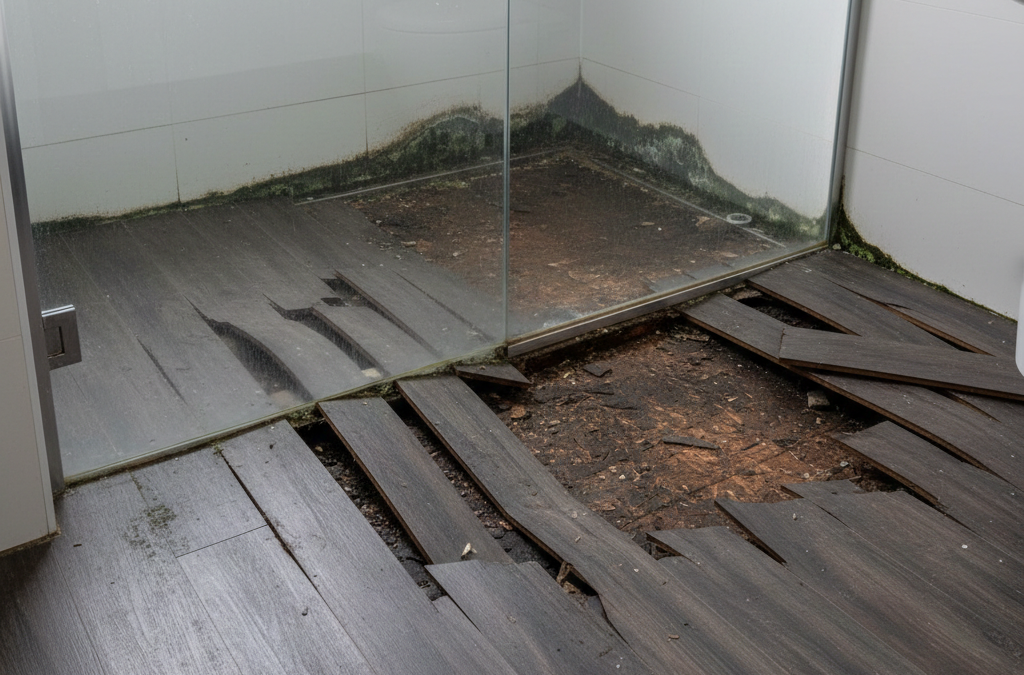
Solid hardwood absorbs moisture through its grain structure, causing expansion, warping, and cupping within months of bathroom installation. Even sealed hardwood allows moisture penetration through joints, edges, and any surface scratches.
The natural beauty that makes hardwood desirable becomes its weakness. Wood fibres swell unevenly, creating permanent distortion. Once warped, hardwood cannot be restored—only replaced.
Laminate Flooring
Laminate consists of a high-density fibreboard core with a photographic surface layer. That fibreboard core absorbs water like a sponge. Once moisture reaches the core through seams, edges, or surface damage, the material swells irreversibly.
Manufacturers explicitly exclude bathroom installation from warranties. The “water-resistant” laminate products available still fail at seams and edges where water naturally pools.
Carpet and Carpet Tiles
Carpet in bathrooms creates immediate hygiene problems. The fibres trap moisture, creating ideal conditions for mould, mildew, and bacteria growth. Drying times extend for hours, maintaining damp conditions continuously.
Beyond health concerns, carpet padding deteriorates rapidly when wet. The subfloor beneath receives constant moisture exposure, leading to structural damage and persistent odours that cleaning cannot eliminate.
Unsealed Natural Stone
Natural stone like marble, limestone, and travertine contains microscopic pores that absorb water, soap residue, and cleaning chemicals. Without professional sealing and regular resealing, these materials stain permanently and harbour bacteria.
The porosity also allows moisture to reach the subfloor. Efflorescence—white mineral deposits—appears as water evaporates through the stone, indicating ongoing moisture problems beneath the surface.
Bamboo Flooring
Despite marketing claims about durability, bamboo shares hardwood’s fundamental weakness: organic material that absorbs moisture. Bamboo’s laminated construction adds vulnerability at adhesive layers where water penetration causes delamination.
Sydney’s humidity accelerates bamboo deterioration. The material expands and contracts with moisture changes, loosening installations and creating gaps where water accumulates.
Cork Flooring
Cork’s cellular structure provides excellent insulation and comfort but creates moisture retention problems in bathrooms. Water absorbed into cork cells promotes mould growth within the material itself.
Sealed cork offers temporary protection, but bathroom conditions eventually compromise any sealant. Once moisture penetrates, cork becomes permanently damaged and requires complete replacement.
Why These Flooring Materials Fail in Wet Environments
Understanding failure mechanisms helps you evaluate any flooring material’s bathroom suitability. Three primary processes cause bathroom flooring failures.
Water Absorption and Warping Issues
Organic materials—wood, bamboo, cork—and composite materials with organic cores absorb water through capillary action. This absorption causes dimensional changes as fibres swell. The uneven swelling creates warping, cupping, and buckling.
Bathroom installations experience repeated wet-dry cycles. Each cycle causes expansion and contraction that loosens fasteners, opens seams, and accelerates deterioration. Materials that might survive occasional moisture exposure fail under continuous cycling.
Mould and Mildew Growth Risks
Mould requires three conditions: moisture, organic material, and temperatures between 15-30°C. Bathrooms provide all three consistently. Organic flooring materials become mould food sources.
Surface mould can be cleaned, but mould within flooring materials cannot be eliminated without replacement. Spores spread through the subfloor structure, creating health hazards and requiring extensive remediation.
Structural Damage and Subfloor Problems
Water penetrating through flooring reaches the subfloor—typically particleboard or plywood in Sydney homes. Particleboard swells and disintegrates when wet. Plywood delaminates and develops rot.
Subfloor damage often remains hidden until flooring fails visibly. By then, structural repairs become necessary. Joists may require treatment or replacement if moisture exposure has been prolonged.
Common Mistakes Sydney Homeowners Make with Bathroom Flooring
Local renovation experience reveals patterns in flooring failures. These mistakes occur repeatedly, often driven by understandable but misguided priorities.
Prioritising Aesthetics Over Functionality
The desire for a cohesive home aesthetic leads homeowners to extend living area flooring into bathrooms. Hardwood throughout the home looks stunning—until the bathroom section fails within two years.
Bathroom flooring must meet functional requirements first. Aesthetic preferences should guide choices among suitable materials, not override suitability considerations entirely.
Ignoring Waterproofing Requirements
Australian Standard AS 3740 mandates waterproofing in wet areas. Waterproofing membranes protect the subfloor regardless of surface flooring. However, unsuitable flooring materials still fail even with proper waterproofing beneath.
Some homeowners assume waterproofing eliminates flooring restrictions. It doesn’t. Waterproofing protects the structure; appropriate flooring protects itself and maintains the waterproofing system’s integrity.
Underestimating Installation Costs for Unsuitable Materials
Attempting to make unsuitable materials work in bathrooms requires expensive modifications. Enhanced sealing, specialised adhesives, and frequent maintenance add costs that exceed simply choosing appropriate materials initially.
These modifications rarely succeed long-term. The additional investment delays failure rather than preventing it, ultimately increasing total project costs.
What Flooring Works Best in Bathrooms Instead
Avoiding unsuitable materials leaves excellent options that combine durability, aesthetics, and value. These alternatives handle bathroom conditions reliably.
Porcelain and Ceramic Tiles
Porcelain and ceramic tiles remain the gold standard for bathroom flooring. Porcelain’s density makes it virtually waterproof—absorption rates below 0.5% compared to 3-7% for standard ceramics.
Tiles offer unlimited design options, from natural stone looks to contemporary patterns. Proper installation with appropriate grout creates a seamless waterproof surface. Maintenance requires only regular cleaning.
Sydney material costs range from $30-$150 per square metre for quality porcelain, with installation adding $50-$80 per square metre including waterproofing preparation.
Luxury Vinyl Plank (LVP) and Sheet Vinyl
Modern luxury vinyl plank provides waterproof performance with realistic wood or stone appearances. The 100% synthetic construction eliminates organic material vulnerabilities.
Sheet vinyl offers seamless installation, eliminating seam vulnerabilities. Both options provide comfort underfoot and easier installation than tiles, reducing labour costs.
Budget $40-$90 per square metre for quality LVP materials, with installation around $35-$55 per square metre in Sydney.
Sealed Natural Stone Options
Properly sealed granite, slate, and certain dense stones perform well in bathrooms. Professional sealing fills pores, preventing moisture absorption. Annual resealing maintains protection.
These premium options suit homeowners wanting natural materials and willing to commit to maintenance requirements. Material costs range from $100-$300 per square metre before installation.
How to Budget for Bathroom Flooring That Lasts
Smart budgeting considers total cost of ownership, not just initial purchase price. The cheapest flooring option often becomes the most expensive over a renovation’s lifespan.
Material Costs vs. Long-Term Value
Quality bathroom flooring costs more initially but eliminates replacement expenses. Porcelain tiles installed correctly last 25+ years. Quality LVP provides 15-20 years of service.
Compare this to unsuitable materials requiring replacement within 3-5 years. The second installation costs more than the first due to demolition, disposal, and potential subfloor repairs.
Installation and Waterproofing Allowances
Professional installation ensures waterproofing integrity and flooring performance. DIY bathroom flooring installations frequently fail due to inadequate waterproofing preparation or incorrect adhesive application.
Budget $80-$150 per square metre total for professional tile installation including waterproofing in Sydney. This investment protects your renovation for decades.
Hidden Costs of Replacing Failed Flooring
Failed bathroom flooring replacement involves:
- Demolition and disposal: $500-$1,500
- Subfloor assessment and repair: $1,000-$5,000+
- Waterproofing rectification: $1,500-$3,000
- New flooring and installation: Original cost again
A $2,000 initial flooring choice that fails costs $7,000-$12,000 to rectify. A $4,000 appropriate choice costs nothing additional for decades.
Conclusion
Avoiding hardwood, laminate, carpet, unsealed stone, bamboo, and cork in bathrooms prevents water damage, mould growth, and expensive repairs. These materials cannot withstand the moisture exposure, humidity, and wet-dry cycling that bathrooms demand daily.
Choosing porcelain tiles, luxury vinyl, or properly sealed stone protects your renovation investment and eliminates premature replacement costs. The right flooring choice made once serves your bathroom for decades.
Sydney Home Renovation helps homeowners select and install bathroom flooring that performs reliably in Sydney’s climate. Contact our team for transparent pricing on bathroom renovations that stay on budget and deliver lasting value.
Frequently Asked Questions
Can you use hardwood flooring in a bathroom if it’s sealed?
Sealing provides temporary protection but cannot prevent moisture penetration through joints, edges, and surface wear. Even sealed hardwood warps and deteriorates in bathroom conditions within 2-5 years. The maintenance required to delay failure exceeds the cost of installing appropriate materials initially.
Is laminate flooring waterproof enough for bathrooms?
No. Laminate’s fibreboard core absorbs moisture through seams and edges regardless of surface treatments. Manufacturers exclude bathrooms from laminate warranties specifically because the material cannot withstand wet area conditions. “Water-resistant” laminate delays but does not prevent failure.
Why is carpet a bad choice for bathroom floors?
Carpet traps moisture, creating conditions for mould, mildew, and bacteria growth. The material cannot dry quickly enough between uses, maintaining constant dampness. Health risks, odours, and subfloor damage make carpet entirely unsuitable for any bathroom application.
What happens if you install the wrong flooring in a wet area?
Unsuitable flooring absorbs moisture, warps, and deteriorates. Water penetrates to the subfloor, causing structural damage and mould growth. Replacement requires demolition, subfloor repair, waterproofing rectification, and new installation—typically costing three to five times the original flooring investment.
How much does it cost to replace failed bathroom flooring in Sydney?
Complete replacement including demolition, subfloor repair, waterproofing, and new flooring typically costs $7,000-$15,000 for an average Sydney bathroom. Severe subfloor damage or mould remediation can push costs higher. Prevention through appropriate initial material selection eliminates these expenses entirely.
Are engineered wood floors safe for bathrooms?
Engineered wood performs slightly better than solid hardwood but still contains organic materials vulnerable to moisture. The plywood base and wood veneer surface both absorb water over time. Most manufacturers recommend against bathroom installation, and warranties exclude wet area use.
What is the most durable and budget-friendly bathroom flooring?
Porcelain tiles offer the best combination of durability, water resistance, and long-term value. Initial costs exceed some alternatives, but 25+ year lifespans eliminate replacement expenses. Luxury vinyl plank provides a lower-cost waterproof option with 15-20 year durability for budget-conscious renovations.