
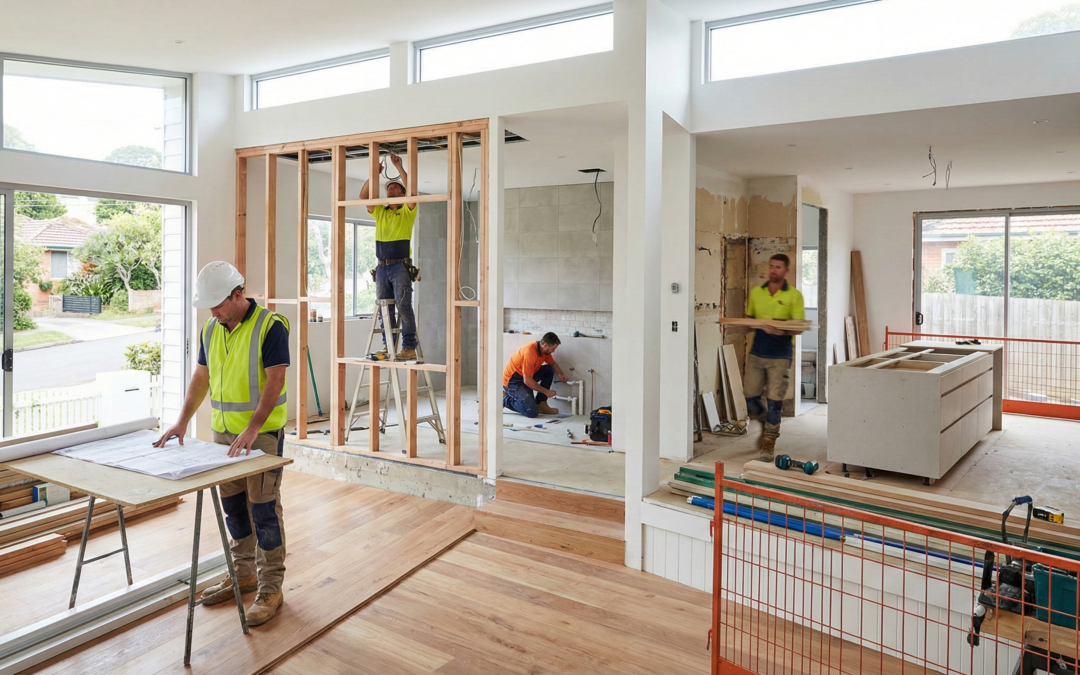
A full house renovation typically includes structural modifications, electrical and plumbing upgrades, kitchen and bathroom remodels, flooring replacement, painting, and fixture installations—with Sydney projects ranging from $150,000 to $500,000+ depending on scope and finishes. Understanding exactly what’s involved prevents budget blowouts and ensures you’re comparing quotes accurately.
Whether you’re modernising a dated property, preparing for resale, or creating your forever home, knowing each renovation component helps you prioritise spending and avoid costly surprises. This knowledge puts you in control of contractor conversations and financial planning.
This guide breaks down every element of a full house renovation, from demolition through to final finishes, with realistic Sydney pricing, typical timelines, and practical advice for homeowners, first-time renovators, and property investors.
Understanding Full House Renovation Scope
A full house renovation transforms an entire property rather than updating individual rooms. This comprehensive approach addresses structural integrity, building compliance, functional layouts, and aesthetic finishes simultaneously. Unlike partial renovations that tackle one space at a time, whole-house projects require coordinated planning across all trades and systems.
The scope typically encompasses everything from foundation to roof, including all internal spaces and external elements that affect livability. Full renovations suit properties requiring significant modernisation, those with outdated electrical or plumbing systems, or homes where piecemeal updates would prove more expensive long-term.
Renovation vs Extension vs Knockdown Rebuild
Renovation retains the existing structure while upgrading systems, finishes, and layouts. Extensions add new floor space to the current footprint. Knockdown rebuilds demolish the existing dwelling entirely, constructing a new home on the same land.
Full renovations typically cost 30-50% less than knockdown rebuilds while preserving character features and avoiding lengthy council approval processes for new builds. However, older properties with significant structural issues may prove more economical to rebuild than renovate extensively.
When Full Renovation Makes Sense
Full house renovation suits properties where the bones remain sound but systems and finishes need comprehensive updating. Homes built before 1980 often require complete electrical rewiring, plumbing replacement, and asbestos removal—making room-by-room renovation inefficient.
Properties in established Sydney suburbs with heritage overlays or strict development controls often benefit from renovation over rebuilding. The existing structure’s footprint and height may exceed what current regulations permit for new construction.
Structural and Building Works
Structural work forms the foundation of any full house renovation, addressing the building’s skeleton before cosmetic improvements begin. These elements ensure safety, compliance, and longevity of all subsequent renovation investments.
Foundation and Subfloor Repairs
Foundation assessment identifies settlement, cracking, or moisture issues requiring remediation. Sydney’s reactive clay soils cause many older homes to experience foundation movement, necessitating underpinning or restumping.
Subfloor work includes replacing damaged bearers and joists, improving ventilation to prevent moisture damage, and levelling floors before new coverings. Budget $15,000-$50,000 for significant foundation repairs in Sydney, with restumping averaging $10,000-$25,000 depending on house size.
Wall Modifications and Structural Changes
Removing walls to create open-plan living requires engineering assessment and potentially steel beam installation. Load-bearing wall removal in Sydney typically costs $2,500-$8,000 including engineering, temporary supports, and beam installation.
Adding new walls, doorways, or window openings involves framing, lintels, and integration with existing structures. Structural modifications require council approval when affecting load-bearing elements or changing the building’s footprint.
Roof Repairs and Replacement
Roof assessment determines whether repairs suffice or complete replacement proves necessary. Sydney’s weather extremes stress roofing materials, with terracotta tiles lasting 50-100 years while metal roofing typically requires replacement after 25-50 years.
Full roof replacement costs $15,000-$40,000 for an average Sydney home, including removal, disposal, new materials, and installation. Repairs to specific sections, flashing, or valleys cost considerably less but may prove false economy on aging roofs.
Electrical System Upgrades
Electrical work in full renovations typically involves complete rewiring, switchboard upgrades, and installation of modern fixtures and safety systems. Older Sydney homes often have inadequate electrical capacity for contemporary appliances and technology demands.
Complete Rewiring Requirements
Homes with original wiring from before 1980 generally require complete rewiring to meet current Australian Standards. Old rubber-insulated wiring deteriorates, creating fire and shock hazards that insurance companies increasingly refuse to cover.
Full house rewiring in Sydney costs $10,000-$30,000 depending on property size, accessibility, and complexity. This includes new cables throughout walls and ceilings, updated outlets and switches, and connection to the upgraded switchboard.
Switchboard and Safety Switch Installation
Modern switchboards accommodate increased electrical loads while incorporating safety switches (RCDs) now mandatory in Australian homes. Upgrading from old ceramic fuse boxes to circuit breaker switchboards costs $1,500-$4,000.
Safety switches protect against electrocution by cutting power within milliseconds of detecting current leakage. All power and lighting circuits require RCD protection in renovated properties, with smoke alarm interconnection now standard practice.
Lighting Design and Power Points
Contemporary renovations include comprehensive lighting design with layered ambient, task, and accent lighting. LED downlights, pendant fixtures, and integrated strip lighting create functional, atmospheric spaces while reducing energy consumption.
Adequate power point placement prevents reliance on power boards and extension leads. Modern kitchens require 8-12 power points, living areas need outlets every 2-3 metres, and home offices demand dedicated circuits for equipment.
Plumbing and Gas Works
Plumbing upgrades address water supply, drainage, gas lines, and hot water systems throughout the property. Full renovations provide opportunity to replace aging pipes, improve water pressure, and install efficient fixtures.
Pipe Replacement and Upgrades
Galvanised steel and copper pipes in older Sydney homes corrode internally, reducing water pressure and quality. Full pipe replacement with modern PEX or copper costs $8,000-$20,000 depending on property size and accessibility.
Drainage upgrades address blocked, cracked, or root-damaged sewer lines. CCTV inspection identifies issues before renovation begins, with relining or replacement costs varying from $3,000 for spot repairs to $15,000+ for complete drainage overhauls.
Hot Water System Installation
Hot water system selection impacts ongoing energy costs and available capacity. Options include electric storage, gas storage, gas instantaneous, heat pump, and solar systems, each with different upfront and operating costs.
Heat pump systems suit Sydney’s climate, offering 60-75% energy savings over electric storage at installation costs of $3,000-$5,000. Gas instantaneous systems provide unlimited hot water at $1,500-$3,000 installed, with lower running costs than electric storage.
Gas Line Installation and Compliance
Gas work requires licensed gasfitters and compliance certification. New gas lines for cooktops, heating, or hot water cost $500-$2,000 per appliance connection, with complete gas fitting for a full renovation typically $3,000-$8,000.
Gas compliance certificates confirm safe installation and are required for property sales and insurance claims. All gas work must meet AS/NZS 5601 standards, with annual servicing recommended for ongoing safety.
Kitchen Renovation Components
Kitchen renovation typically represents 10-15% of total full house renovation budgets, reflecting the complexity and material costs involved. This space combines plumbing, electrical, cabinetry, and appliances in a high-use environment.
Cabinetry and Benchtops
Kitchen cabinetry ranges from flat-pack options at $5,000-$10,000 to custom-built solutions at $20,000-$50,000+. Material choices include melamine, polyurethane, timber veneer, and solid timber, each affecting durability and cost.
Benchtop selection significantly impacts both budget and aesthetics. Laminate costs $200-$500 per linear metre installed, engineered stone $600-$1,200, and natural stone $800-$2,000+. Thickness, edge profiles, and cutout complexity affect final pricing.
Appliance Allowances
Appliance packages for full kitchen renovations range from $5,000 for budget options to $30,000+ for premium brands. Essential items include cooktop, oven, rangehood, dishwasher, and refrigerator, with many renovators adding integrated microwaves and wine fridges.
Energy efficiency ratings affect long-term operating costs, with higher-rated appliances commanding premium prices but delivering savings over their lifespan. Consider warranty periods and service availability when selecting brands.
Plumbing and Electrical Requirements
Kitchen plumbing includes sink installation, dishwasher connection, and potentially refrigerator water lines for ice makers. Relocating sinks or adding islands with sinks requires drainage modifications costing $1,000-$3,000.
Electrical requirements include dedicated circuits for ovens and cooktops, adequate power points for small appliances, and under-cabinet lighting. Kitchen electrical work typically costs $2,000-$5,000 within a full renovation scope.
Bathroom Renovation Elements
Bathroom renovations within full house projects address waterproofing, plumbing, fixtures, and finishes. Each bathroom typically costs $15,000-$50,000 depending on size, fixture quality, and complexity.
Waterproofing and Tiling
Waterproofing represents the most critical bathroom element, preventing moisture damage to structural components. Australian Standards require waterproof membranes in wet areas, with certification mandatory before tiling.
Tiling costs vary dramatically based on tile selection and layout complexity. Budget tiles cost $30-$60 per square metre, mid-range options $60-$150, and premium tiles $150-$400+. Labour for tiling averages $50-$80 per square metre in Sydney.
Fixtures and Fittings
Bathroom fixtures include toilets, basins, baths, and showers, with prices ranging from budget to luxury. A complete bathroom fixture package costs $2,000-$5,000 for standard quality, $5,000-$15,000 for mid-range, and $15,000-$40,000+ for premium selections.
Tapware and accessories add $500-$3,000 per bathroom depending on brand and finish. Matte black, brushed nickel, and brass finishes command premiums over standard chrome, while quality brands offer longer warranties and better durability.
Ventilation and Heating
Bathroom ventilation prevents moisture buildup causing mould and structural damage. Exhaust fans cost $200-$800 installed, with ducted systems providing superior moisture removal compared to recirculating units.
Heated towel rails and underfloor heating add comfort and assist moisture management. Electric underfloor heating costs $100-$150 per square metre installed, while heated towel rails range from $300-$1,500 depending on size and style.
Flooring Throughout the Home
Flooring replacement in full renovations creates cohesive flow between spaces while addressing worn or dated materials. Selection balances durability, maintenance requirements, comfort, and budget across different zones.
Timber and Engineered Flooring
Solid timber flooring costs $120-$250 per square metre installed, offering longevity and refinishing potential. Engineered timber at $80-$180 per square metre provides similar aesthetics with improved stability over concrete slabs.
Timber species selection affects both appearance and durability. Spotted gum and blackbutt suit high-traffic areas, while softer species like Victorian ash work well in bedrooms. Consider acoustic underlays for upper floors and apartments.
Tile and Stone Options
Floor tiles suit wet areas, living zones, and high-traffic entries. Porcelain tiles cost $50-$150 per square metre installed, offering durability and low maintenance. Natural stone at $150-$400+ per square metre requires sealing and more careful maintenance.
Large format tiles create contemporary aesthetics with fewer grout lines, though installation costs increase due to handling requirements and substrate preparation. Rectified tiles enable minimal grout joints for sleeker appearances.
Carpet and Hybrid Flooring
Carpet remains popular for bedrooms, offering warmth and comfort at $60-$150 per square metre installed. Wool carpets provide superior durability and feel compared to synthetic options, justifying higher upfront costs.
Hybrid flooring combines vinyl wear layers with rigid cores, offering waterproof performance at $50-$100 per square metre installed. This option suits open-plan living areas connecting to kitchens and provides easier maintenance than timber.
Internal Wall Finishes
Wall finishes transform renovated spaces, with preparation work often exceeding the cost of final coatings. Full renovations typically include plaster repairs, painting throughout, and feature wall treatments.
Plastering and Repairs
Plaster repairs address cracks, holes, and uneven surfaces before painting. Skim coating entire walls costs $15-$25 per square metre, creating smooth surfaces for premium paint finishes.
Replacing damaged plasterboard sections, installing new cornices, and adding decorative mouldings fall within plastering scope. Budget $3,000-$10,000 for comprehensive plaster repairs in a full house renovation.
Painting and Wallcoverings
Interior painting costs $20-$40 per square metre in Sydney, including preparation, priming, and two finish coats. A typical three-bedroom home requires $8,000-$15,000 for complete internal painting.
Feature walls using wallpaper, timber panelling, or textured finishes add visual interest at $50-$200 per square metre. These treatments work effectively in living areas, bedrooms, and powder rooms.
Architraves and Skirting
Replacing dated architraves and skirting boards modernises interiors significantly. Standard profiles cost $8-$15 per linear metre installed, while decorative options range $15-$30 per linear metre.
Matching profiles throughout the home creates cohesion, with many renovators selecting slightly larger dimensions than original for contemporary proportions. MDF profiles accept paint well and resist warping better than timber in climate-controlled homes.
Windows and Doors
Window and door replacement improves energy efficiency, security, and aesthetics throughout renovated properties. These elements significantly impact both street appeal and interior comfort.
Window Replacement Options
Aluminium windows cost $400-$800 per square metre installed, offering durability and slim profiles. Timber windows at $600-$1,200 per square metre suit heritage properties and provide superior insulation.
Double glazing adds $100-$200 per square metre but delivers meaningful energy savings in Sydney’s climate. Low-E coatings further improve thermal performance, reducing heating and cooling costs throughout the year.
Internal Door Upgrades
Internal door replacement costs $300-$800 per door installed, depending on style and hardware. Solid core doors provide better sound insulation than hollow core options, justifying premium pricing in bedrooms and bathrooms.
Barn doors and cavity sliders save floor space in tight areas, with installation costs of $800-$2,000 including tracks and hardware. These options suit bathrooms, ensuites, and walk-in wardrobes.
External Door and Security
Front door replacement creates immediate impact, with quality doors costing $1,500-$5,000 installed. Pivot doors, double doors, and custom designs command premiums but establish property character.
Security screen doors and window screens add $300-$800 per opening, providing ventilation while maintaining security. Stainless steel mesh options offer superior strength and visibility compared to aluminium alternatives.
Heating, Ventilation, and Air Conditioning
Climate control systems ensure year-round comfort in renovated homes. Full renovations provide opportunity to install ducted systems or upgrade existing units for improved efficiency.
Ducted Air Conditioning
Ducted reverse-cycle systems suit full renovations, with installation during construction significantly cheaper than retrofitting. Systems for average Sydney homes cost $10,000-$20,000 installed, including indoor and outdoor units, ductwork, and zoning.
Zoning allows independent temperature control across different areas, improving comfort and reducing running costs. Four-zone systems add $1,000-$2,000 to base pricing but deliver meaningful efficiency improvements.
Split System Installation
Split systems provide cost-effective climate control for specific rooms or zones. Units cost $1,500-$4,000 installed depending on capacity, with multi-head systems connecting multiple indoor units to single outdoor compressors.
Strategic placement in living areas and master bedrooms addresses primary comfort needs at lower cost than full ducted systems. Many renovators combine ducted systems in living zones with splits in bedrooms.
Ventilation Systems
Whole-house ventilation improves air quality and reduces moisture issues. Heat recovery ventilation systems cost $5,000-$15,000 installed, exchanging stale indoor air for filtered fresh air while retaining heating or cooling energy.
Subfloor ventilation addresses moisture issues in older homes, with fan systems costing $1,500-$4,000 installed. These systems protect floor structures and improve indoor air quality in properties with inadequate natural ventilation.
External Works and Landscaping
External elements complete full house renovations, addressing street appeal, outdoor living, and property functionality. These works often occur simultaneously with internal renovation to minimise overall project duration.
Facade and Cladding Updates
Facade improvements transform property appearance and may include rendering, cladding, or paint. Cement rendering costs $50-$80 per square metre, while feature cladding in timber or composite materials ranges $100-$250 per square metre.
Updating fascias, gutters, and downpipes typically costs $3,000-$8,000 for an average home. Colorbond options provide durability and colour consistency, with premium profiles adding architectural interest.
Driveway and Pathways
Driveway replacement or resurfacing addresses cracked, stained, or dated surfaces. Concrete driveways cost $80-$150 per square metre, exposed aggregate $100-$180, and paving $120-$250.
Pathway upgrades improve accessibility and aesthetics, with costs varying based on materials and complexity. Consider drainage requirements and connection to stormwater systems when planning hardscape works.
Outdoor Living Spaces
Deck and patio construction extends living areas outdoors. Timber decking costs $300-$600 per square metre installed, while composite options range $400-$800 per square metre with lower maintenance requirements.
Pergolas and covered outdoor areas cost $5,000-$30,000 depending on size, materials, and roofing options. These structures add usable space and protect outdoor furniture from Sydney’s weather extremes.
Project Management and Compliance
Successful full house renovations require careful coordination of trades, council approvals, and quality control. Understanding these elements helps homeowners manage expectations and budgets effectively.
Council Approvals and Certifications
Development applications or complying development certificates may be required depending on renovation scope. DA costs range $2,000-$10,000 including council fees and professional preparation, with approval timeframes of 6-12 weeks.
Building certifiers inspect work at critical stages, issuing occupation certificates upon completion. Certification costs $3,000-$8,000 for full renovations, covering multiple inspections throughout the project.
Trade Coordination
Full renovations require sequential coordination of demolition, structural, rough-in, and finishing trades. Typical trade sequence includes demolition, structural work, electrical and plumbing rough-in, plastering, waterproofing, tiling, cabinetry, painting, flooring, and final fix.
Delays in one trade cascade through subsequent work, making realistic scheduling essential. Allow 10-20% contingency in timelines for weather delays, material availability, and unforeseen issues.
Quality Control and Defect Management
Regular site inspections identify issues before they become costly to rectify. Document progress photographically and maintain written records of variations and decisions.
Defect liability periods typically extend 6-12 months after completion, during which builders must rectify identified issues. Final payments should be withheld until defects are satisfactorily addressed.
Realistic Budget Planning
Accurate budgeting prevents financial stress and project abandonment. Understanding cost components and contingency requirements enables informed decision-making throughout renovation projects.
Cost Breakdown by Category
Typical full house renovation budgets allocate approximately: structural work 15-20%, electrical 8-12%, plumbing 8-12%, kitchen 15-20%, bathrooms 15-25%, flooring 8-12%, painting and finishes 8-12%, and external works 10-15%.
Sydney full house renovations range from $1,500-$3,000 per square metre for standard quality to $3,000-$5,000+ for premium finishes. A 150-square-metre home therefore costs $225,000-$750,000 depending on scope and specifications.
Contingency Requirements
Contingency allowances of 15-20% protect against unforeseen issues common in renovation projects. Older properties typically require higher contingencies due to hidden conditions revealed during demolition.
Common contingency items include asbestos discovery, structural issues, electrical or plumbing complications, and material price increases. Maintaining contingency funds throughout the project prevents compromising quality to cover unexpected costs.
Value Engineering Options
Value engineering identifies cost savings without sacrificing quality or functionality. Options include selecting mid-range fixtures with premium aesthetics, timing purchases around sales, and prioritising spending in high-impact areas.
Consider phasing non-essential elements for future completion if budgets tighten. Landscaping, some external works, and decorative features can often be deferred without affecting livability.
Conclusion
A full house renovation encompasses structural work, complete electrical and plumbing upgrades, kitchen and bathroom remodels, flooring, painting, and external improvements—requiring careful coordination and realistic budgeting to achieve successful outcomes. Understanding each component helps you plan effectively, compare quotes accurately, and make informed decisions throughout your project.
At Sydney Home Renovation, we guide homeowners through every stage of full house renovation, from initial planning and accurate cost estimation through to quality construction and final handover. Our transparent approach ensures you understand exactly what’s included and what to expect at each phase.
Ready to transform your property with confidence? Contact Sydney Home Renovation for a detailed consultation and discover how we can bring your full house renovation vision to life while keeping your project on budget and on schedule.
Frequently Asked Questions
How long does a full house renovation take in Sydney?
Full house renovations typically take 4-8 months depending on scope and complexity. Larger projects with structural modifications or council approvals may extend to 12 months. Weather delays and material availability can impact timelines.
Can I live in my house during a full renovation?
Living on-site during full renovation is generally impractical and potentially unsafe. Most homeowners arrange alternative accommodation for the project duration. Some staged renovations allow partial occupancy, though this extends timelines and increases costs.
Do I need council approval for a full house renovation?
Council approval requirements depend on renovation scope. Internal cosmetic updates typically don’t require approval, while structural changes, additions, or work affecting heritage properties usually need development consent or complying development certificates.
What’s the difference between a renovation and a restoration?
Renovation updates and modernises properties to current standards and preferences. Restoration returns properties to original condition, preserving or recreating period features. Full renovations often blend both approaches, maintaining character while improving functionality.
How do I choose between renovating and rebuilding?
Consider structural condition, renovation costs versus rebuild costs, council restrictions, and desired outcome. Properties with sound structures typically suit renovation, while those requiring extensive structural work may prove more economical to rebuild.
What hidden costs should I budget for in a full renovation?
Common hidden costs include asbestos removal, structural repairs revealed during demolition, electrical and plumbing upgrades to meet current codes, and temporary accommodation. Budget 15-20% contingency to cover unexpected expenses.
Should I hire a builder or manage trades myself?
Builder management suits most full renovations, providing single-point accountability, trade coordination, and warranty coverage. Owner-managed projects can save 15-20% but require significant time, construction knowledge, and risk tolerance.