
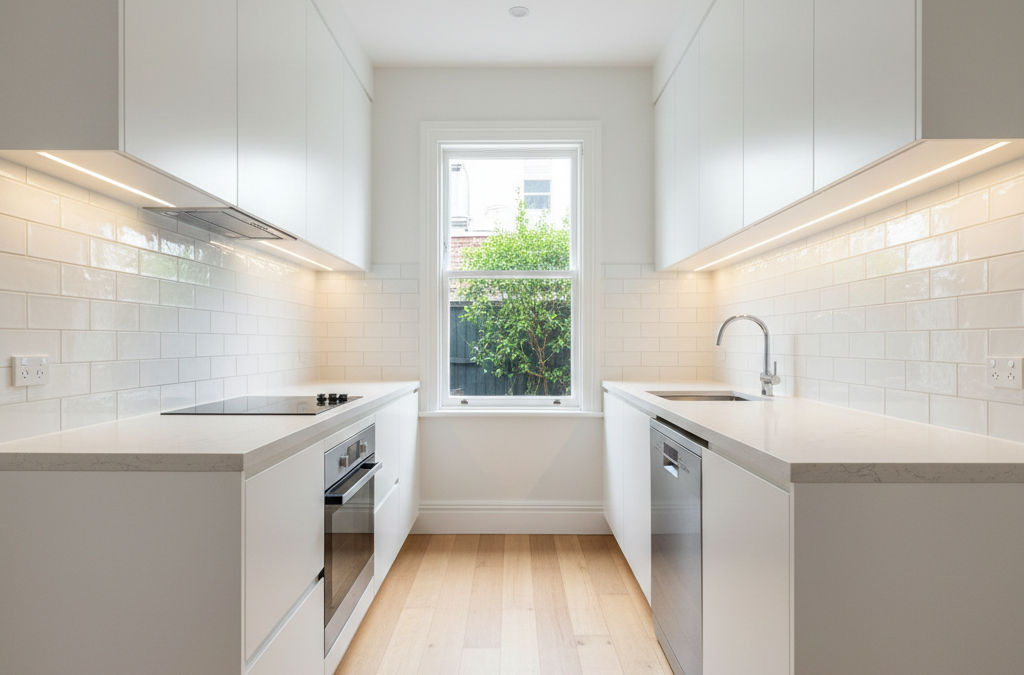
A small kitchen renovation in Sydney typically costs between $15,000 and $70,000 depending on layout changes, material selections, and the scope of plumbing and electrical work involved. That is a wide range, and the final number depends on decisions you have not made yet.
Whether you are updating a tired galley kitchen in a Marrickville terrace or gutting a compact apartment kitchen in Parramatta, understanding where your money goes is the difference between a renovation that runs smoothly and one that spirals. This guide breaks down real costs, practical layouts, material choices, hidden expenses, and the planning steps that keep small kitchen renovations on track and on budget across Sydney.
What Is a Small Kitchen Renovation
A small kitchen renovation is the process of upgrading, reconfiguring, or completely replacing the fixtures, finishes, and layout of a kitchen that typically measures under 10 square metres. In Sydney, this covers everything from cosmetic refreshes like new doors and benchtops through to full strip-outs involving new cabinetry, plumbing, electrical, tiling, and appliances.
The scope varies enormously. Some homeowners keep the existing layout and swap surfaces. Others relocate the sink, add a dishwasher, or knock out a wall to connect the kitchen to a living area. The cost, timeline, and complexity of your renovation all hinge on which category your project falls into.
How Small Kitchens Are Defined in Sydney Homes
Most Sydney kitchens classified as “small” fall between 5 and 10 square metres of floor space. In older suburbs like Balmain, Newtown, Surry Hills, and Leichhardt, terrace houses and semi-detached homes frequently have galley or single-wall kitchens under 7 square metres. Post-war fibro homes across Western Sydney often have slightly larger but still compact L-shaped kitchens.
Apartments across the Inner West, North Shore, and CBD typically feature kitchens between 4 and 8 square metres. Unit renovations come with additional constraints including strata by-laws, limited structural modification options, and shared plumbing stacks.
The physical size of the kitchen directly affects material quantities, cabinetry runs, and labour hours. A smaller footprint does not automatically mean a smaller budget. Compact spaces often require more creative solutions, custom joinery, and careful trade coordination, which can increase per-square-metre costs compared to larger kitchens.
Renovation vs Remodel — What You Actually Need
A renovation updates the existing space without changing the structural footprint. You replace cabinetry, benchtops, appliances, and finishes while keeping plumbing and electrical in roughly the same positions. This is the most common and cost-effective approach for small kitchens.
A remodel involves structural changes. Moving walls, relocating plumbing, changing the kitchen’s position within the home, or opening up to an adjoining room. Remodels require engineering assessments, council approvals in many cases, and significantly more trade involvement.
For most small kitchen projects in Sydney, a renovation delivers the biggest improvement for the lowest cost. If your layout already works but the finishes are dated, a renovation is the right path. If the layout fundamentally does not function, a remodel may be necessary, but expect the budget to increase by 30 to 50 percent or more.
How Much Does a Small Kitchen Renovation Cost in Sydney
Kitchen renovation costs in Sydney vary based on the quality of materials, extent of layout changes, and the trades required. Here is what to expect across three common tiers for a small kitchen under 10 square metres.
Budget Kitchen Renovation ($15,000–$25,000)
A budget renovation keeps the existing layout intact. You are replacing cabinet doors or full carcasses with flat-pack or semi-custom options, installing a laminate benchtop, fitting a standard tile splashback, and upgrading to mid-range appliances.
Typical inclusions at this level:
- Flat-pack or semi-custom cabinetry ($3,000–$7,000)
- Laminate benchtop ($800–$2,000)
- Basic tiled splashback ($600–$1,200)
- Mid-range appliances ($2,500–$5,000)
- Plumbing reconnection, no relocation ($1,000–$2,000)
- Electrical — new power points, LED downlights ($800–$1,500)
- Labour and installation ($4,000–$7,000)
This tier works well for investment properties, rental upgrades, and homeowners who want a clean, functional kitchen without premium finishes. The key constraint is keeping plumbing and electrical in existing positions.
Mid-Range Kitchen Renovation ($25,000–$45,000)
Mid-range is where most Sydney homeowners land. You get custom cabinetry built to your specifications, stone or engineered stone benchtops, quality appliances from brands like Bosch, Fisher & Paykel, or Westinghouse, and the flexibility to make minor layout adjustments.
Typical inclusions at this level:
- Custom cabinetry with soft-close hardware ($7,000–$15,000)
- Engineered stone benchtop like Caesarstone or Essastone ($2,500–$5,000)
- Glass or porcelain splashback ($1,200–$3,000)
- Quality appliances ($5,000–$10,000)
- Plumbing modifications including potential sink relocation ($2,000–$4,500)
- Electrical upgrades and additional circuits ($1,500–$3,000)
- Tiling or vinyl plank flooring ($1,500–$3,500)
- Labour, project management, and finishing ($5,000–$10,000)
This tier allows you to improve both the look and the functionality of the kitchen. You can move the sink, add a dishwasher where there was not one, upgrade lighting, and select finishes that will last 15 to 20 years.
High-End Kitchen Renovation ($45,000–$70,000+)
High-end renovations involve premium materials, fully custom joinery, top-tier appliances, and often structural modifications. Natural stone benchtops, handleless cabinetry, integrated appliances from Miele or SMEG, and designer tapware are standard at this level.
Typical inclusions:
- Fully custom joinery with premium finishes ($15,000–$25,000)
- Natural stone or premium engineered stone benchtop ($5,000–$10,000)
- Designer splashback — stone slab, metallic, or custom tile ($3,000–$6,000)
- Premium appliances ($10,000–$20,000)
- Full plumbing and electrical redesign ($4,000–$8,000)
- Structural work if walls are being moved ($3,000–$10,000)
- Flooring, painting, and finishing ($3,000–$6,000)
- Design fees, project management, and certification ($2,000–$5,000)
This tier is common in owner-occupied homes in Sydney’s Inner West, Eastern Suburbs, and North Shore where the kitchen is a centrepiece of daily living and long-term property value.
Small Kitchen Renovation Cost Breakdown
Understanding where every dollar goes removes the guesswork from budgeting. Here is how costs typically distribute across a mid-range small kitchen renovation in Sydney.
Labour Costs and Trade Pricing
Labour typically accounts for 35 to 40 percent of a small kitchen renovation budget. In Sydney, you will need a combination of trades including a carpenter or cabinet installer, plumber, electrician, tiler, and potentially a plasterer and painter.
Typical Sydney trade rates for kitchen renovations:
- Carpenter/installer: $55–$85 per hour
- Licensed plumber: $80–$120 per hour
- Licensed electrician: $75–$110 per hour
- Tiler: $50–$80 per square metre (supply and install)
- Plasterer: $40–$60 per square metre
- Painter: $35–$55 per square metre
A small kitchen renovation generally requires 5 to 10 days of combined trade labour depending on scope. Coordinating trades efficiently is critical. Delays between trades cost money and extend the timeline.
Cabinetry and Benchtop Allowances
Cabinetry is the single largest material cost in most kitchen renovations, typically representing 25 to 35 percent of the total budget.
Flat-pack cabinetry from suppliers like Kaboodle or Bunnings ranges from $3,000 to $7,000 for a small kitchen. Semi-custom options from local manufacturers sit between $7,000 and $12,000. Fully custom joinery from a Sydney cabinet maker starts around $12,000 and can exceed $25,000 for premium finishes.
Benchtop costs depend heavily on material choice. Laminate runs $200 to $500 per linear metre installed. Engineered stone like Caesarstone costs $400 to $900 per linear metre. Natural stone including marble and granite ranges from $700 to $1,500 per linear metre.
For a small kitchen with 3 to 5 linear metres of benchtop, material and installation costs typically fall between $800 and $6,000.
Appliance Costs and Selections
Appliances account for 15 to 25 percent of most kitchen renovation budgets. The range is enormous depending on brand preference and features.
A basic appliance package including oven, cooktop, rangehood, and dishwasher starts around $2,500 from brands like Westinghouse or Chef. Mid-range packages from Bosch, Fisher & Paykel, or Electrolux sit between $5,000 and $10,000. Premium packages from Miele, SMEG, or integrated options can exceed $15,000.
For small kitchens, consider compact or slimline appliances. A 60cm oven instead of 90cm, a slimline dishwasher, or a two-burner induction cooktop can save both space and money without sacrificing daily functionality.
Plumbing and Electrical Work
Plumbing and electrical are the trades most likely to generate unexpected costs. If you are keeping the sink, dishwasher, and gas connections in their current positions, expect to pay $1,500 to $3,000 for disconnection, reconnection, and compliance checks.
Relocating a sink or adding a dishwasher connection involves extending water supply lines and waste pipes. In Sydney, this typically costs $2,500 to $5,000 depending on access and distance from existing connections.
Electrical work for a small kitchen renovation usually includes new power points, dedicated circuits for ovens and cooktops, LED lighting, and rangehood wiring. Budget $1,500 to $4,000 depending on the extent of upgrades. All electrical work must be completed by a licensed electrician and certified to comply with NSW regulations.
Tiling, Splashbacks, and Flooring
Splashback costs vary dramatically by material. Basic ceramic tiles cost $30 to $60 per square metre for supply, plus $50 to $80 per square metre for installation. Porcelain tiles run $50 to $120 per square metre. Glass splashbacks cost $350 to $700 per square metre installed. Stone slab splashbacks start around $500 per square metre.
For a small kitchen with 2 to 4 square metres of splashback area, total costs range from $400 for basic tiles to $2,500 or more for glass or stone.
Flooring in a small kitchen typically covers 5 to 10 square metres. Vinyl plank flooring costs $40 to $80 per square metre installed. Porcelain floor tiles run $80 to $150 per square metre installed. Timber flooring ranges from $100 to $200 per square metre.
Fixtures, Hardware, and Finishing Touches
Kitchen fixtures include the sink, tapware, handles, and accessories. These items are often underestimated in budgets but add up quickly.
A stainless steel undermount sink costs $200 to $800. A quality kitchen mixer tap ranges from $200 to $700. Cabinet handles and knobs cost $5 to $30 each, and a small kitchen with 15 to 25 handles can add $75 to $750 to the budget.
Other finishing costs include paint ($300–$800 for a small kitchen), silicone and sealant work, bin systems ($100–$400), and any accessories like towel rails, spice racks, or knife blocks built into the cabinetry.
Hidden Costs in a Small Kitchen Renovation
Every experienced renovator will tell you the same thing: it is the costs you did not plan for that blow the budget. In Sydney, several hidden expenses are common enough that they should be line items in every kitchen renovation budget.
Structural and Compliance Surprises
Once you strip out old cabinetry and remove wall tiles, you often discover problems that were invisible before demolition. Water damage behind sinks, termite damage in wall framing, cracked or uneven wall surfaces, and non-compliant previous work are all common in Sydney homes built before 1990.
Repairing water-damaged framing can cost $500 to $3,000 depending on extent. Replastering walls after tile removal typically adds $500 to $1,500. If load-bearing walls are involved in any layout changes, an engineer’s report ($500–$1,500) and structural modifications ($2,000–$8,000) may be required.
Build a contingency of 10 to 15 percent of your total budget specifically for these discoveries.
Asbestos Testing and Removal
Any Sydney home built before 1990 may contain asbestos in wall sheeting, floor tiles, backing boards, or textured ceilings. If your kitchen renovation involves disturbing these materials, testing and removal are legally required.
Asbestos testing costs $50 to $150 per sample. If asbestos is confirmed, licensed removal for a small kitchen area typically costs $1,500 to $5,000 depending on the material type and quantity. Friable asbestos removal is significantly more expensive than bonded asbestos.
Do not skip this step. It is a legal requirement under NSW Work Health and Safety regulations, and the health risks are serious.
Temporary Kitchen and Living Arrangements
A small kitchen renovation typically takes 3 to 6 weeks. During that time, you will not have a functioning kitchen. Setting up a temporary kitchen in a laundry, garage, or living area with a microwave, portable cooktop, and bar fridge is the most common solution.
Budget $200 to $500 for temporary kitchen setup costs. Factor in increased spending on takeaway meals and dining out, which can easily add $500 to $1,500 over the renovation period for a family.
If the renovation is part of a larger project and the home is uninhabitable, temporary accommodation costs need to be included in the overall budget.
Council Approvals and Certification Fees
Most cosmetic kitchen renovations in Sydney do not require council approval. However, if your renovation involves structural changes, moving plumbing stacks, changing the building footprint, or work in heritage-listed properties, a Development Application (DA) or Complying Development Certificate (CDC) may be required.
A CDC through a private certifier typically costs $1,500 to $3,000. A DA through your local council can cost $2,000 to $5,000 or more and takes 4 to 12 weeks for determination.
Even without a DA, all plumbing and electrical work must be certified. Your plumber should provide a Certificate of Compliance, and your electrician must issue a Certificate of Compliance Electrical Work (CCEW). Ensure these are included in your trade quotes.
How to Plan a Small Kitchen Renovation on a Budget
Planning is where budgets are saved or lost. The decisions you make before a single tool is picked up determine whether your renovation stays on track.
Setting a Realistic Renovation Budget
Start with the end number, not the wish list. Determine the maximum amount you can spend, then work backwards to allocate funds across each category.
A practical budget allocation for a mid-range small kitchen renovation:
- Cabinetry and benchtops: 30–35%
- Appliances: 15–20%
- Labour (all trades): 30–35%
- Fixtures, hardware, and finishes: 5–10%
- Contingency: 10–15%
If your total budget is $35,000, that means roughly $10,500 to $12,250 for cabinetry and benchtops, $5,250 to $7,000 for appliances, $10,500 to $12,250 for labour, $1,750 to $3,500 for fixtures, and $3,500 to $5,250 held in reserve for unexpected costs.
Write these numbers down before you start getting quotes. They become your decision-making framework for every selection.
Where to Save and Where to Spend
Spend on the things you touch, use, and see every day. Save on the things hidden behind doors or under benchtops.
Where to spend:
- Benchtop material and quality — you use it daily and it defines the kitchen’s look
- Soft-close hinges and drawer runners — you will open these thousands of times
- A good sink and mixer tap — cheap tapware fails within 2 to 3 years
- Adequate lighting — under-cabinet LED strips and quality downlights transform a small kitchen
Where to save:
- Cabinet carcass material — standard white melamine performs identically to premium options behind closed doors
- Internal shelving — adjustable melamine shelves do the same job as custom timber
- Handles — simple stainless steel or matte black handles cost a fraction of designer options and look just as clean
- Splashback — a well-laid subway tile at $40 per square metre can look as good as a $500 per square metre glass panel in a small space
Getting Accurate Quotes from Sydney Contractors
Get a minimum of three detailed quotes from licensed contractors. Avoid quotes that provide a single lump sum without a breakdown. A quality quote should itemise labour, materials, allowances, and exclusions.
When comparing quotes, check:
- Are all trades included or are some quoted separately?
- What is the allowance for cabinetry, benchtops, and appliances? Is it realistic for what you want?
- Are demolition and waste removal included?
- Is there a provisional sum for plumbing and electrical, or a fixed price?
- What is excluded? Paint, flooring, appliance supply, and certification fees are commonly excluded.
Ask every contractor about their process for handling variations. A variation is any change or unexpected cost that arises during the renovation. Clear variation processes protect both you and the contractor.
Best Layout Ideas for Small Kitchen Renovations
The right layout makes a small kitchen feel twice its size. The wrong layout creates bottlenecks, wasted space, and daily frustration. Your layout choice affects cabinetry costs, plumbing positions, and how the kitchen connects to the rest of your home.
Galley Kitchen Layout
The galley layout places cabinetry and appliances along two parallel walls. It is one of the most space-efficient designs for small kitchens and is extremely common in Sydney terraces and older apartments.
A galley kitchen works best when the corridor between the two runs is at least 900mm to 1200mm wide. Anything narrower feels cramped. Anything wider starts wasting space that could be used for storage.
The main advantage is efficiency. Everything is within one or two steps. The main disadvantage is that galley kitchens can feel enclosed, especially without natural light. Consider open shelving on one side or a window splashback to reduce the closed-in feeling.
L-Shaped Kitchen Layout
The L-shaped layout uses two adjacent walls, creating an open floor area on the remaining sides. This is the most versatile layout for small kitchens and works well in open-plan living areas common in Sydney apartments and renovated terraces.
An L-shaped kitchen naturally creates an efficient work triangle between the sink, cooktop, and fridge. The open side can accommodate a small breakfast bar or island bench if space allows, adding both prep space and casual seating.
Corner cabinetry in L-shaped kitchens requires careful planning. Standard corner cabinets waste space. Invest in a carousel, Le Mans pull-out, or magic corner system to make that corner storage accessible and functional.
U-Shaped Kitchen Layout
The U-shaped layout wraps cabinetry around three walls. It maximises storage and bench space but requires a room width of at least 2.4 metres to avoid feeling too tight.
This layout works well in dedicated kitchen rooms rather than open-plan spaces. It provides the most storage of any small kitchen layout and keeps everything within arm’s reach.
The trade-off is that U-shaped kitchens can feel dark and enclosed. Use light-coloured cabinetry, reflective splashbacks, and strong lighting to counteract this. Avoid overhead cabinets on all three walls. Leave one section open or use open shelving to create visual breathing room.
Single-Wall Kitchen Layout
The single-wall layout, sometimes called a one-wall kitchen, places all cabinetry, appliances, and the sink along a single wall. It is the most compact option and is common in studio apartments, granny flats, and secondary kitchens across Sydney.
This layout works for spaces under 5 square metres where other configurations simply do not fit. The key challenge is limited bench space and storage. Prioritise vertical storage with floor-to-ceiling cabinetry and consider a fold-down bench extension for additional prep area.
Single-wall kitchens are the most affordable to renovate because they require the least cabinetry and the simplest plumbing and electrical runs.
Smart Storage Solutions for Small Kitchens
Storage makes or breaks a small kitchen. The goal is to maximise every centimetre of available space without making the kitchen feel cluttered or difficult to navigate.
Vertical Storage and Overhead Cabinetry
In a small kitchen, vertical space is your greatest untapped resource. Standard overhead cabinets are typically 720mm tall, but extending them to the ceiling at 900mm or even 2400mm full-height creates significantly more storage.
The top shelves of tall overhead cabinets are ideal for items used infrequently: seasonal serving platters, specialty appliances, and bulk pantry items. Keep everyday items at eye level and below.
Open shelving above the benchtop can replace a section of overhead cabinetry to reduce visual bulk. This works well for frequently used items like glasses, plates, and cooking oils, but requires discipline to keep tidy.
Pull-Out Drawers and Corner Units
Deep drawers outperform standard shelved cabinets in small kitchens. A pull-out drawer lets you see and access everything inside without reaching into dark corners. Pot drawers, cutlery inserts, and spice drawer organisers keep contents visible and organised.
Corner units are where small kitchens waste the most space. A standard corner cabinet with fixed shelves leaves roughly 30 percent of the space inaccessible. A carousel or lazy Susan improves access. A Le Mans pull-out or magic corner system maximises it, though these fittings add $300 to $800 per unit to the cabinetry cost.
Open Shelving vs Closed Cabinetry
Open shelving creates a sense of space and makes a small kitchen feel less boxed in. It costs less than closed cabinetry and provides easy access to everyday items.
The downside is maintenance. Open shelves collect grease and dust in a kitchen environment. Everything on display needs to be presentable. For most homeowners, a combination works best: closed cabinetry for most storage with one or two sections of open shelving for visual relief and frequently used items.
Floating timber shelves cost $50 to $150 each installed. Compared to $300 to $600 per linear metre for overhead cabinetry, they offer significant savings while adding character to the kitchen.
Choosing Materials and Finishes for a Small Kitchen
Material and finish selections have the biggest impact on both the look and the longevity of your kitchen. In a small space, every surface is visible and within arm’s reach, so quality matters more than in a large kitchen where imperfections can hide.
Benchtop Materials Compared
| Material | Cost per Linear Metre (Installed) | Durability | Maintenance | Best For |
| Laminate | $200–$500 | Good (10–15 years) | Low | Budget renovations, rentals |
| Engineered Stone (Caesarstone) | $400–$900 | Excellent (20+ years) | Low | Mid-range to high-end |
| Natural Stone (Marble/Granite) | $700–$1,500 | Excellent (lifetime) | Medium-High | High-end, statement kitchens |
| Timber | $400–$800 | Moderate (requires resealing) | High | Feature sections, breakfast bars |
| Stainless Steel | $500–$1,000 | Excellent | Medium | Professional-style kitchens |
For most small kitchen renovations in Sydney, engineered stone offers the best balance of durability, aesthetics, and cost. It resists staining, does not require sealing, and comes in a wide range of colours and patterns.
Laminate has improved dramatically in recent years. Premium laminate benchtops from brands like Laminex and Polytec now closely replicate the look of stone and timber at a fraction of the cost. For budget renovations and investment properties, laminate is a smart choice.
Cabinet Door Styles and Finishes
Cabinet doors define the visual style of your kitchen. In a small space, the right door style can make the room feel larger and more cohesive.
Flat-panel (slab) doors in a matte or satin finish create a clean, modern look that works well in compact kitchens. They do not collect dust in grooves and are easy to wipe clean. Shaker-style doors add a classic, slightly traditional feel and work well in terrace houses and period homes.
For finishes, consider:
- Polyurethane (2-pack): The premium option. Spray-painted to a smooth, durable finish. Costs $350–$600 per square metre of door face. Available in any colour.
- Thermolaminated (vinyl wrap): A cost-effective alternative that mimics the look of 2-pack at roughly half the price. Less durable but suitable for most residential kitchens.
- Melamine: The most affordable option. Available in a wide range of colours and woodgrain patterns. Suitable for budget renovations and carcass interiors.
Light colours, particularly whites, light greys, and pale timbers, make small kitchens feel more spacious. Dark cabinetry can work in small kitchens but requires strong lighting and lighter benchtops or splashbacks to avoid a cave-like effect.
Splashback Options That Make Small Kitchens Feel Bigger
The splashback is one of the most visible surfaces in a small kitchen. Choosing the right material and colour can visually expand the space.
Large-format tiles or full-height glass splashbacks with minimal grout lines create a seamless look that makes walls appear larger. Reflective surfaces like glass, mirror, or high-gloss tiles bounce light around the room.
Subway tiles remain one of the most popular and cost-effective splashback options in Sydney. A standard white subway tile laid in a brick pattern costs $30 to $60 per square metre for supply and $50 to $80 per square metre for installation. The classic look suits almost every kitchen style.
For a more contemporary feel, consider large-format porcelain panels that mimic marble or concrete. These come in sheets up to 3200mm x 1600mm, meaning a small kitchen splashback can often be covered with a single panel and zero grout lines.
Small Kitchen Renovation Timeline — What to Expect
Knowing the timeline helps you plan temporary kitchen arrangements, coordinate deliveries, and manage expectations. A typical small kitchen renovation in Sydney takes 3 to 6 weeks from demolition to completion.
Pre-Renovation Planning Phase
The planning phase takes 4 to 12 weeks before any physical work begins. This includes design finalisation, material selections, ordering cabinetry (which can have 4 to 8 week lead times), obtaining quotes, and scheduling trades.
Custom cabinetry is the longest lead-time item. Order it as early as possible. Appliances should also be ordered early, particularly if you are selecting specific models that may not be held in stock.
If council approval is required, add 4 to 12 weeks for the DA or CDC process. A private certifier for a CDC is typically faster than a council DA.
Demolition and Rough-In Stage
Demolition of a small kitchen takes 1 to 2 days. This includes removing old cabinetry, appliances, splashback tiles, and flooring if being replaced. Waste removal for a small kitchen demolition typically costs $300 to $800 for a skip bin.
The rough-in stage follows demolition and takes 3 to 5 days. Plumbers relocate or extend water supply and waste lines. Electricians run new circuits, install power point boxes, and wire for lighting. If walls need replastering or repairing, this happens during the rough-in stage as well.
This is the phase where hidden costs most commonly emerge. Water damage, asbestos, and non-compliant previous work are typically discovered once walls and floors are exposed.
Installation and Final Fit-Out
Cabinet installation takes 2 to 3 days for a small kitchen. Benchtop templating happens after cabinets are installed, with fabrication and installation taking an additional 5 to 10 working days depending on the material and fabricator’s schedule.
After the benchtop is installed, the plumber returns to connect the sink and dishwasher. The electrician connects the oven, cooktop, and rangehood. The tiler installs the splashback. Finally, handles are fitted, silicone is applied, and touch-up painting is completed.
The final fit-out stage takes 5 to 10 days, though much of this time is waiting for the benchtop fabrication rather than active on-site work.
Common Mistakes to Avoid in a Small Kitchen Renovation
Mistakes in a small kitchen are amplified. There is no room to hide poor decisions. These are the errors we see most frequently on Sydney kitchen renovation projects.
Underestimating the Budget
The most common mistake is starting with an unrealistic budget. Homeowners frequently base their expectations on online cost calculators or interstate pricing that does not reflect Sydney’s higher labour rates and material costs.
A genuine small kitchen renovation in Sydney with quality finishes rarely comes in under $20,000. If your budget is below this, you need to be very strategic about scope. Focus on cosmetic updates rather than a full renovation.
Always include a 10 to 15 percent contingency. On a $35,000 renovation, that is $3,500 to $5,250 set aside for the unexpected. If you do not use it, it becomes a bonus. If you do, it prevents the project from stalling.
Ignoring Workflow and the Kitchen Triangle
The kitchen work triangle connects the three most-used areas: the sink, the cooktop, and the refrigerator. In a small kitchen, the triangle should be compact but not cramped. Each leg of the triangle should measure between 1.2 and 2.7 metres, and the total of all three legs should not exceed 8 metres.
Placing the sink and cooktop too close together creates a cramped prep area. Positioning the fridge too far from the prep zone means constant back-and-forth. In a small kitchen, even 30 centimetres of misplacement creates daily inconvenience.
Before finalising your layout, stand in the space and physically walk through your cooking routine. Prep, cook, plate, clean. If any movement feels awkward, the layout needs adjustment.
Choosing Style Over Function
A waterfall marble island bench looks stunning in a magazine spread. In a 7 square metre kitchen, it might consume half your floor space and a third of your budget.
Small kitchens demand practical decisions. Every element needs to earn its place. Choose finishes that are beautiful and durable. Select appliances that fit the space and match your actual cooking habits. Prioritise storage and bench space over decorative features.
This does not mean your kitchen cannot look exceptional. It means every design decision should serve both form and function.
Skipping Professional Design Input
A professional kitchen designer costs $500 to $2,500 for a small kitchen design. That investment typically saves multiples of its cost by optimising layout, avoiding expensive mistakes, and identifying storage solutions you would not have considered.
Many Sydney kitchen renovation companies include design as part of their service. If yours does not, consider engaging an independent kitchen designer before committing to a layout. They can produce detailed plans that any cabinet maker or installer can work from.
For small kitchens especially, professional design input is not a luxury. It is one of the highest-return investments in the entire renovation.
Does a Small Kitchen Renovation Add Value to Your Property
Kitchen condition is one of the first things buyers and renters assess. A dated, poorly functioning kitchen can reduce a property’s appeal and sale price significantly. But not every renovation delivers the same return.
Return on Investment for Kitchen Renovations in Sydney
Kitchen renovations in Australia typically return 50 to 80 percent of their cost in added property value, according to property industry estimates. In Sydney’s competitive market, a well-executed kitchen renovation can return even more, particularly in suburbs where comparable properties have already been updated.
A $30,000 mid-range kitchen renovation on a property valued at $1.2 million could add $20,000 to $35,000 in perceived value. More importantly, it can reduce time on market and attract a wider pool of buyers or tenants.
The key word is “well-executed.” An over-capitalised renovation that costs $70,000 in a suburb where median house prices are $800,000 is unlikely to return its full cost. Match your renovation spend to the property’s value and the expectations of buyers in your area.
What Buyers and Renters Look For
Buyers and renters in Sydney consistently prioritise:
- Functional layout with adequate bench and storage space
- Quality benchtops — stone or engineered stone signals quality
- Modern appliances — a dishwasher is now considered essential, not optional
- Good lighting — dark kitchens are an immediate negative
- Neutral, clean finishes — white or light grey cabinetry appeals to the broadest market
- Connection to living areas — open-plan or semi-open layouts are strongly preferred
You do not need a luxury kitchen to impress buyers. You need a clean, functional, well-lit kitchen with quality basics. A mid-range renovation that ticks these boxes will outperform a budget renovation with cheap finishes or a high-end renovation with polarising design choices.
Conclusion
A small kitchen renovation in Sydney is one of the most impactful upgrades you can make to your home. With realistic budgeting, smart material choices, and a layout that prioritises function, even the most compact kitchen can become a space that works harder and looks better every day.
The difference between a renovation that stays on budget and one that spirals comes down to planning. Understanding your costs before you start, building in contingency, and making informed decisions about where to invest and where to save puts you in control of the outcome.
At Sydney Home Renovation, we help homeowners and investors plan and deliver small kitchen renovations with transparent pricing, skilled trades, and clear communication from start to finish. Contact us today for a detailed quote and let us turn your kitchen plans into reality.
Frequently Asked Questions
How much does it cost to renovate a small kitchen in Sydney?
A small kitchen renovation in Sydney costs between $15,000 and $70,000 depending on the scope, materials, and layout changes involved. A mid-range renovation with custom cabinetry, engineered stone benchtops, and quality appliances typically falls between $25,000 and $45,000.
How long does a small kitchen renovation take?
Most small kitchen renovations take 3 to 6 weeks from demolition to completion. The planning and ordering phase before work begins adds another 4 to 12 weeks, with custom cabinetry lead times being the main factor.
Can you renovate a small kitchen for under $20,000?
Yes, but the scope will be limited. A sub-$20,000 renovation typically involves keeping the existing layout, using flat-pack or semi-custom cabinetry, laminate benchtops, and mid-range appliances. It works well for cosmetic refreshes and investment property upgrades.
Do I need council approval for a kitchen renovation in Sydney?
Most cosmetic kitchen renovations do not require council approval. However, structural changes, plumbing stack relocations, or work on heritage-listed properties may require a Development Application or Complying Development Certificate. All plumbing and electrical work must be certified regardless.
What is the best layout for a small kitchen?
The galley and L-shaped layouts are the most efficient for small kitchens. Galley kitchens maximise storage along two walls, while L-shaped layouts create an open feel and work well in open-plan living areas. The best choice depends on your room shape and how the kitchen connects to adjacent spaces.
Is it worth renovating a small kitchen before selling?
In most cases, yes. A well-executed mid-range kitchen renovation can return 50 to 80 percent of its cost in added property value and significantly reduce time on market. The key is matching your renovation spend to the property’s value and buyer expectations in your suburb.
Should I hire a kitchen designer or go straight to a builder?
For small kitchens, professional design input is highly recommended. A kitchen designer costs $500 to $2,500 and can optimise your layout, maximise storage, and prevent costly mistakes. Many renovation companies include design as part of their service, so ask before engaging a separate designer.