
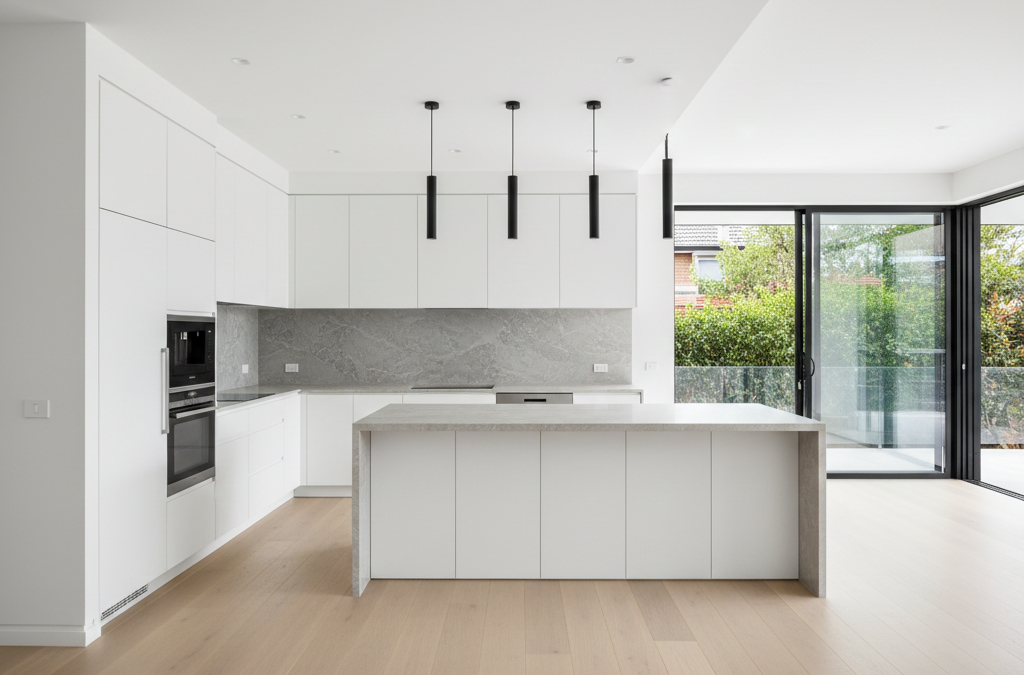
The right kitchen layout can cut your renovation costs by thousands, eliminate wasted space, and transform how your household functions every single day. Whether you are gutting a dated galley kitchen in a Sydney terrace or reconfiguring an open-plan space in a new build, the layout you choose dictates everything from traffic flow and storage capacity to plumbing costs and long-term property value.
This guide breaks down every major kitchen layout option suited to Sydney homes, explains the design elements that drive your budget, and gives you a clear framework for planning a kitchen renovation that delivers lasting results without blowing past your numbers.
What Is Kitchen Layout and Design?
Kitchen layout refers to the physical arrangement of your key work areas: the sink, cooktop, refrigerator, preparation zones, and storage. It is the structural blueprint that determines how you move through the space, where your plumbing and electrical connections sit, and how efficiently you can cook, clean, and store.
Kitchen design, on the other hand, encompasses the aesthetic and material choices layered on top of that layout. This includes cabinetry style, benchtop materials, splashback finishes, lighting fixtures, colour palettes, and hardware selections.
Both work together. A beautifully designed kitchen built on a poor layout will frustrate you daily. A well-planned layout with cheap finishes will still function efficiently. Understanding this distinction is critical before you spend a dollar on your renovation.
Kitchen Layout vs Kitchen Design — What’s the Difference?
Layout is structural. It answers the question: where does everything go? It deals with floor plans, appliance positioning, clearance zones, plumbing locations, and the spatial relationship between cooking, cleaning, and food storage areas.
Design is visual and material. It answers: what does everything look and feel like? It covers surface finishes, cabinet door profiles, tap styles, tile selections, and the overall aesthetic direction of the space.
During a renovation, layout decisions come first because they determine structural work, plumbing rough-ins, and electrical placement. These are the expensive changes. Design decisions come second and are generally easier and cheaper to adjust. Confusing the order is one of the most common reasons kitchen renovations in Sydney go over budget.
Why Kitchen Layout Matters More Than Aesthetics
A kitchen is the most labour-intensive room in any home. The average household uses it multiple times a day for meal preparation, cooking, cleaning, and often as a social hub. If the layout forces you to walk extra steps between the fridge and the prep area, or if two people cannot work in the space simultaneously without colliding, no amount of premium stone benchtops will fix the problem.
Layout also has the largest cost impact. Moving a sink means relocating plumbing. Shifting a cooktop means rerouting gas lines or electrical circuits. Repositioning a wall to open up the floor plan involves structural engineering, plastering, and potentially new support beams. These structural and services changes account for a significant portion of total renovation spend.
For property investors, layout quality directly affects resale value and rental appeal. Buyers and tenants in Sydney consistently prioritise functional kitchens with logical flow over kitchens that simply look expensive.
Most Popular Kitchen Layouts for Sydney Homes
Sydney’s housing stock ranges from compact inner-city apartments and narrow terrace houses to sprawling suburban homes and modern townhouses. Each property type suits different kitchen configurations. Here are the six most common layouts and where each one works best.
Galley Kitchen Layout
The galley kitchen features two parallel runs of cabinetry and benchtop facing each other, with a walkway in between. It is one of the most space-efficient layouts available.
Best for: Small apartments, terraces, and narrow floor plans common in suburbs like Surry Hills, Newtown, and Balmain.
Advantages: Maximises storage and bench space in a compact footprint. Keeps everything within arm’s reach. Minimises plumbing and electrical runs because services stay on two walls.
Limitations: Can feel enclosed if not well-lit. Limited to one or two people working at a time. No room for a dining table or island within the layout itself.
Budget note: Galley kitchens are typically the most affordable layout to build because they require less cabinetry linear meterage and simpler plumbing configurations than larger layouts.
L-Shaped Kitchen Layout
The L-shaped layout uses two adjacent walls forming a right angle. It is the most versatile and widely used kitchen configuration in Australian homes.
Best for: Medium-sized kitchens, open-plan living areas, and homes where the kitchen shares space with a dining or living zone.
Advantages: Creates an open feel with one side free for traffic or a dining table. Provides a natural work triangle between sink, cooktop, and fridge. Adapts well to adding an island later.
Limitations: Corner cabinetry can create dead space if not fitted with carousel units or pull-out systems. Long L-shapes can spread work zones too far apart.
Budget note: L-shaped kitchens offer a strong balance between cost and functionality. Corner cabinet solutions like lazy Susans or magic corners add cost but recover otherwise wasted space.
U-Shaped Kitchen Layout
The U-shaped layout wraps cabinetry and benchtops along three walls, creating an enclosed workspace with maximum storage and preparation area.
Best for: Dedicated kitchen rooms, larger homes, and households that cook frequently or need extensive storage.
Advantages: Offers the most bench space and storage of any standard layout. Keeps the work triangle compact. Provides clear separation between the kitchen and adjacent living areas.
Limitations: Requires a room width of at least 3 metres to maintain comfortable clearance between opposing benchtops. Can feel boxed in without adequate lighting or a window.
Budget note: U-shaped kitchens cost more due to the additional cabinetry run and extra benchtop material. Expect roughly 30 to 50 percent more cabinetry than an equivalent L-shape.
Island Kitchen Layout
An island kitchen adds a freestanding bench unit to any base layout, most commonly an L-shape or a single-wall configuration. The island serves as additional prep space, casual dining, or housing for a cooktop or sink.
Best for: Open-plan homes with generous floor space. Popular in newer builds across Sydney’s Hills District, Northern Beaches, and Inner West renovations where walls have been removed.
Advantages: Creates a social focal point. Adds significant bench and storage space. Can accommodate seating on one side. Allows multiple people to work in the kitchen simultaneously.
Limitations: Requires a minimum of 1 metre clearance on all sides of the island, meaning the kitchen footprint needs to be at least 4 metres wide. Plumbing and electrical to the island adds cost because services must run through the floor slab.
Budget note: Islands with sinks or cooktops require under-floor plumbing and electrical, which can add $3,000 to $8,000 or more depending on slab type and distance from existing services.
Peninsula Kitchen Layout
A peninsula is essentially an island that connects to the main cabinetry run on one end, forming a partial barrier between the kitchen and an adjacent room.
Best for: Kitchens that want the benefits of an island but lack the floor space for a fully freestanding unit. Common in semi-open-plan renovations.
Advantages: Provides extra bench space and a natural room divider without requiring clearance on all four sides. Easier and cheaper to connect plumbing and electrical because it ties into existing wall services.
Limitations: Restricts traffic flow to one entry point on the open end. Can make the kitchen feel more enclosed than a true island.
Budget note: Peninsulas are a cost-effective alternative to islands. You gain similar functionality with lower structural and services costs.
Open-Plan Kitchen Layout
Open-plan kitchens remove the walls separating the kitchen from the living and dining areas, creating a single integrated space. The kitchen itself typically uses an L-shape, single wall, or island configuration within the open room.
Best for: Modern family homes, entertainer-style living, and renovation projects aiming to increase natural light and spatial flow.
Advantages: Makes the home feel larger and more connected. Allows supervision of children while cooking. Ideal for entertaining.
Limitations: Cooking smells, noise, and visual clutter are shared with the living area. Requires strong ventilation and a disciplined approach to storage and tidiness. Structural wall removal may require engineering certification and council approval in Sydney.
Budget note: The layout itself may be simple, but the cost of removing load-bearing walls, installing steel beams, and upgrading rangehood ventilation can add $5,000 to $15,000 or more to the project.
How to Choose the Right Kitchen Layout for Your Space
Choosing a layout is not about picking the one that looks best on Pinterest. It is about matching the physical constraints of your space, the way your household actually uses the kitchen, and your renovation budget.
Assessing Your Kitchen Dimensions and Floor Plan
Start by measuring your existing kitchen. Record the total floor area, wall lengths, ceiling height, and the location of windows, doors, and existing plumbing and electrical points.
Key measurements to note:
- Total floor area in square metres
- Wall-to-wall width (determines whether a U-shape or island will fit)
- Distance from existing plumbing stack to your preferred sink location
- Window and door positions (these constrain where tall cabinetry and rangehoods can go)
- Structural walls vs partition walls (structural walls are expensive to move; partition walls are relatively simple)
If your kitchen is under 8 square metres, a galley or small L-shape will likely be your most practical option. Between 8 and 14 square metres, an L-shape or U-shape works well. Above 14 square metres, you have room to consider an island or open-plan configuration.
The Kitchen Work Triangle and Kitchen Zones Explained
The kitchen work triangle is a planning principle that positions the three most-used areas, the sink, cooktop, and refrigerator, in a triangular arrangement. Each leg of the triangle should measure between 1.2 and 2.7 metres, and the total perimeter should not exceed 8 metres.
The purpose is efficiency. You want to minimise unnecessary steps between the areas where you wash, cook, and retrieve ingredients.
Modern kitchen planning has expanded this concept into kitchen zones:
- Preparation zone: Bench space near the sink for chopping and food prep
- Cooking zone: Cooktop, oven, rangehood, and nearby utensil storage
- Cleaning zone: Sink, dishwasher, and bin storage
- Storage zone: Pantry, fridge, and dry goods
- Serving zone: Bench or island area for plating and casual dining
Zoning is particularly useful for larger kitchens and open-plan layouts where the traditional triangle becomes too spread out.
Matching Layout to Lifestyle and Household Size
A couple in a Bondi apartment has different kitchen needs than a family of five in Castle Hill. Consider these factors:
How many people cook at once? If two or more people regularly share the kitchen, you need a layout with multiple work zones and enough clearance for two people to pass comfortably. Islands and U-shapes handle this well.
Do you entertain frequently? Open-plan layouts with islands or peninsulas allow the cook to face guests. Galley kitchens isolate the cook from the living area.
How much storage do you need? Large families and bulk shoppers need pantry space, deep drawers, and overhead cabinetry. A galley kitchen may not provide enough.
Do you have young children? Consider cooktop placement away from high-traffic paths. Induction cooktops are safer than gas for households with small children.
Are you renovating for resale or for yourself? If selling within five years, prioritise broadly appealing layouts like L-shapes with islands. If staying long-term, optimise for your specific household patterns.
Kitchen Design Elements That Impact Your Budget
Once your layout is locked in, the design decisions begin. These choices determine the final look of your kitchen and have a direct, measurable impact on your total renovation cost.
Cabinetry and Storage Solutions
Cabinetry is typically the single largest cost item in a kitchen renovation, often accounting for 30 to 40 percent of the total budget.
Cabinet types by cost tier:
- Flat-pack (DIY assembly): The most affordable option. Suitable for investment properties and tight budgets. Limited customisation.
- Semi-custom: Manufactured to standard sizes with some finish and configuration options. The most popular choice for mid-range Sydney renovations.
- Custom-built: Made to exact measurements by a cabinet maker. Required for unusual spaces, premium finishes, or specific storage solutions. Highest cost.
Storage features that add cost but add value:
- Soft-close hinges and drawer runners
- Pull-out pantry systems
- Corner carousel or magic corner units
- Deep pot drawers instead of base cupboards
- Integrated bin systems
For a standard Sydney kitchen renovation, cabinetry costs typically range from $8,000 for basic flat-pack to $25,000 or more for fully custom joinery.
Benchtops and Splashbacks
Benchtop material is the second most visible design decision after cabinetry and varies enormously in price.
Common benchtop materials in Sydney kitchens:
- Laminate: $200 to $800 per linear metre installed. Affordable, wide colour range, but less durable and lower perceived value.
- Engineered stone (e.g., Caesarstone, Essastone): $600 to $1,200 per linear metre installed. The most popular mid-to-upper range choice. Durable, consistent appearance, wide colour range.
- Natural stone (marble, granite): $800 to $2,000+ per linear metre installed. Premium look, unique veining, but requires sealing and more maintenance.
- Porcelain slab: $700 to $1,500 per linear metre installed. Growing in popularity. Highly durable, heat and scratch resistant.
Splashbacks protect the wall behind your cooktop and sink. Options range from simple painted glass ($500 to $1,500 installed) to tiled splashbacks ($1,000 to $3,000+) to full-height stone or porcelain matching the benchtop.
Appliance Placement and Selection
Appliance selection affects both your design aesthetic and your budget. More importantly, appliance placement must be decided during the layout phase because it determines electrical, gas, and ventilation requirements.
Key appliance decisions:
- Cooktop type: Gas requires a gas line. Induction requires a dedicated high-amperage electrical circuit. Switching from gas to induction (or vice versa) during renovation adds cost.
- Oven position: Under-bench ovens are standard. Wall-mounted ovens at eye level are more ergonomic but require additional cabinetry and structural support.
- Rangehood type: Ducted rangehoods vent externally and are far more effective than recirculating models. Ducting installation adds cost, especially in apartments.
- Dishwasher placement: Should be adjacent to the sink for efficient plumbing and workflow.
- Fridge cavity: Ensure adequate width, depth, and ventilation clearance. Integrated fridges require custom cabinetry panels.
Budget tip: Select your appliances before finalising cabinetry design. Appliance dimensions vary between brands, and retrofitting cabinetry to fit a different appliance is an avoidable expense.
Lighting, Ventilation, and Electrical Planning
These are the elements most often underestimated in kitchen renovation budgets.
Lighting layers:
- Task lighting: Under-cabinet LED strips illuminating benchtops. Essential for food preparation safety and comfort.
- General lighting: Ceiling downlights or a central pendant. Provides overall room illumination.
- Accent lighting: In-cabinet or above-cabinet lighting. Adds visual depth and highlights design features.
Ventilation: A properly ducted rangehood is critical, especially in open-plan layouts where cooking odours and moisture travel into living areas. Ducting to an external wall or roof costs more than a recirculating filter but performs significantly better.
Electrical planning: A modern kitchen requires more power points than most people expect. Plan for dedicated circuits for the oven, cooktop (if induction), dishwasher, and fridge. Add general power points for small appliances at bench height. USB charging points are increasingly standard.
Electrical and lighting upgrades in a Sydney kitchen renovation typically cost between $2,000 and $6,000 depending on the extent of rewiring and the number of new circuits required.
Kitchen Renovation Costs in Sydney — What to Expect
Understanding realistic cost ranges before you start planning prevents budget shock and helps you make informed trade-off decisions throughout the project.
Average Kitchen Renovation Cost Breakdown
Kitchen renovation costs in Sydney vary widely based on kitchen size, layout complexity, material quality, and the extent of structural changes.
General cost ranges for a complete kitchen renovation in Sydney (2025):
| Renovation Level | Typical Cost Range | What’s Included |
| Budget | $15,000 – $25,000 | Flat-pack cabinetry, laminate benchtops, basic appliances, minimal layout changes |
| Mid-range | $25,000 – $45,000 | Semi-custom cabinetry, engineered stone benchtops, quality appliances, moderate layout changes |
| High-end | $45,000 – $80,000+ | Custom joinery, premium stone benchtops, high-end appliances, structural changes, island with services |
These figures include demolition, cabinetry, benchtops, splashback, appliances, plumbing, electrical, tiling, painting, and project management. They assume a standard-sized kitchen of approximately 10 to 15 square metres.
Labour Costs vs Material Costs
In most Sydney kitchen renovations, the split between labour and materials falls roughly 40 to 50 percent labour and 50 to 60 percent materials.
Typical labour components:
- Demolition and removal: $1,000 – $3,000
- Plumbing: $2,000 – $5,000 (more if relocating services)
- Electrical: $2,000 – $6,000
- Tiling: $1,500 – $4,000
- Cabinet installation: $1,500 – $4,000
- Benchtop templating and installation: $500 – $1,500
- Painting and finishing: $800 – $2,000
- Project management: Often 10 to 15 percent of total cost
Labour costs in Sydney are higher than most other Australian cities due to demand, cost of living, and trade availability. Getting multiple quotes from licensed tradespeople is essential.
Hidden Costs and Budget Contingencies
Every experienced renovator will tell you: unexpected costs are not unexpected. They are inevitable. The question is how well you prepare for them.
Common hidden costs in kitchen renovations:
- Asbestos removal: Pre-1990 Sydney homes may contain asbestos in wall sheeting, flooring, or splashback adhesive. Testing costs $200 to $500. Removal by a licensed contractor can add $1,500 to $5,000+.
- Structural defects: Removing a wall may reveal termite damage, water damage, or substandard framing that must be repaired before new work proceeds.
- Plumbing and electrical upgrades: Older homes may have galvanised steel pipes or aluminium wiring that no longer meets current Australian Standards and must be replaced.
- Council approvals: Structural changes, changes to external walls, or work in heritage conservation areas may require Development Application (DA) approval from your local Sydney council.
- Waste disposal: Skip bin hire and tip fees for demolition waste typically cost $500 to $1,500.
- Temporary kitchen setup: If your renovation takes four to eight weeks, you may need a temporary cooking and washing area.
Recommended contingency: Set aside 10 to 20 percent of your total budget as a contingency fund. On a $40,000 renovation, that means keeping $4,000 to $8,000 in reserve for unplanned expenses.
Common Kitchen Layout Mistakes to Avoid
Poor layout decisions are expensive to fix after construction begins. These are the mistakes we see most frequently in Sydney kitchen renovations.
Poor Traffic Flow and Clearance Zones
The most common layout error is insufficient clearance between benchtops, islands, and walkways. Australian kitchen design standards recommend a minimum of 1,000mm clearance for a single-cook kitchen and 1,200mm where two people work simultaneously.
Placing an island in a kitchen that is too narrow creates a bottleneck. Positioning the fridge so its door blocks a walkway when open causes daily frustration. Locating the dishwasher so it cannot open fully without hitting the island renders it impractical.
Before committing to a layout, map out door swing paths, drawer extension depths, and walking routes. Test these on your floor plan at full scale if possible.
Ignoring Storage and Bench Space Requirements
Homeowners frequently underestimate how much storage they need. A visually clean, minimalist kitchen requires more hidden storage, not less. Every appliance, utensil, and pantry item needs a designated home.
Common storage shortfalls:
- Not enough drawer space for utensils and cookware
- Insufficient pantry depth or height
- No dedicated space for bins and recycling
- Overhead cabinets too high to reach without a step
- No landing space next to the oven or cooktop for hot dishes
Aim for a minimum of 3 metres of bench space for food preparation in addition to the areas occupied by the sink, cooktop, and appliances.
Underestimating Plumbing and Electrical Relocation Costs
Moving a sink from one wall to another is not a simple task. It requires extending or rerouting drain lines and water supply pipes, often through the floor slab. In Sydney slab-on-ground homes, this means cutting concrete, which is noisy, dusty, and expensive.
Similarly, adding a cooktop to an island requires running gas or electrical services through the floor. Relocating a rangehood duct from one wall to another may require new penetrations through external walls or the roof.
Cost reality check:
- Moving a sink less than 1 metre: $500 – $1,500
- Moving a sink to a different wall: $2,000 – $5,000+
- Running services to an island through a concrete slab: $3,000 – $8,000+
- Relocating rangehood ducting: $1,000 – $3,000
Always get a plumbing and electrical assessment before finalising your layout. The cost of a pre-renovation inspection is negligible compared to the cost of discovering problems mid-build.
How to Plan a Kitchen Renovation That Stays on Budget
A well-planned kitchen renovation does not just happen. It requires disciplined budgeting, clear priorities, and the right professional support.
Setting a Realistic Kitchen Renovation Budget
Start with your total available funds, not with a wish list. Work backwards from what you can afford, allocating percentages to each cost category.
Suggested budget allocation for a mid-range Sydney kitchen renovation:
| Category | Percentage of Total Budget |
| Cabinetry and installation | 30 – 35% |
| Benchtops and splashback | 10 – 15% |
| Appliances | 15 – 20% |
| Plumbing | 8 – 12% |
| Electrical and lighting | 8 – 12% |
| Tiling and flooring | 5 – 8% |
| Demolition and waste removal | 3 – 5% |
| Painting and finishing | 2 – 4% |
| Contingency | 10 – 15% |
If your numbers do not add up, adjust scope before starting. Reducing the size of an island, choosing engineered stone over natural marble, or keeping the sink in its current position can each save thousands without compromising the overall result.
Prioritising Value-Adding Upgrades
Not every upgrade delivers equal return. Focus your budget on changes that improve daily functionality and long-term property value.
High-value upgrades:
- Soft-close drawers and hinges (small cost, big daily impact)
- Quality engineered stone benchtops (durable, attractive, broadly appealing)
- Adequate task lighting under cabinets (improves safety and usability)
- Efficient storage systems like pull-out pantries and deep pot drawers
- A well-positioned island with seating (if space allows)
Lower-value upgrades (nice to have, not essential):
- Premium tap brands with minimal functional difference over mid-range options
- Exotic natural stone that requires ongoing sealing and maintenance
- Fully integrated appliance panels (expensive cabinetry for a marginal visual gain)
- Automated cabinet lighting systems with motion sensors
For property investors, focus on durability and broad appeal. Neutral colour palettes, engineered stone, and quality semi-custom cabinetry deliver the best return on investment in the Sydney rental and resale market.
Working with a Renovation Contractor in Sydney
A kitchen renovation involves multiple trades: demolition, carpentry, plumbing, electrical, tiling, painting, and sometimes structural engineering and waterproofing. Coordinating these trades yourself is possible but time-consuming and risky if you lack construction experience.
A renovation contractor manages the entire process. They provide a detailed scope of works, coordinate trade scheduling, handle council requirements if applicable, manage material procurement, and ensure work meets Australian Standards and the National Construction Code.
What to look for in a Sydney kitchen renovation contractor:
- Current NSW contractor licence (verify on the NSW Fair Trading website)
- Home Building Compensation Fund (HBCF) insurance for projects over $20,000
- Detailed written quotation with itemised costs, not a single lump sum
- Clear project timeline with milestones
- References from recent kitchen renovation projects
- Transparent communication about potential additional costs
Getting three comparable quotes is standard practice. Ensure each quote covers the same scope so you are comparing like with like. The cheapest quote is not always the best value if it excludes items the others include.
Conclusion
Kitchen layout and design is the foundation of every successful kitchen renovation. The layout you choose determines your daily workflow, your renovation costs, and the long-term value of your home. Getting it right means understanding your space, your household needs, and the real costs involved before any demolition begins.
Every decision, from the position of your sink to the material on your benchtop, connects back to that initial layout plan. A clear budget, realistic expectations, and professional guidance turn a complex renovation into a controlled, rewarding project.
We help Sydney homeowners and property investors plan and deliver kitchen renovations that work. If you are ready to start planning your kitchen layout and design project, contact Sydney Home Renovation for a detailed consultation and transparent quote tailored to your home, your goals, and your budget.
Frequently Asked Questions
What is the most efficient kitchen layout?
The galley kitchen is the most space-efficient layout because it keeps all work zones within a few steps. For larger spaces, an L-shaped kitchen with an island provides excellent efficiency by maintaining a compact work triangle while adding bench space and storage.
How much does a kitchen renovation cost in Sydney?
A complete kitchen renovation in Sydney typically costs between $15,000 and $80,000 or more depending on size, materials, and layout complexity. A mid-range renovation with semi-custom cabinetry and engineered stone benchtops generally falls between $25,000 and $45,000.
What is the kitchen work triangle?
The kitchen work triangle is a design principle that positions the sink, cooktop, and refrigerator in a triangular arrangement. Each side should measure between 1.2 and 2.7 metres, with a total perimeter under 8 metres, to minimise unnecessary movement during cooking and food preparation.
Can I change my kitchen layout during a renovation?
Yes, but changing the layout involves relocating plumbing, electrical, and potentially structural elements, which adds significant cost. Moving a sink to a different wall or adding services to an island can add $2,000 to $8,000 or more. Plan your layout thoroughly before demolition begins.
How long does a kitchen renovation take in Sydney?
A standard kitchen renovation in Sydney takes four to eight weeks from demolition to completion. Complex projects involving structural changes, council approvals, or custom joinery may take 10 to 12 weeks. Trade availability and material lead times also affect the timeline.
What kitchen layout works best for small spaces?
Galley and L-shaped layouts work best for small kitchens. A galley layout maximises storage along two walls in narrow spaces. An L-shaped layout opens up one side of the room, making the kitchen feel larger while maintaining efficient workflow.
Should I hire a kitchen designer or a renovation contractor?
A kitchen designer focuses on aesthetics and spatial planning. A renovation contractor manages the full build, including trades coordination, structural work, and compliance. Many Sydney renovation contractors offer design services or work alongside designers, giving you both design expertise and construction management in one relationship.