
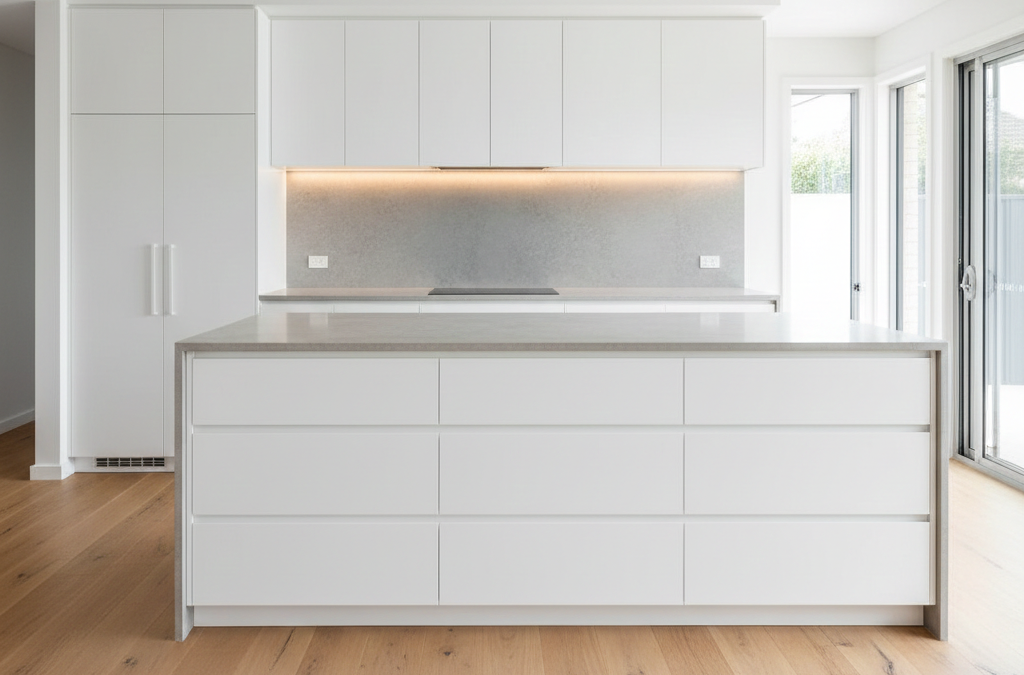
Kitchen cabinetry typically accounts for 40% to 50% of your total kitchen renovation budget in Sydney, with costs ranging from $8,000 for basic stock cabinets to $45,000 or more for a fully custom setup. That single line item shapes the look, function, and long-term value of your entire kitchen.
Whether you are a first-time renovator, a homeowner upgrading an outdated kitchen, or a property investor maximising resale appeal, understanding cabinet types, materials, layouts, and realistic pricing is the difference between a renovation that delivers and one that spirals over budget.
This guide breaks down everything you need to know about kitchen cabinetry in Sydney. From material comparisons and cost breakdowns to layout planning, hardware selection, and budgeting strategies, you will have the practical knowledge to make confident, informed decisions before a single cabinet door is ordered.
What Is Kitchen Cabinetry and Why Does It Matter in a Renovation
Kitchen cabinetry refers to the complete system of base cabinets, wall cabinets, tall pantry units, and specialty storage modules that form the structural and visual backbone of a kitchen. It includes the cabinet boxes (carcasses), doors, drawer fronts, internal fittings, and hardware that together determine how your kitchen looks, functions, and holds up over time.
Cabinetry matters more than most homeowners initially realise. It dictates your storage capacity, your workflow efficiency, and the overall aesthetic of the room. A poorly planned cabinet layout creates dead zones, wasted space, and daily frustration. A well-designed one makes cooking, cleaning, and entertaining feel effortless.
In a renovation context, cabinetry is also the single largest cost driver. The material you choose, the level of customisation, the finish quality, and the internal fittings all compound quickly. Getting this decision right from the start protects your budget and ensures the finished kitchen delivers genuine, lasting value.
How Kitchen Cabinets Affect Your Home’s Value
Kitchen renovations consistently rank among the highest-return improvements for residential property in Australia. According to Archistar’s property data analysis, a well-executed kitchen renovation can add between $20,000 and $50,000 to a Sydney home’s resale value, depending on the scope and quality of finishes.
Cabinets are the centrepiece of that equation. Buyers notice cabinetry first. Dated laminate doors, sagging hinges, and poor storage layouts signal neglect. Modern, well-built cabinetry with quality hardware signals a home that has been maintained and upgraded thoughtfully.
For property investors and landlords, this is especially relevant. Tenants and buyers in Sydney’s competitive market expect functional kitchens with adequate storage. Upgrading cabinetry, even without a full kitchen gut, can meaningfully lift rental yield and sale price.
Kitchen Cabinetry vs Bathroom Cabinetry: Key Differences
While both kitchen and bathroom cabinets share construction principles, the demands on each are different. Kitchen cabinets endure heavier daily use. They need to support the weight of cookware, appliances, and pantry goods. Drawer runners and hinges in a kitchen see thousands more open-close cycles than a bathroom vanity.
Moisture exposure also differs. Bathroom cabinetry faces sustained humidity and direct water contact, requiring moisture-resistant materials like marine-grade plywood or moisture-rated MDF. Kitchen cabinets deal with steam and splashes but generally face less prolonged moisture unless positioned near a sink or dishwasher.
Sizing and configuration vary too. Kitchen cabinetry involves a wider range of unit types: base cabinets, overhead cabinets, corner solutions, pantry towers, appliance housings, and island units. Bathroom cabinetry is typically limited to vanity units, mirror cabinets, and occasional tall storage. If you are renovating both rooms simultaneously, understanding these differences helps you allocate budget and material choices appropriately.
Types of Kitchen Cabinets Every Homeowner Should Know
Not all kitchen cabinets are built the same way or priced the same way. The three main categories, stock, semi-custom, and custom, represent a spectrum of cost, flexibility, and quality. Knowing where each sits helps you match your expectations to your budget.
Stock Cabinets
Stock cabinets are pre-manufactured in standard sizes and finishes. They are the most affordable option, typically ranging from $100 to $350 per linear metre for the cabinet carcass and door in Sydney. You will find them at large home improvement retailers and flat-pack suppliers.
The trade-off is limited flexibility. Stock cabinets come in fixed widths (usually in 50mm or 100mm increments), fixed heights, and a narrow selection of door styles and colours. If your kitchen has non-standard dimensions, odd angles, or specific storage needs, stock cabinets may leave gaps or require filler panels.
Stock cabinets suit budget-conscious renovations, rental properties, and straightforward kitchen layouts where standard sizing works. They are quick to source and relatively simple to install, which also keeps labour costs down.
Semi-Custom Cabinets
Semi-custom cabinets bridge the gap between off-the-shelf and fully bespoke. You start with a standard cabinet carcass but gain options to modify dimensions, door styles, finishes, and internal fittings. Pricing in Sydney typically falls between $350 and $800 per linear metre, depending on the level of modification and finish quality.
This category offers the best balance of cost and personalisation for most homeowners. You can adjust cabinet widths to fit your exact kitchen dimensions, choose from a broader palette of door profiles and colours, and add internal accessories like pull-out bins, spice racks, or drawer organisers.
Lead times are longer than stock, usually four to eight weeks, because modifications are made to order. But the result is a kitchen that looks and feels tailored without the price tag of full custom work.
Custom Cabinets
Custom cabinets are designed and built from scratch to your exact specifications. Every dimension, material, finish, and internal fitting is chosen by you and your cabinet maker. In Sydney, custom kitchen cabinetry typically starts at $800 per linear metre and can exceed $2,000 per linear metre for premium timbers, hand-painted finishes, or complex configurations.
This is the right choice when your kitchen has unusual dimensions, when you want a specific design aesthetic that stock and semi-custom ranges cannot deliver, or when you need specialised storage solutions. Heritage homes, architect-designed kitchens, and high-end renovations almost always require custom cabinetry.
The investment is significant, but so is the result. Custom cabinets maximise every centimetre of available space, use higher-grade materials and construction methods, and deliver a finish quality that mass-produced options cannot match.
Kitchen Cabinet Materials and Finishes Explained
The material you choose for your cabinet carcasses and doors determines durability, appearance, maintenance requirements, and cost. Sydney’s climate, with its humidity and temperature fluctuations, also plays a role in material performance.
Solid Timber Cabinets
Solid timber remains the premium choice for kitchen cabinetry. Hardwoods like Tasmanian oak, blackbutt, and spotted gum are popular in Sydney for their natural grain, warmth, and longevity. Solid timber cabinet doors can be sanded and refinished multiple times over their lifespan, making them a genuinely long-term investment.
The cost reflects the quality. Solid timber doors typically add $200 to $600 per door on top of carcass costs, depending on the species and profile. Timber also requires more careful maintenance. It can expand and contract with humidity changes, and it needs periodic oiling or resealing to maintain its finish.
For homeowners who value natural materials and plan to stay in their home long-term, solid timber delivers unmatched character and durability. For investment properties or budget renovations, it is usually not the most cost-effective choice.
Laminate and Melamine Cabinets
Laminate and melamine are the workhorses of Australian kitchen cabinetry. Melamine is a resin-coated particleboard or MDF used primarily for cabinet carcasses and sometimes doors. High-pressure laminate (HPL) is a more durable surface material bonded to a substrate, offering better scratch and moisture resistance.
These materials are affordable, low-maintenance, and available in an enormous range of colours, patterns, and textures, including convincing timber-look finishes. Melamine carcasses with laminate doors represent the most common mid-range kitchen cabinet specification in Sydney.
Pricing is accessible. A full set of melamine carcasses with laminate doors for an average-sized Sydney kitchen typically falls between $5,000 and $15,000, depending on the layout complexity and door quality. The main limitation is repairability. Deep scratches or chips in laminate are difficult to fix, and melamine can swell if exposed to prolonged moisture.
Polyurethane and 2-Pac Painted Finishes
Polyurethane (commonly called 2-pac in Australia) is a spray-applied paint finish that delivers a smooth, seamless look. It is applied to MDF doors and panels, creating a factory-quality finish that can be produced in virtually any colour.
2-pac finishes are the go-to choice for modern, contemporary kitchens in Sydney. They offer a clean, handleless aesthetic when paired with push-to-open mechanisms or integrated finger pulls. The finish is durable, easy to clean, and resistant to moisture when properly applied.
Cost sits in the mid-to-upper range. 2-pac painted doors typically add $150 to $400 per door compared to standard laminate. The finish is also more susceptible to chipping on impact than laminate, and colour matching for repairs can be challenging. Despite this, 2-pac remains one of the most popular finish choices for Sydney kitchen renovations.
Engineered Wood and MDF Options
Medium-density fibreboard (MDF) is the most common substrate for kitchen cabinet doors in Australia. It machines cleanly, accepts paint and vinyl wraps well, and provides a stable, consistent surface free from the knots and grain variations found in natural timber.
Engineered wood products, including plywood and particleboard, are used for carcass construction. Plywood is the stronger and more moisture-resistant option, making it the preferred choice for higher-quality cabinets, especially around sinks and dishwashers. Particleboard is more affordable but less durable when exposed to water.
For most Sydney kitchen renovations, a combination of moisture-resistant particleboard or plywood carcasses with MDF doors (finished in laminate, vinyl wrap, or 2-pac paint) offers the best balance of performance and price. Always confirm that your cabinet maker uses moisture-resistant (MR) rated board for any cabinets near water sources.
Kitchen Cabinetry Costs in Sydney
Understanding realistic pricing is the single most important step in avoiding budget blowouts. Kitchen cabinetry costs in Sydney vary widely based on cabinet type, material, finish, layout complexity, and the installer you choose.
Average Price Ranges for Kitchen Cabinets in 2025
Here is a realistic breakdown of kitchen cabinetry costs in Sydney for 2025, based on an average-sized kitchen (approximately 10 to 15 linear metres of cabinetry):
| Cabinet Category | Price Range (Supply Only) | Price Range (Supply + Install) |
| Stock / Flat-Pack | $3,000 – $8,000 | $5,000 – $12,000 |
| Semi-Custom | $8,000 – $18,000 | $12,000 – $25,000 |
| Custom | $15,000 – $35,000 | $22,000 – $50,000+ |
| Premium Custom (Solid Timber / Specialty) | $30,000 – $60,000+ | $40,000 – $80,000+ |
These figures cover carcasses, doors, and basic internal fittings. Benchtops, splashbacks, appliances, plumbing, and electrical work are separate costs. According to HiPages’ renovation cost guide, the average total kitchen renovation in Sydney ranges from $15,000 to $45,000, with cabinetry representing the largest single component.
Labour Costs for Cabinet Installation in Sydney
Labour for kitchen cabinet installation in Sydney typically ranges from $50 to $85 per hour for a qualified cabinet installer, or $1,500 to $5,000 as a fixed project fee for a standard kitchen. The total depends on the number of cabinets, the complexity of the layout, and whether any structural modifications are needed.
Installation labour includes assembling and securing carcasses to walls and floors, fitting doors and drawer fronts, adjusting hinges and runners, and installing internal fittings. It does not typically include plumbing, electrical, tiling, or benchtop installation, which are separate trades with their own costs.
If you are using flat-pack cabinets, some homeowners attempt DIY installation to save money. This can work for simple layouts, but mistakes in levelling, alignment, or fixing can compromise the finished result and void manufacturer warranties. For semi-custom and custom cabinetry, professional installation is essential.
Hidden Costs and Budget Pitfalls to Watch For
Kitchen cabinetry quotes often exclude items that add up quickly. Watch for these common hidden costs:
Removal and disposal of existing cabinets. Demolition and skip bin hire can add $500 to $2,000 depending on the size of the kitchen and the materials being removed.
Plumbing and electrical relocation. If your new cabinet layout changes the position of the sink, dishwasher, or rangehood, you will need a licensed plumber and electrician. Relocating a single plumbing point in Sydney can cost $300 to $800.
Wall and floor repairs. Once old cabinets come out, you often discover damaged plaster, uneven floors, or outdated wiring that needs rectification before new cabinets can go in.
Benchtop templating and installation. Stone benchtops require a separate templating visit after cabinets are installed, adding $2,000 to $6,000 or more depending on the material and edge profile.
Upgraded internal fittings. Pull-out pantry systems, corner carousel units, and drawer organisers are often quoted as extras. A single pull-out pantry unit can cost $400 to $1,200 installed.
GST and variations. Always confirm whether quoted prices include GST. And build a contingency of at least 10% to 15% into your budget for unexpected variations.
How to Plan Your Kitchen Cabinet Layout
A good cabinet layout starts with understanding how you use your kitchen. The goal is to create a workflow that minimises unnecessary movement between the sink, cooktop, and refrigerator, while maximising accessible storage.
Standard Kitchen Layouts and Cabinet Configurations
Most Sydney kitchens follow one of five standard layouts, each with different cabinetry requirements:
Single wall (I-shape). All cabinets along one wall. Common in apartments and small homes. Requires careful vertical storage planning to compensate for limited linear space.
Galley (parallel). Two parallel runs of cabinets facing each other. Efficient for cooking but can feel narrow. Works well in homes where the kitchen is a dedicated room rather than open-plan.
L-shape. Cabinets along two adjoining walls. The most common layout in Sydney homes. Offers good workflow and flexibility for adding an island or dining area.
U-shape. Cabinets along three walls. Maximises storage and bench space but requires a room width of at least 3 metres to avoid feeling cramped.
Island. An L-shape or U-shape with a freestanding island unit. Popular in open-plan Sydney homes. The island adds storage, bench space, and a social hub, but requires adequate floor area (at least 1.2 metres clearance on all sides).
Your layout determines the number and type of cabinet units you need, which directly drives cost. An L-shape kitchen with an island will require significantly more cabinetry than a single-wall setup.
Measuring Your Kitchen for New Cabinets
Accurate measurements prevent costly errors. Before meeting with a cabinet maker or ordering stock cabinets, measure the following:
Wall lengths. Measure each wall at both floor level and bench height (900mm). Walls are rarely perfectly straight, so note any variations.
Ceiling height. Standard overhead cabinets are designed for 2,400mm ceilings. If your ceiling is higher or lower, you will need to adjust overhead cabinet heights or add bulkheads.
Window and door positions. Note the exact position, width, and height of every window, door, and opening. Cabinets must work around these.
Plumbing and electrical locations. Mark the position of water supply points, waste pipes, power outlets, and gas connections. Relocating these adds cost, so designing around existing services where possible saves money.
Appliance dimensions. Measure every appliance that will be integrated or housed within cabinetry: oven, microwave, dishwasher, rangehood, and refrigerator. Check manufacturer specifications for required clearances.
Always measure twice. And if you are investing in semi-custom or custom cabinetry, your cabinet maker will conduct their own site measure to verify dimensions before manufacturing begins.
Storage Solutions and Internal Fittings
The inside of your cabinets matters as much as the outside. Internal fittings transform basic boxes into highly functional storage systems.
Drawer systems are more accessible than shelved cabinets for base units. Deep pot drawers, cutlery inserts, and tiered drawer organisers keep contents visible and within reach.
Pull-out pantry units use narrow spaces efficiently. A 300mm-wide pull-out pantry can store as much as a standard 600mm shelved cupboard while making every item visible.
Corner solutions address the dead space where two cabinet runs meet. Options include corner carousels (lazy Susans), Le Mans pull-out systems, and magic corner units. These fittings add cost ($300 to $1,500 per unit) but recover otherwise wasted space.
Overhead cabinet interiors benefit from pull-down shelf systems, especially for users who find reaching upper shelves difficult. These mechanisms bring the shelf contents down to bench level.
Under-sink organisers work around plumbing to create usable storage in an area that is often wasted. Pull-out bins for recycling and waste are a practical addition here.
Prioritise internal fittings based on how you actually use your kitchen. Investing in quality drawer runners and pull-out systems for the cabinets you open most frequently delivers the best return on comfort and functionality.
Choosing the Right Kitchen Cabinet Hardware and Accessories
Hardware is the mechanical backbone of your cabinetry. Cheap hinges and runners degrade quickly, leading to sagging doors, sticky drawers, and a kitchen that feels tired within a few years. Quality hardware costs more upfront but pays for itself in longevity and daily satisfaction.
Hinges, Drawer Runners, and Soft-Close Mechanisms
Hinges. Concealed European-style hinges (also called cup hinges) are the standard for modern kitchen cabinets. Brands like Blum and Hettich dominate the Australian market. Look for hinges with integrated soft-close dampening, which prevents doors from slamming and reduces wear on the cabinet structure. A quality soft-close hinge costs $5 to $12 per unit.
Drawer runners. Undermount, full-extension drawer runners are the current benchmark. They allow the drawer to open fully, giving you access to the entire contents, and they hide beneath the drawer box for a clean look. Blum Tandembox and similar systems are widely used by Sydney cabinet makers. Budget $30 to $80 per drawer for quality undermount runners with soft-close.
Soft-close mechanisms should be non-negotiable on every door and drawer in your kitchen. The cost difference between soft-close and standard hardware is modest (typically $3 to $10 per unit), but the improvement in daily use and long-term durability is substantial.
Handles, Knobs, and Pull Styles
Cabinet handles are a small detail with outsized visual impact. The style, finish, and placement of your handles set the design tone for the entire kitchen.
Bar handles (also called T-bar or rail handles) are the most popular choice in contemporary Sydney kitchens. They come in brushed nickel, matte black, brushed brass, and stainless steel. Pricing ranges from $5 to $30 per handle depending on length and finish.
Knobs suit traditional, Hamptons, and Shaker-style kitchens. They are less ergonomic for drawers but work well on doors.
Integrated finger pulls (also called J-pulls or lip pulls) are routed directly into the door edge, creating a handleless look. This is a popular choice for modern, minimalist kitchens but requires precise manufacturing.
Push-to-open (tip-on) mechanisms eliminate handles entirely. The door or drawer opens with a light press. This creates the cleanest visual line but requires quality mechanisms to function reliably over time.
When budgeting, remember that a standard kitchen has 20 to 40 handles. At $15 to $25 each, that is $300 to $1,000 just for handles. It is a small line item that is easy to overlook.
Kitchen Cabinetry Trends in Sydney for 2025
Design trends shift, but the best kitchen renovations balance current style with timeless functionality. Here is what is popular in Sydney right now and what is likely to hold its value.
Popular Colours and Finish Trends
Matte finishes continue to dominate over gloss in Sydney kitchens. Matte surfaces hide fingerprints and minor scratches better, and they photograph well for property listings.
Dark and moody tones are gaining ground. Deep greens, navy blues, and charcoal greys are appearing on island units and lower cabinetry, often paired with lighter overhead cabinets or open shelving. This two-tone approach adds depth without making the kitchen feel dark.
Warm neutrals remain the safest long-term choice. Soft whites, warm greys, and natural timber tones appeal to the broadest range of buyers and tenants. If you are renovating for resale or rental, these colours minimise the risk of dating your kitchen.
Timber-look finishes in laminate and melamine have improved dramatically. Modern woodgrain laminates are nearly indistinguishable from real timber at a fraction of the cost and maintenance. They are an excellent choice for achieving a warm, natural look on a mid-range budget.
Smart Storage and Functional Design Features
Sydney homeowners are increasingly prioritising function over pure aesthetics. The most requested features in 2025 include:
Integrated appliance housing. Built-in coffee machines, steam ovens, and microwave drawers housed within cabinetry for a seamless look.
Butler’s pantries. A secondary preparation and storage area behind the main kitchen. Even a small butler’s pantry (1.5m x 1m) adds significant storage and keeps the main kitchen clutter-free.
Drawer-dominant base cabinets. Replacing traditional door-and-shelf base cabinets with deep drawers throughout. Drawers provide better visibility and access to stored items.
Integrated charging stations. Discreet power outlets and USB ports built into cabinetry for charging devices without cluttering benchtops.
Bin drawer systems. Multi-compartment pull-out bins for general waste, recycling, and compost, integrated into the cabinet run near the sink.
These features add cost but deliver daily functional value that homeowners consistently rate as worthwhile after living with them.
How to Budget for Kitchen Cabinetry Without Blowing Out Costs
Budget blowouts in kitchen renovations almost always trace back to poor planning, unclear specifications, or scope creep during the project. A disciplined approach to budgeting protects your finances and reduces stress.
Where to Save and Where to Spend
Spend on: Drawer runners, hinges, and soft-close hardware. You interact with these components every single day. Quality hardware from brands like Blum or Hettich lasts 15 to 20 years. Cheap alternatives fail in 3 to 5 years.
Spend on: Carcass construction quality. Moisture-resistant board, solid backs (not cardboard), and proper dowel-and-cam construction ensure your cabinets hold up structurally.
Save on: Door finishes for less visible cabinets. Your pantry interior and laundry cabinets do not need the same premium finish as your main kitchen run. Using a simpler finish in secondary areas can save hundreds.
Save on: Overhead cabinet quantity. Open shelving or a combination of overhead cabinets and open shelves can reduce costs while creating a more open feel. Just be realistic about whether you will keep open shelves tidy.
Save on: Handle upgrades for every cabinet. A mid-range handle at $8 to $12 performs identically to a designer handle at $30. Unless a specific handle style is central to your design vision, the mid-range option is the smarter financial choice.
Getting Accurate Quotes from Sydney Cabinet Makers
An accurate quote requires accurate information. Before requesting quotes, prepare the following:
A clear floor plan with dimensions, window positions, and service locations. Even a hand-drawn plan with accurate measurements is better than a verbal description.
Your appliance list with model numbers and dimensions. Cabinet makers need to know exactly what they are designing around.
Your finish preferences. Specify door material, colour, and handle style. Vague briefs produce vague quotes.
Your internal fitting wishlist. List every pull-out, drawer insert, and corner solution you want. These are often quoted as extras, so including them upfront gives you a true total cost.
Request at least three quotes from licensed cabinet makers or renovation contractors. Compare them line by line, not just on the bottom-line figure. A lower quote that excludes installation, internal fittings, or GST is not actually cheaper.
Avoiding Common Kitchen Renovation Budget Mistakes
Mistake 1: Not including a contingency. Unexpected issues, structural problems behind walls, asbestos in older homes, plumbing that does not meet current code, appear in the majority of Sydney kitchen renovations. A 10% to 15% contingency is not optional. It is essential.
Mistake 2: Changing specifications mid-project. Upgrading your benchtop material or adding extra cabinets after manufacturing has begun triggers variation costs that are always higher than if the change had been included in the original scope.
Mistake 3: Choosing the cheapest quote without checking inclusions. The lowest price often excludes items that other quotes include. Always compare scope, not just price.
Mistake 4: Forgetting ancillary trades. Your cabinet maker installs cabinets. You still need a plumber, electrician, tiler, and possibly a painter. Budget for all trades, not just cabinetry.
Mistake 5: Underestimating timeline costs. If your kitchen is out of action for six to eight weeks, the cost of eating out, temporary cooking setups, and general disruption adds up. Factor this into your overall renovation budget.
How to Choose a Kitchen Cabinet Installer in Sydney
The quality of installation determines whether your cabinets look and function as intended. Even the best cabinets will disappoint if they are poorly installed, misaligned, or inadequately secured.
What to Look for in a Licensed Kitchen Renovation Contractor
Licensing. In NSW, any building work valued over $5,000 requires a licensed contractor. Verify your installer holds a current NSW Fair Trading licence. You can check licence status on the NSW Fair Trading website.
Insurance. Confirm they hold public liability insurance and, if they employ staff, workers compensation insurance. Ask for certificates of currency, not just verbal confirmation.
Portfolio and references. Ask to see completed kitchen projects, ideally in person or through detailed photos. Speak to at least two previous clients about their experience, particularly regarding communication, timeline adherence, and finish quality.
Warranty. Reputable cabinet makers and installers provide a written warranty on both materials and workmanship. Five years on carcasses and two years on hardware adjustments is a reasonable benchmark.
Clear contract. Your agreement should detail the full scope of work, materials and finishes specified, total price including GST, payment schedule, estimated timeline, and the process for managing variations.
Questions to Ask Before Signing a Contract
- What exactly is included in this quote, and what is excluded?
- Are prices fixed, or are there provisional sums that could change?
- What is the estimated timeline from order to completed installation?
- Who will be on site doing the installation, and are they employees or subcontractors?
- How do you handle unexpected issues discovered during installation?
- What is your payment schedule, and is a deposit required?
- What warranty do you provide on materials and workmanship?
- Can I see a recent project similar in scope to mine?
- How do you manage coordination with other trades (plumber, electrician, tiler)?
- What happens if the project runs over the agreed timeline?
Getting clear answers to these questions before signing protects you from misunderstandings, unexpected costs, and disputes during the project.
Conclusion
Kitchen cabinetry is the foundation of every successful kitchen renovation. From choosing the right materials and cabinet type to planning a functional layout and setting a realistic budget, every decision you make at the cabinetry stage shapes the final result. Understanding costs, comparing options, and planning for hidden expenses puts you in control of your renovation outcome.
The difference between a kitchen renovation that delivers long-term value and one that disappoints almost always comes down to preparation. Accurate measurements, clear specifications, quality hardware, and a trustworthy installer are not luxuries. They are the baseline requirements for a result you will be satisfied with for years to come.
At Sydney Home Renovation, we help homeowners and property investors plan and deliver kitchen cabinetry projects with transparent pricing, skilled workmanship, and clear communication from start to finish. If you are ready to move forward with your kitchen renovation, get in touch with our team for an honest, detailed quote tailored to your home and budget.
Frequently Asked Questions
How much do kitchen cabinets cost in Sydney?
Kitchen cabinet costs in Sydney range from $5,000 to $12,000 for stock or flat-pack options (supply and install) up to $40,000 to $80,000 or more for premium custom cabinetry. The total depends on your kitchen size, layout complexity, materials, finishes, and internal fittings. Always request itemised quotes to understand exactly what is included.
What is the best material for kitchen cabinets in Australia?
For most Australian kitchens, moisture-resistant MDF or plywood carcasses with laminate, melamine, or 2-pac painted doors offer the best balance of durability, appearance, and cost. Solid timber is the premium choice for longevity and character but comes at a higher price point and requires more maintenance.
How long does it take to install kitchen cabinets?
Installation of kitchen cabinets typically takes three to five days for a standard-sized kitchen, assuming the cabinets are ready and the site is prepared. The total project timeline, including design, manufacturing, and installation, ranges from six to twelve weeks for semi-custom and custom cabinetry. Stock cabinets can be installed within one to two weeks of ordering.
Can I keep my existing kitchen layout and just replace the cabinets?
Yes. Replacing cabinets within the same layout is one of the most cost-effective kitchen upgrades because it avoids plumbing and electrical relocation costs. This approach works well when your current layout is functional but the cabinets are dated or damaged. Your new cabinets can still feature updated materials, finishes, and internal fittings.
What is the difference between custom and semi-custom kitchen cabinets?
Semi-custom cabinets start with standard carcass sizes that can be modified in width, height, and depth, with a range of door styles and finishes to choose from. Custom cabinets are built entirely from scratch to your exact specifications, with no limitations on size, material, or configuration. Custom costs significantly more but offers complete design freedom.
Are flat-pack kitchen cabinets worth it?
Flat-pack cabinets are worth considering for budget renovations, rental properties, and simple layouts. They cost significantly less than semi-custom or custom options and have improved in quality over the past decade. However, they use lighter-gauge hardware, thinner board, and limited finish options. For a primary residence where you want longevity and a premium feel, investing in semi-custom or custom cabinetry is usually the better long-term decision.
How do I set a realistic budget for new kitchen cabinetry?
Start by measuring your kitchen and determining the approximate linear metres of cabinetry needed. Use the price ranges in this guide as a baseline, then add 10% to 15% for contingency. Get at least three itemised quotes from licensed Sydney cabinet makers, and ensure each quote covers the same scope including carcasses, doors, hardware, internal fittings, and installation. Do not forget to budget separately for benchtops, splashbacks, plumbing, electrical, and other trades.