
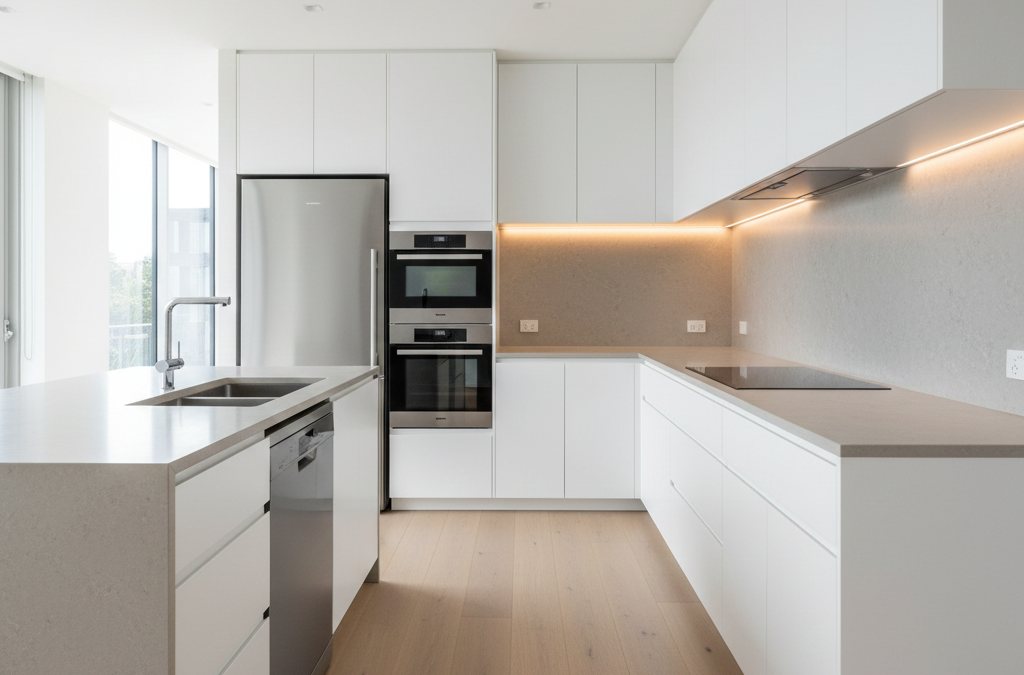
Kitchen appliances typically account for 10% to 20% of your total kitchen renovation budget in Sydney, with most homeowners spending between $5,000 and $15,000 depending on brand preferences, kitchen size, and whether they choose built-in or freestanding models.
Getting this allowance right early prevents budget blowouts and last-minute compromises on quality. The wrong appliance choices can stall your renovation timeline and add thousands in unexpected installation costs.
This guide breaks down appliance costs, brand options, sizing decisions, installation requirements, and the most common budgeting mistakes Sydney renovators make so you can plan with confidence.
What Kitchen Appliances Do You Need for a Full Renovation
Every kitchen renovation in Sydney starts with the same core question: which appliances are essential, and which ones are optional upgrades? The answer depends on how you cook, how many people live in your household, and what your renovation budget allows.
Splitting appliances into categories helps you prioritise spending. Major appliances form the backbone of your kitchen. Small appliances add convenience. And the choice between built-in and freestanding units affects both your cabinetry design and your bottom line.
Major Kitchen Appliances Every Sydney Home Needs
These are the non-negotiable items that every functional kitchen requires:
- Oven (wall-mounted or under-bench): $800 to $5,000+
- Cooktop (gas, electric, or induction): $400 to $4,000+
- Rangehood: $300 to $3,000+
- Refrigerator: $800 to $6,000+
- Dishwasher: $500 to $2,500+
Most Sydney kitchens also include a microwave, though placement varies. If your renovation includes a laundry nook within the kitchen footprint, a washing machine and dryer may also factor into your appliance budget.
The combined cost of these five core appliances ranges from roughly $2,800 at the entry level to well over $20,000 for premium European brands. That spread is why setting a clear appliance allowance before you start shopping matters so much.
Small Appliances That Add Daily Value
Small appliances sit outside your cabinetry budget but still affect your kitchen’s functionality and bench space planning. The most common ones Sydney homeowners factor into a renovation include:
- Toaster and kettle (often purchased as a matching set)
- Coffee machine (benchtop or built-in)
- Stand mixer
- Food processor or blender
- Air fryer
Built-in coffee machines have surged in popularity across Sydney renovations. They look seamless but add $2,000 to $5,000 to your appliance spend. If you are working within a tight budget, a quality benchtop espresso machine delivers similar results at a fraction of the cost.
Plan your powerpoint locations around these small appliances during the electrical rough-in stage. Retrofitting power outlets after cabinetry installation is expensive and disruptive.
Built-In vs Freestanding Appliances
This decision shapes your entire kitchen design. Built-in appliances sit flush with cabinetry, creating a streamlined look. Freestanding appliances are self-contained units that slot into a gap between cabinets.
Built-in appliances:
- Higher purchase price (typically 20% to 40% more than freestanding equivalents)
- Require precise cabinetry cutouts
- Professional installation is essential
- Deliver a premium, integrated aesthetic
- Harder and more expensive to replace
Freestanding appliances:
- Lower upfront cost
- Easier to swap out or upgrade later
- More brand and model flexibility
- Simpler installation
- Visible gaps between unit and cabinetry
For property investors renovating to sell or lease, freestanding packages often deliver better return on investment. Owner-occupiers planning to stay long-term tend to prefer built-in units for the cleaner finish and higher perceived value.
How Much Do Kitchen Appliances Cost in Sydney
Appliance costs in Sydney vary significantly based on brand, features, energy rating, and whether you buy at retail or through a trade supplier. Understanding the three main pricing tiers helps you set a realistic budget before you walk into a showroom.
Budget Kitchen Appliance Packages ($2,000 to $5,000)
At this level, you are looking at reliable Australian and entry-level international brands. Expect basic features, standard finishes, and fewer size options.
Typical brands in this range include Westinghouse, Chef, and Euromaid. A complete package at this tier usually covers an oven, cooktop, rangehood, dishwasher, and a basic refrigerator.
Budget packages work well for investment properties, rental units, and first-home renovations where functionality matters more than aesthetics. The trade-off is shorter warranty periods, fewer energy-efficient models, and limited design integration with premium cabinetry.
Mid-Range Kitchen Appliance Costs ($5,000 to $12,000)
This is where most Sydney homeowners land. Mid-range appliances offer better build quality, improved energy ratings, quieter operation, and more design options.
Brands in this tier include Bosch, Fisher & Paykel, Electrolux, and Samsung. You get access to induction cooktops, pyrolytic self-cleaning ovens, and integrated rangehoods that were previously only available at premium price points.
A mid-range package typically includes:
| Appliance | Price Range |
| Oven (pyrolytic) | $1,200 – $2,500 |
| Induction cooktop | $1,000 – $2,200 |
| Rangehood (integrated) | $600 – $1,500 |
| Dishwasher | $800 – $1,800 |
| Refrigerator (French door) | $1,800 – $3,500 |
This tier gives you the best balance between cost, performance, and long-term durability. For most owner-occupier renovations in Sydney, mid-range appliances deliver strong value without the premium markup.
Premium and High-End Appliance Pricing ($12,000 to $30,000+)
Premium appliances are where performance, design, and brand prestige converge. At this level, you are choosing from brands like Miele, SMEG, V-ZUG, Gaggenau, and Sub-Zero.
Expect features like steam-assist ovens, integrated ventilation systems, smart connectivity, whisper-quiet dishwashers, and column refrigeration. Finishes include brushed stainless steel, matte black, and custom panel-ready options that disappear behind cabinetry.
Premium appliances make sense for high-end renovations where the kitchen is a centrepiece. They also hold their value better at resale in Sydney’s upper-market suburbs. However, the cost gap between mid-range and premium is steep, and the performance difference for everyday cooking is often marginal.
Cost Comparison Table by Appliance Type
| Appliance | Budget | Mid-Range | Premium |
| Oven | $800 – $1,200 | $1,200 – $2,500 | $2,500 – $7,000+ |
| Cooktop | $400 – $800 | $1,000 – $2,200 | $2,200 – $5,000+ |
| Rangehood | $300 – $600 | $600 – $1,500 | $1,500 – $4,000+ |
| Dishwasher | $500 – $800 | $800 – $1,800 | $1,800 – $3,500+ |
| Refrigerator | $800 – $1,500 | $1,800 – $3,500 | $3,500 – $12,000+ |
| Total Package | $2,800 – $4,900 | $5,400 – $11,500 | $11,500 – $31,500+ |
These figures reflect Sydney retail pricing as of 2025. Trade pricing through your renovation contractor can reduce these totals by 10% to 25% depending on the supplier relationship and order volume.
How to Choose the Right Kitchen Appliances for Your Renovation
Choosing appliances is not just about brand preference. Your kitchen layout, household size, energy costs, and renovation timeline all influence which models will actually work in your space.
Matching Appliances to Your Kitchen Layout
Your kitchen’s footprint dictates appliance sizing more than any other factor. A galley kitchen in a Surry Hills terrace has different constraints than an open-plan layout in a new build at Kellyville.
Key layout considerations:
- Oven placement: Wall ovens need a tall cabinet. Under-bench ovens need clearance from adjacent drawers.
- Cooktop width: Standard is 600mm. Larger households often prefer 900mm, but this requires wider benchtop runs.
- Rangehood coverage: The rangehood should match or exceed the cooktop width for effective extraction.
- Refrigerator depth: Counter-depth models sit flush with cabinetry but offer less internal capacity than standard-depth units.
- Dishwasher clearance: Standard dishwashers are 600mm wide. Compact models at 450mm suit smaller kitchens or secondary prep areas.
Finalise your kitchen design and cabinetry layout before purchasing appliances. Buying a 900mm cooktop for a kitchen designed around 600mm cutouts creates costly rework.
Energy Efficiency Ratings and Running Costs
Energy ratings directly affect your long-term running costs. In Sydney, where electricity prices continue to climb, choosing a higher-rated appliance pays for itself over time.
The Australian Government’s Energy Rating Label system assigns star ratings to most kitchen appliances. More stars mean lower energy consumption.
Practical examples of annual running cost differences:
- A 2-star refrigerator may cost $120 to $180 per year to run. A 4-star model of the same size typically costs $60 to $90.
- Induction cooktops use approximately 10% to 15% less energy than gas cooktops and significantly less than electric coil or ceramic models.
- Pyrolytic ovens use more energy during the self-cleaning cycle, but the convenience often outweighs the marginal cost increase.
For a renovation you plan to live in for five or more years, investing an extra $200 to $500 upfront for a higher energy rating often saves $50 to $100 annually. That adds up.
Size and Capacity Considerations for Sydney Households
Appliance capacity should match your household, not your aspirations. Oversized appliances waste energy and take up valuable kitchen real estate. Undersized ones create daily frustration.
General sizing guidelines:
| Household Size | Refrigerator Capacity | Dishwasher Type | Oven Size |
| 1–2 people | 300–400L | Standard or compact | 60cm |
| 3–4 people | 400–550L | Standard | 60cm |
| 5+ people | 550–700L+ | Standard (or two units) | 90cm or double oven |
Sydney apartments often have spatial constraints that limit refrigerator depth and width. Measure your available space precisely, including door swing clearance, ventilation gaps, and adjacent cabinetry reveals, before committing to a model.
Warranty, Servicing, and After-Sales Support
Warranty length varies dramatically between brands and price tiers. Budget appliances typically carry a 2-year manufacturer warranty. Mid-range brands often offer 3 to 5 years. Premium brands like Miele provide up to 10 years on select components.
Check these details before purchasing:
- Is there a local Sydney service centre for the brand?
- What does the warranty actually cover (parts, labour, call-out fees)?
- Are extended warranty options available, and are they worth the cost?
- How long do replacement parts typically take to arrive?
Brands with strong Australian distribution networks, like Fisher & Paykel and Bosch, tend to offer faster servicing turnaround in Sydney. European imports from smaller brands may require longer wait times for parts.
Kitchen Appliance Brands Available in Sydney
Sydney renovators have access to a wide range of appliance brands across every price point. Knowing which brands sit where helps you compare options without wasting time in showrooms that do not match your budget.
Australian and International Brands Compared
| Category | Brands | Price Tier | Strengths |
| Australian-made | Fisher & Paykel, Electrolux (AU range) | Mid-range | Local servicing, parts availability, designed for AU conditions |
| European (accessible) | Bosch, Electrolux, SMEG | Mid to premium | Strong design, energy efficiency, wide model range |
| European (luxury) | Miele, Gaggenau, V-ZUG | Premium | Superior build quality, long warranties, prestige |
| Korean/Japanese | Samsung, LG | Budget to mid-range | Smart features, competitive pricing, innovation |
| Budget/Value | Westinghouse, Chef, Euromaid | Budget | Affordable, functional, widely available |
Fisher & Paykel remains one of the most popular choices for Sydney renovations. Their appliances balance design, reliability, and price effectively. Bosch dominates the mid-range segment with consistent quality across their entire product line.
Where to Buy Kitchen Appliances in Sydney
Your purchasing channel affects both price and after-sales experience.
Retail showrooms: Harvey Norman, The Good Guys, Winning Appliances, and E&S Trading offer hands-on product experience. Winning Appliances and E&S Trading specialise in mid-range to premium brands and provide design consultation services.
Online retailers: Appliances Online (now part of Winning Group) offers competitive pricing with free Sydney metro delivery on most items. Useful for price comparison even if you buy in-store.
Trade suppliers: If your renovation contractor has trade accounts, you can often access appliances at 10% to 25% below retail. This is one of the most overlooked savings opportunities in a kitchen renovation.
Direct from manufacturer: Some brands, including Miele and Fisher & Paykel, operate their own Sydney showrooms. Buying direct sometimes includes installation packages or extended warranty offers not available through third-party retailers.
Trade vs Retail Pricing for Renovators
Trade pricing is not a secret, but many homeowners do not know to ask about it. Licensed builders and renovation contractors maintain accounts with appliance distributors that offer wholesale or trade-level pricing.
The savings depend on the brand and order size:
- Budget brands: 5% to 10% below retail
- Mid-range brands: 10% to 20% below retail
- Premium brands: 15% to 25% below retail (especially on full kitchen packages)
Ask your renovation contractor whether they can supply appliances through their trade accounts. Even after a small coordination fee, the net savings often exceed what you would pay buying retail yourself.
The trade-off is that you may have fewer opportunities to physically inspect models before purchase. Visiting a showroom first, then ordering through trade channels, gives you the best of both worlds.
Common Kitchen Appliance Mistakes That Blow Your Budget
Appliance budgets blow out for predictable reasons. Most of them are avoidable with better planning and sequencing.
Overspending on Features You Will Not Use
Modern kitchen appliances come loaded with features. Steam-assist cooking, Wi-Fi connectivity, automated cooking programs, and built-in cameras sound impressive in a showroom. In practice, most households use a fraction of these capabilities.
Before paying a premium for advanced features, ask yourself:
- Will I actually use steam cooking more than once a month?
- Do I need my oven connected to my phone?
- Is a self-cleaning function worth an extra $500 to $800?
Pyrolytic self-cleaning is one feature that consistently delivers value for most households. Smart connectivity, on the other hand, ranks among the least-used features according to appliance retailers.
Spend your budget on build quality, energy efficiency, and reliability rather than feature lists. A well-built mid-range oven will outperform and outlast a feature-packed budget model every time.
Ignoring Installation and Connection Costs
The sticker price on an appliance is not the total cost. Installation adds a layer of expense that many first-time renovators overlook.
Common installation costs in Sydney:
| Service | Typical Cost |
| Gas cooktop connection (licensed gasfitter) | $150 – $350 |
| Rangehood ducting to external wall | $300 – $800 |
| Electrical circuit for oven (dedicated) | $200 – $500 |
| Plumbing for dishwasher or fridge with water/ice | $150 – $400 |
| Cabinetry modification for non-standard sizes | $200 – $600+ |
These costs add $500 to $2,000+ to your total appliance spend depending on your kitchen’s existing infrastructure. Older Sydney homes, particularly pre-1980s builds, often require electrical upgrades to support modern appliance loads.
Factor installation into your appliance budget from day one. Not as an afterthought.
Buying Appliances Before Finalising Your Kitchen Design
This is the single most expensive mistake renovators make with kitchen appliances. Purchasing appliances before your kitchen design is locked in leads to:
- Cabinetry that needs custom modifications to fit non-standard appliance dimensions
- Appliances that do not align with benchtop heights or overhead cabinet clearances
- Rangehoods that cannot be ducted effectively due to ceiling or wall constraints
- Refrigerators that block walkways or cannot open fully due to adjacent walls
The correct sequence is: finalise kitchen layout, confirm cabinetry dimensions, select appliances that fit those dimensions, then purchase. Your kitchen designer or renovation contractor should provide an appliance schedule with exact model numbers and dimensions before any orders are placed.
How to Budget for Kitchen Appliances During a Renovation
Smart appliance budgeting starts before you visit a single showroom. It requires understanding what percentage of your total renovation budget should go toward appliances, which items to prioritise, and when to make purchases.
Setting a Realistic Appliance Allowance
A practical rule of thumb for Sydney kitchen renovations: allocate 10% to 20% of your total kitchen renovation budget to appliances.
| Total Kitchen Renovation Budget | Suggested Appliance Allowance |
| $15,000 – $25,000 | $2,000 – $5,000 |
| $25,000 – $45,000 | $5,000 – $9,000 |
| $45,000 – $70,000 | $7,000 – $14,000 |
| $70,000+ | $12,000 – $20,000+ |
These ranges assume a standard Sydney kitchen renovation including demolition, cabinetry, benchtops, splashback, plumbing, electrical, and appliances. If your cabinetry costs are unusually high (custom joinery, for example), your appliance percentage may sit closer to 10%.
Build a 5% to 10% contingency into your appliance allowance. Price increases between quoting and purchasing, model discontinuations requiring alternatives, and unexpected installation requirements all eat into fixed budgets.
Prioritising Appliances That Add Long-Term Value
Not all appliances contribute equally to your home’s value or your daily quality of life. Prioritise spending on the items you use most and that buyers notice first.
High-priority (spend more here):
- Oven and cooktop (used daily, visible, affects cooking experience)
- Refrigerator (largest appliance, most visible, runs 24/7)
- Rangehood (affects air quality, noise levels, and cooking comfort)
Medium-priority:
- Dishwasher (important for convenience, but mid-range models perform nearly as well as premium)
Lower-priority (save here if needed):
- Microwave (minimal impact on property value or daily experience)
- Small appliances (replace easily without renovation disruption)
For property investors, a clean, matching appliance package from a recognised mid-range brand adds more perceived value than a mix of premium and budget items. Consistency matters more than individual appliance prestige.
Coordinating Appliance Purchases With Your Renovation Timeline
Timing your appliance purchases correctly prevents storage headaches and missed installation windows.
Ideal timeline:
- Week 1–2 of planning: Set appliance budget and shortlist preferred brands
- During design phase: Confirm exact models with your kitchen designer (dimensions are critical)
- 2–4 weeks before installation phase: Place orders (allow for delivery lead times, especially for European imports)
- During cabinetry installation: Appliances should arrive on-site or be stored nearby
- Final fix stage: Appliances installed, connected, and tested
Ordering too early means you need storage space and risk damage. Ordering too late delays your renovation completion. European brands like Miele and Gaggenau can have lead times of 6 to 12 weeks for certain models. Australian-stocked brands like Bosch and Fisher & Paykel typically deliver within 1 to 3 weeks in Sydney metro.
Coordinate with your renovation contractor to lock in delivery dates that align with the installation schedule.
Kitchen Appliance Installation and What to Expect
Installation is where appliance planning meets construction reality. Even the best appliances underperform or create problems if they are not installed correctly.
Electrical and Plumbing Requirements
Modern kitchen appliances have specific power and plumbing demands that your renovation must accommodate during the rough-in stage.
Electrical requirements:
- Ovens require a dedicated circuit (usually 20A or 32A depending on the model)
- Induction cooktops draw significant power and need a dedicated 32A circuit minimum
- Dishwashers need a dedicated power outlet, typically located inside the adjacent cabinet
- Refrigerators should be on a circuit that is not shared with high-draw appliances
Plumbing requirements:
- Dishwashers need hot and cold water supply plus a drain connection
- Refrigerators with ice makers or water dispensers need a dedicated water line
- Gas cooktops require a certified gas connection point
All electrical work must be completed by a licensed electrician in NSW. Gas connections require a licensed gasfitter. These are not DIY tasks, and non-compliant work can void your home insurance and create serious safety risks.
Your renovation contractor should coordinate these trades during the rough-in phase so that all connection points are in place before cabinetry and appliances arrive.
Who Installs Kitchen Appliances During a Renovation
In a managed renovation, your contractor typically handles appliance installation as part of the project scope. This includes:
- Positioning and securing built-in ovens, cooktops, and rangehoods
- Connecting dishwashers to plumbing and power
- Fitting rangehood ducting to external vents
- Testing all appliances before handover
If you are managing your own renovation, you will need to coordinate between the cabinetmaker, electrician, plumber, and gasfitter. Misalignment between these trades is one of the most common causes of installation delays and additional costs.
Some appliance retailers offer installation services, but these are typically limited to freestanding units. Built-in appliances almost always require your renovation team to handle the fit-out.
Hidden Installation Costs to Plan For
Beyond the standard connection fees, several less obvious costs can surface during appliance installation:
- Switchboard upgrades: Older Sydney homes may not have enough circuit capacity for modern induction cooktops and ovens. A switchboard upgrade costs $1,000 to $3,000.
- Rangehood ducting extensions: If your cooktop is on an island bench or far from an external wall, ducting runs become longer and more complex. Expect $500 to $1,500 for extended ducting.
- Gas line extensions: Moving a gas cooktop to a new location requires extending the gas line. Costs range from $300 to $800 depending on distance and access.
- Structural modifications: Some rangehood installations require cutting through ceiling joists or external walls. This may need engineering approval and adds $500 to $2,000.
- Waterproofing adjustments: Dishwasher installations near wet areas may require additional waterproofing to meet BCA requirements.
Build a line item for “appliance installation contingency” in your renovation budget. A figure of $1,000 to $2,500 covers most unexpected installation costs for a standard Sydney kitchen renovation.
Conclusion
Choosing the right kitchen appliances for your Sydney renovation comes down to matching your budget, layout, and lifestyle with the right brands, features, and installation plan. Every dollar you allocate wisely to appliances protects your overall renovation budget and adds lasting value to your home.
From setting a realistic appliance allowance to avoiding common purchasing mistakes, informed decisions at this stage prevent costly surprises during construction. The right guidance turns appliance selection from an overwhelming task into a confident, well-sequenced part of your renovation.
We help Sydney homeowners and investors plan every detail of their renovation, including appliance coordination, budgeting, and installation. Contact Sydney Home Renovation today to discuss your kitchen project and get a transparent, itemised quote you can trust.
Frequently Asked Questions
What is the average cost of kitchen appliances for a renovation in Sydney?
Most Sydney homeowners spend between $5,000 and $12,000 on a complete kitchen appliance package. Budget setups start around $2,500, while premium European packages can exceed $30,000 depending on brand and features.
Should I buy kitchen appliances before or after choosing cabinetry?
Always finalise your kitchen design and cabinetry layout first. Appliance dimensions must match cabinet cutouts precisely, and buying before your design is locked in often leads to costly modifications or incompatible sizing.
Are package deals on kitchen appliances worth it?
Package deals from the same brand can save 10% to 20% compared to buying individual units. They also ensure a consistent finish and design language across your kitchen, which adds to the overall aesthetic.
What kitchen appliances add the most value to a property?
The oven, cooktop, and refrigerator have the greatest impact on both daily use and property value. Buyers and tenants notice these first. A quality rangehood also adds perceived value, especially in open-plan layouts where cooking odours travel.
How do I know what size appliances will fit my kitchen?
Measure the available width, depth, and height of each appliance cavity, including clearance for ventilation and door swing. Your kitchen designer should provide an appliance schedule with exact dimensions before you purchase anything.
Do I need a licensed electrician to install kitchen appliances?
Yes. In NSW, all electrical appliance connections must be completed by a licensed electrician. Gas appliances require a licensed gasfitter. Non-compliant installations can void warranties, breach building codes, and create safety hazards.
How can I save money on kitchen appliances without sacrificing quality?
Buy through your contractor’s trade accounts for wholesale pricing, choose mid-range brands over premium where performance differences are marginal, and avoid paying for smart features you will not use. Timing purchases around end-of-financial-year sales also helps.