
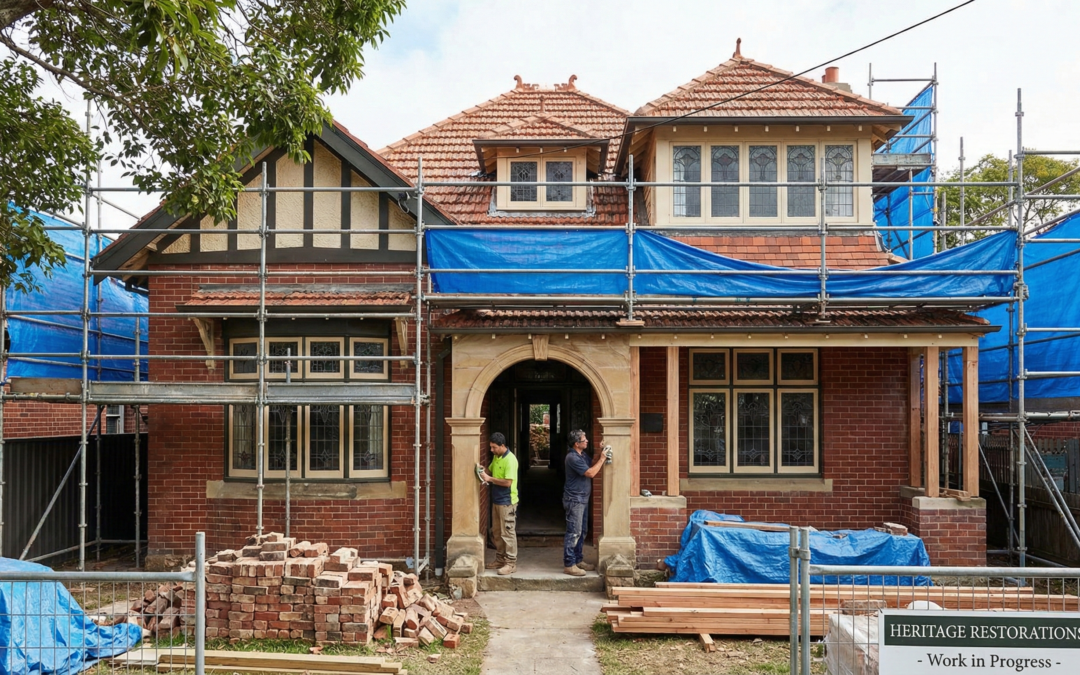
Restoring an old building requires careful planning, heritage compliance checks, structural assessments, and a realistic budget that typically ranges from $1,500 to $4,000+ per square metre depending on the building’s condition and heritage significance. Whether you’re preserving a Federation-era home, converting a heritage warehouse, or breathing new life into a neglected property, the restoration process demands a methodical approach that balances historical authenticity with modern functionality.
Old building restoration differs fundamentally from standard renovation. You’re working with aged materials, outdated construction methods, and often strict council regulations that dictate what you can and cannot change. Getting this wrong costs time, money, and potentially the building’s heritage value.
This guide walks you through every stage of restoring an old building—from initial feasibility assessment through to final completion—giving you the practical knowledge to approach your project with confidence.
What Is Building Restoration and Why Does It Matter?
Building restoration involves returning a structure to its original condition or a specific period in its history while addressing structural deficiencies and integrating essential modern systems. Unlike renovation, which modernises spaces according to current preferences, restoration prioritises historical accuracy and preservation of original features.
The distinction matters for several reasons. Heritage-listed properties in NSW operate under strict guidelines enforced by local councils and Heritage NSW. Unauthorised modifications can result in significant fines and mandatory reinstatement of original features at your expense. Beyond compliance, proper restoration maintains or increases property value—heritage properties in Sydney’s inner suburbs consistently command premium prices when original features remain intact.
Restoration also serves broader community interests. These buildings represent tangible connections to architectural history, construction craftsmanship, and cultural heritage that cannot be replicated. When you restore rather than demolish or inappropriately modify, you’re contributing to neighbourhood character and historical continuity.
How Do You Assess Whether an Old Building Can Be Restored?
Before committing funds to any restoration project, you need honest answers about the building’s condition and restoration viability. This assessment phase prevents costly surprises and helps you make informed decisions about proceeding.
Conducting a Preliminary Building Inspection
Start with a thorough visual inspection covering every accessible area. Look for obvious structural issues: cracks in walls (particularly diagonal cracks near windows and doors), sagging rooflines, uneven floors, and evidence of previous repairs. Document everything with photographs and notes.
Pay particular attention to moisture damage. Water is the primary enemy of old buildings. Check for staining on ceilings and walls, musty odours, peeling paint, and visible mould. Inspect the roof cavity for daylight penetration, water staining on timbers, and signs of pest activity. Examine subfloor areas for dampness, timber rot, and adequate ventilation.
Test windows and doors for operation. Binding or sticking often indicates structural movement. Check original hardware, glass condition, and frame integrity. These elements significantly impact restoration costs and heritage compliance requirements.
Engaging Professional Building Assessors
Visual inspections reveal surface issues, but professional assessments uncover hidden problems. Engage a structural engineer experienced with heritage buildings to evaluate load-bearing walls, foundation condition, and overall structural integrity. Their report identifies what requires immediate attention versus cosmetic concerns.
A heritage architect provides invaluable guidance on restoration approaches that satisfy both your goals and regulatory requirements. They understand period-appropriate materials, construction techniques, and design elements that maintain historical authenticity.
Building inspectors specialising in older properties can identify issues like asbestos-containing materials, lead paint, outdated electrical wiring, and non-compliant plumbing—all common in pre-1980s buildings. These findings directly impact your budget and project timeline.
Understanding Structural Integrity Requirements
Structural assessment determines whether restoration is economically viable. Minor foundation settling, localised timber damage, and surface cracking typically present manageable challenges. However, significant foundation failure, widespread structural timber decay, or major wall movement may indicate costs exceeding the building’s restored value.
Engineers assess load paths, connection points, and material condition. They identify whether existing structures can support intended uses or require reinforcement. For buildings being converted to different uses—residential to commercial, for example—structural requirements may change substantially.
The assessment should also address compliance with current building codes. While heritage exemptions exist for certain requirements, essential safety standards around fire egress, structural adequacy, and electrical safety generally apply regardless of heritage status.
What Permits and Approvals Do You Need for Building Restoration?
Navigating approval requirements represents one of restoration’s most complex aspects. Requirements vary based on heritage listing status, scope of work, and local council policies.
Heritage Listing and Its Implications
Heritage listing occurs at multiple levels: local council heritage schedules, State Heritage Register, and National Heritage List. Each level imposes different obligations and approval pathways.
Locally listed properties require council approval for most external changes and significant internal modifications. State-listed properties need approval from Heritage NSW for works affecting heritage significance. National listing adds Commonwealth oversight for certain activities.
Check your property’s listing status through your local council’s planning portal and the NSW Heritage Database. The listing documentation, particularly the Statement of Significance, identifies which elements hold heritage value and must be preserved. Understanding this document guides your restoration approach and approval strategy.
Council Development Applications
Most restoration projects require Development Application (DA) approval from your local council. The DA process assesses your proposal against planning controls, heritage provisions, and building regulations.
For heritage properties, councils typically require a Heritage Impact Statement prepared by a qualified heritage consultant. This document demonstrates how your proposal affects heritage significance and justifies any changes to significant fabric.
DA processing times vary considerably—from eight weeks for straightforward applications to six months or longer for complex heritage projects. Factor this timeline into your project planning. Pre-lodgement meetings with council planners can identify potential issues early and streamline the formal application process.
Building Permits and Compliance Certificates
Separate from planning approval, building work requires construction certificates or complying development certificates depending on the approval pathway. These certify that proposed construction complies with the Building Code of Australia and relevant Australian Standards.
Upon completion, an occupation certificate confirms the building is suitable for its intended use. For staged projects, interim occupation certificates allow partial occupancy while work continues elsewhere.
Engage a private certifier or council building surveyor early in your planning. They identify compliance requirements specific to your project and building type, preventing costly redesigns during construction.
How Do You Create a Restoration Plan and Budget?
Successful restoration requires detailed planning that accounts for the unique challenges of working with aged buildings. Generic renovation budgets consistently underestimate restoration costs.
Developing a Scope of Works
Your scope of works document defines exactly what the project includes. Start with the professional assessment reports and heritage documentation. List every element requiring attention, categorised by priority: structural repairs, weatherproofing, services upgrades, heritage restoration, and cosmetic finishes.
For each element, specify the intended approach. Will original windows be repaired or replaced with period-appropriate reproductions? Are you restoring original plasterwork or installing new finishes? These decisions affect both cost and heritage compliance.
Include provisional items for likely discoveries. Old buildings invariably reveal hidden issues once work begins—concealed timber damage, outdated wiring, or asbestos materials. Experienced restoration contractors expect scope variations; your budget should too.
Estimating Restoration Costs Accurately
Restoration costs typically exceed standard renovation costs by 20-50% due to specialised labour, heritage-appropriate materials, and the complexity of working with existing structures.
Structural repairs vary enormously based on extent. Minor foundation underpinning might cost $15,000-$30,000, while comprehensive structural remediation can exceed $150,000. Roof restoration—including timber repairs, re-slating or re-tiling, and flashing replacement—commonly ranges from $30,000 to $100,000 for heritage properties.
Heritage joinery restoration or reproduction commands premium pricing. Expect $2,000-$5,000 per window for proper restoration, or $3,000-$8,000 for custom reproduction windows matching original profiles. Original doors, architraves, and skirtings require similar investment when restoration rather than replacement is appropriate.
Services upgrades—electrical rewiring, plumbing replacement, and heating/cooling installation—typically cost $40,000-$80,000 for a standard heritage home, more for larger or more complex buildings.
Building Contingency Into Your Budget
Contingency allowances for restoration projects should exceed standard renovation contingencies. Where new construction might include 10% contingency, restoration projects warrant 15-25% depending on building condition and assessment thoroughness.
Contingency covers genuine unknowns: concealed damage revealed during demolition, additional heritage requirements identified during construction, material cost escalations, and scope additions necessary for proper completion. It does not cover scope creep or upgrades beyond the original plan.
Establish clear protocols for contingency use. Define who authorises expenditure, documentation requirements, and thresholds for project reassessment. Running out of contingency mid-project creates difficult decisions between compromised outcomes and budget overruns.
How Do You Find the Right Restoration Professionals?
Restoration projects demand specialised skills that general builders and tradespeople may lack. Assembling the right team significantly influences project outcomes.
Selecting Heritage-Experienced Contractors
Seek contractors with demonstrated heritage restoration experience. Request portfolios showing completed projects similar to yours in scale, era, and building type. Contact previous clients about their experience, particularly regarding budget management, communication, and problem-solving when issues arose.
Verify appropriate licensing and insurance. In NSW, builders must hold a contractor licence for work exceeding $5,000. Confirm current public liability and workers compensation insurance. For heritage projects, check whether contractors have completed heritage-specific training or hold relevant trade certifications.
Obtain detailed written quotes specifying inclusions, exclusions, provisional sums, and variation procedures. Vague quotes create disputes later. Compare quotes on scope alignment, not just price—the cheapest quote often excludes items others include.
Working With Heritage Architects and Consultants
Heritage architects bring specialised knowledge of historical construction methods, period-appropriate design, and regulatory navigation. Their involvement typically improves approval outcomes and ensures restoration authenticity.
For significant projects, architect involvement from concept through completion provides design continuity and quality oversight. For smaller projects, limited engagement for design documentation and periodic inspections may suffice.
Heritage consultants prepare required documentation including Heritage Impact Statements, Conservation Management Plans, and archival recordings. Their expertise in heritage policy and assessment methodology strengthens approval applications.
Coordinating Specialist Tradespeople
Restoration often requires tradespeople with skills uncommon in modern construction. Stonemasons, heritage plasterers, leadlight specialists, slate roofers, and traditional joiners command premium rates but deliver authentic results that general tradespeople cannot match.
Source specialists through heritage architect recommendations, industry associations like the Australian Institute of Building, or heritage contractor networks. Inspect their previous work in person where possible.
Coordinate specialist trades carefully within the project schedule. These tradespeople often have limited availability and longer lead times. Book early and build scheduling flexibility to accommodate their commitments.
What Are the Key Stages of the Restoration Process?
Restoration follows a logical sequence that protects the building during works and ensures each stage supports subsequent work.
Stabilisation and Protection Works
Before any restoration begins, stabilise the building and protect elements being retained. This includes temporary structural support where needed, weatherproofing compromised areas, and protecting original features from construction damage.
Install protective coverings over original floors, joinery, and decorative elements. Carefully remove and store items being retained but temporarily displaced—original hardware, light fittings, and architectural elements. Label and photograph everything for accurate reinstallation.
Address immediate water ingress to prevent ongoing damage during the project. Temporary roof repairs, drainage improvements, and moisture barriers protect the building while permanent solutions are implemented.
Structural Repairs and Remediation
Structural work proceeds before other restoration activities. Foundation repairs, wall stabilisation, timber replacement, and roof structure remediation establish the sound base that all other work depends upon.
Work methodically, addressing the most critical issues first. Document existing conditions before intervention—photographs, measurements, and material samples support heritage compliance and inform future maintenance.
Use appropriate materials and techniques. Modern materials sometimes conflict with traditional construction—cement renders on lime mortar walls, for example, trap moisture and accelerate deterioration. Heritage-experienced contractors understand compatible approaches.
Services Installation and Upgrades
Electrical, plumbing, and mechanical services installation follows structural completion. Route new services to minimise impact on heritage fabric. Concealed wiring through existing voids, surface-mounted conduit in utilitarian areas, and careful penetration planning preserve original materials.
Upgrade services to current standards while respecting the building’s character. Modern switchboards, safety switches, and compliant plumbing are non-negotiable, but their installation can be sensitively managed.
Consider energy efficiency within heritage constraints. Insulation, draught sealing, and efficient heating/cooling improve comfort and running costs. Many heritage authorities now support sympathetic sustainability upgrades that don’t compromise heritage values.
Heritage Feature Restoration
With structure and services complete, focus shifts to restoring heritage features. This painstaking work often defines the project’s success.
Original joinery restoration involves stripping accumulated paint layers, repairing damaged timber, replacing irreparable sections with matching material, and refinishing appropriately. Skilled craftspeople can achieve remarkable results with seemingly hopeless pieces.
Plaster restoration ranges from minor patching to complete ceiling reconstruction. Match original profiles, materials, and finishes. Decorative plasterwork—cornices, ceiling roses, and ornamental details—requires specialist skills for authentic restoration.
Original hardware, where retained, should be cleaned, repaired, and refitted. Missing hardware can be sourced from architectural salvage suppliers or reproduced by specialist manufacturers.
Final Finishes and Completion
Final stages bring the restoration together. Paint colours should reference historical palettes appropriate to the building’s era—heritage paint ranges offer period-accurate options. Surface preparation and application quality significantly affect longevity.
Flooring restoration or installation completes interior spaces. Original timber floors often respond well to sanding and finishing. Where replacement is necessary, match species, board widths, and installation patterns.
External works—landscaping, fencing, and outbuildings—should complement the restored building. Historical photographs and heritage guidelines inform appropriate approaches.
How Do You Maintain a Restored Building Long-Term?
Restoration represents significant investment. Proper maintenance protects that investment and prevents deterioration requiring future major works.
Establishing a Maintenance Schedule
Develop a cyclical maintenance program addressing all building elements. Annual inspections should check roof condition, drainage function, external paint condition, and subfloor ventilation. Five-yearly reviews assess more durable elements and plan medium-term maintenance.
Document maintenance activities and building condition over time. This record supports future planning, demonstrates responsible stewardship for heritage authorities, and provides valuable information for future owners.
Address issues promptly. Small problems become large problems when neglected. A minor roof leak left unattended causes timber rot, plaster damage, and potentially structural issues—far exceeding the cost of timely repair.
Understanding Heritage Maintenance Obligations
Heritage listing may impose ongoing maintenance obligations. Some listings require owners to maintain buildings in good condition and prevent deterioration of significant fabric. Failure to maintain can trigger enforcement action.
Maintenance of heritage buildings should follow conservation principles. Use compatible materials and techniques. Avoid interventions that cause irreversible change to significant fabric. When in doubt, seek heritage advice before proceeding.
Heritage authorities sometimes offer grants or incentives for maintenance of listed properties. Investigate available programs through Heritage NSW and your local council.
Conclusion
Restoring an old building demands patience, expertise, and realistic budgeting, but the rewards—both personal and financial—justify the effort. Success depends on thorough assessment, proper planning, heritage compliance, and engaging professionals who understand the unique requirements of working with aged structures.
At Sydney Home Renovation, we bring decades of experience to heritage and older building projects across Sydney. Our team understands the complexities of restoration work—from navigating council approvals to sourcing period-appropriate materials and delivering craftsmanship that honours a building’s history.
Contact us today to discuss your restoration project. We’ll provide honest assessment, transparent pricing, and the expertise needed to bring your old building back to life while protecting your investment for generations to come.
Frequently Asked Questions
How much does it cost to restore an old building in Sydney?
Restoration costs typically range from $1,500 to $4,000+ per square metre depending on building condition, heritage requirements, and finish quality. A modest heritage cottage restoration might cost $200,000-$400,000, while substantial heritage properties can exceed $1 million. Professional assessment provides accurate estimates for your specific building.
How long does a building restoration project take?
Most residential restoration projects take 6-18 months from approval to completion. Complex heritage projects or larger buildings may extend to 2-3 years. Approval processes add 3-6 months before construction begins. Realistic scheduling accounts for specialist trade availability and the slower pace of heritage-sensitive work.
Do I need council approval to restore a heritage-listed building?
Yes, most restoration work on heritage-listed properties requires council approval through the Development Application process. Even seemingly minor changes may need approval if they affect heritage significance. Pre-lodgement consultation with council planners clarifies requirements for your specific proposal.
Can I make modern additions to a restored old building?
Modern additions are often possible but must be designed sensitively. Heritage authorities generally support additions that are distinguishable from original fabric, reversible where practical, and subordinate to the heritage building. A heritage architect can design additions that satisfy both your needs and approval requirements.
What happens if I find asbestos during restoration?
Asbestos discovery is common in pre-1990 buildings. Licensed asbestos assessors identify materials and recommend management approaches. Removal must be conducted by licensed removalists following strict safety protocols. Budget provisional allowances for asbestos management in any older building project.
Should I restore original features or install reproductions?
Restoration of original features is generally preferred where feasible, as it maintains authenticity and heritage value. However, reproduction is appropriate when originals are beyond repair or missing entirely. Quality reproductions matching original profiles, materials, and construction methods satisfy most heritage requirements.
How do I find tradespeople experienced in heritage restoration?
Seek recommendations from heritage architects, local heritage societies, and completed project references. Industry bodies like Master Builders Association maintain specialist registers. Inspect previous work, verify licensing and insurance, and confirm understanding of heritage-sensitive approaches before engagement.