
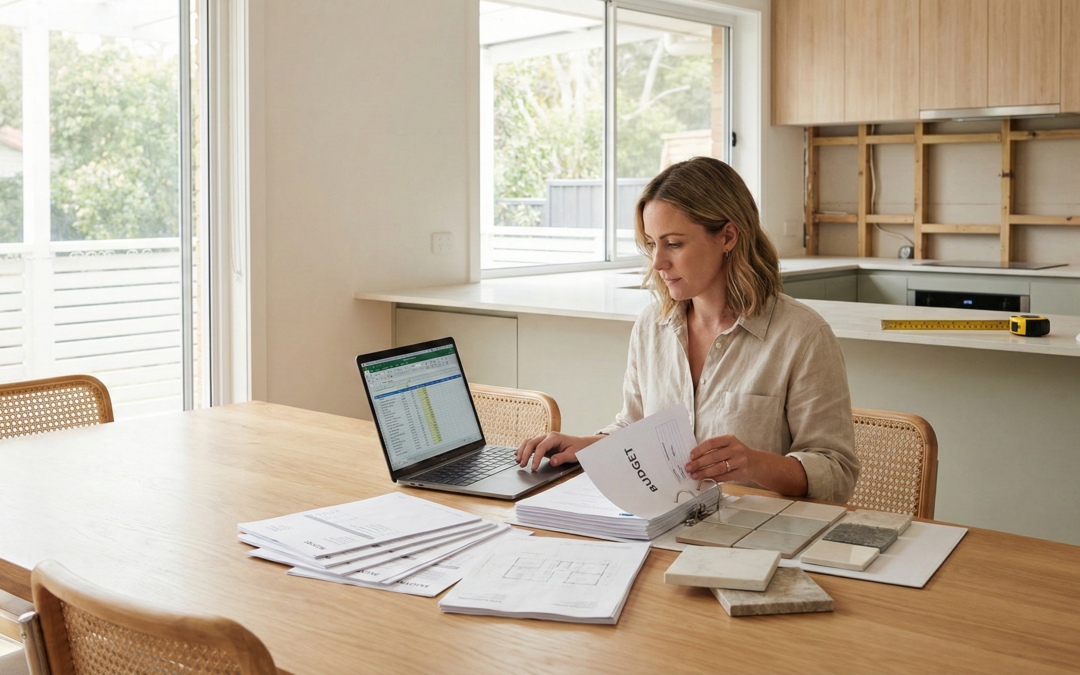
Most homeowners should set aside 10-15% of their property’s value for a comprehensive renovation, with an additional 15-20% contingency buffer for unexpected costs. For a Sydney property valued at $1.5 million, this translates to $150,000-$225,000 in renovation funds, plus $22,500-$45,000 held in reserve.
Understanding your true renovation budget prevents the financial stress that derails countless projects mid-construction. Without proper planning, you risk cost blowouts, compromised finishes, or worse—an incomplete renovation that diminishes your property’s value rather than enhancing it.
This guide breaks down exactly how to calculate your renovation budget, what costs to anticipate across different project types, where hidden expenses lurk, and how to structure your finances for a successful outcome. Whether you’re updating a single bathroom or undertaking a whole-home transformation, you’ll leave with a clear financial roadmap.
Understanding Renovation Budget Fundamentals
Setting aside money for renovation requires understanding the relationship between project scope, property value, and realistic cost expectations. The renovation industry operates on established pricing structures that vary significantly based on location, quality tier, and complexity.
The Property Value Percentage Method
Financial advisors and renovation experts consistently recommend budgeting based on your property’s current market value. This approach ensures your renovation investment remains proportionate to potential returns.
For minor cosmetic updates—painting, flooring, and fixture replacements—budget 5-10% of property value. Mid-range renovations involving kitchen or bathroom overhauls typically require 10-15%. Major structural renovations, extensions, or whole-home transformations demand 15-25% or more.
A $1 million Sydney home undergoing a mid-range renovation should anticipate $100,000-$150,000 in total costs. This percentage method prevents over-capitalisation while ensuring sufficient funds for quality outcomes.
Cost Per Square Metre Calculations
Australian renovation costs range from $500-$5,000+ per square metre depending on finish quality and structural complexity. Basic cosmetic renovations average $500-$1,000 per square metre. Standard renovations with moderate upgrades fall between $1,000-$2,500. High-end renovations featuring premium materials and custom work exceed $2,500-$5,000 per square metre.
A 150-square-metre home renovation at standard quality would require $150,000-$375,000. These figures provide baseline expectations before detailed quoting begins.
Breaking Down Renovation Costs by Project Type
Different renovation projects carry distinct cost profiles. Understanding these breakdowns helps you allocate funds appropriately across your specific scope.
Bathroom Renovation Budget Requirements
Bathroom renovations in Sydney range from $15,000 for basic updates to $50,000+ for luxury transformations. The average mid-range bathroom renovation costs $25,000-$35,000.
Labour typically consumes 40-50% of bathroom budgets, covering demolition, plumbing, electrical, waterproofing, tiling, and installation. Materials—tiles, fixtures, vanities, tapware—account for 35-45%. Contingency should represent 10-20% of the total bathroom budget.
For a $30,000 bathroom renovation, expect approximately $12,000-$15,000 in labour, $10,500-$13,500 in materials, and $3,000-$6,000 in contingency reserves.
Kitchen Renovation Financial Planning
Kitchen renovations represent the largest single-room investment, ranging from $20,000 for budget updates to $80,000+ for premium transformations. Sydney’s average kitchen renovation costs $35,000-$55,000.
Cabinetry consumes 30-40% of kitchen budgets. Appliances require 15-25%. Benchtops, including installation, account for 10-15%. Labour for plumbing, electrical, and installation represents 25-35%.
Whole-Home Renovation Budgets
Complete home renovations in Sydney typically cost $150,000-$500,000+ depending on property size and scope. Structural modifications, including wall removal, extensions, or level additions, significantly increase costs.
Budget allocation for whole-home projects should follow: 25-30% for wet areas (bathrooms, kitchen, laundry), 20-25% for living spaces, 15-20% for bedrooms, 10-15% for structural work, and 15-20% for contingency.
The Critical Contingency Fund
Every renovation budget must include contingency funds. This isn’t optional—it’s essential financial protection against inevitable surprises.
Why Contingency Matters
Renovation projects consistently encounter unforeseen issues. Older Sydney homes frequently reveal asbestos, outdated wiring, plumbing failures, structural deficiencies, or water damage once walls open. These discoveries require immediate attention and additional funds.
Without contingency reserves, you face difficult choices: compromise on finishes, halt work mid-project, or take on unexpected debt. None of these outcomes serves your interests.
Calculating Your Contingency Amount
Standard renovations require 10-15% contingency. Older properties (pre-1980s) warrant 15-20%. Heritage homes or properties with unknown histories should carry 20-25% contingency.
For a $100,000 renovation of a 1970s Sydney home, set aside $15,000-$20,000 specifically for unexpected costs. This money remains untouched unless genuine surprises emerge—it’s not a buffer for scope creep or upgrade decisions.
Managing Contingency Funds
Keep contingency funds in a separate, accessible account. Document every contingency expenditure with photos and invoices. If contingency remains unspent, consider it a bonus for post-renovation furnishing or future maintenance—not an invitation to expand scope mid-project.
Hidden Costs That Blow Renovation Budgets
Beyond obvious construction costs, numerous hidden expenses catch unprepared homeowners off-guard. Anticipating these costs prevents budget shortfalls.
Council and Compliance Costs
Development applications in Sydney range from $500-$5,000+ depending on project scope. Building permits add $1,000-$3,000. Certification and inspections throughout construction cost $2,000-$5,000. Some projects require engineering reports ($1,500-$4,000), surveyor assessments ($500-$2,000), or heritage consultations ($2,000-$10,000).
Temporary Living Arrangements
Major renovations often require vacating your home. Rental accommodation for 8-16 weeks costs $4,000-$12,000+. Storage for furniture and belongings adds $200-$500 monthly. These costs rarely appear in initial renovation quotes but significantly impact total expenditure.
Utility Connections and Upgrades
Older homes frequently require electrical switchboard upgrades ($2,000-$5,000) to support modern appliances and lighting. Gas line modifications cost $500-$2,000. Water meter upgrades or pressure improvements add $500-$1,500. These infrastructure costs often emerge during construction.
Landscaping and External Works
Interior renovations frequently necessitate external repairs. Driveway damage from construction vehicles requires remediation ($1,000-$5,000). Garden restoration after material storage costs $500-$3,000. Fencing repairs or replacements add $1,000-$5,000.
Professional Fees
Architectural design services range from $5,000-$30,000+ depending on complexity. Interior designers charge $2,000-$15,000. Project management fees add 10-15% to construction costs. While optional, these professionals often save money through better planning and contractor management.
Creating Your Renovation Budget Framework
A structured approach to renovation budgeting prevents financial stress and ensures project completion.
Step One: Define Your Maximum Investment
Determine the absolute maximum you can invest without financial strain. Consider savings, available equity, and borrowing capacity. Your renovation budget should never exceed comfortable repayment abilities or emergency fund depletion.
Step Two: Obtain Multiple Detailed Quotes
Request itemised quotes from at least three reputable contractors. Compare line-by-line rather than total figures. Understand what’s included and excluded in each quote. The lowest quote often excludes items others include—true comparison requires detailed analysis.
Step Three: Build Your Budget Spreadsheet
Create categories for every anticipated expense: demolition, structural work, plumbing, electrical, materials, fixtures, labour, permits, professional fees, temporary accommodation, and contingency. Assign realistic figures based on quotes and research.
Step Four: Prioritise and Phase If Necessary
If your ideal renovation exceeds available funds, prioritise ruthlessly. Essential structural and safety work comes first. High-impact visible improvements follow. Cosmetic upgrades can often wait for future phases.
Phased renovations allow quality outcomes within budget constraints. Complete the bathroom this year; tackle the kitchen next year. This approach prevents debt accumulation while achieving long-term goals.
Financing Your Renovation
Understanding financing options helps structure your renovation fund appropriately.
Cash Savings
Paying cash eliminates interest costs and provides negotiating leverage with contractors. However, depleting emergency funds creates financial vulnerability. Maintain 3-6 months of living expenses separate from renovation funds.
Home Equity Loans
Accessing home equity provides substantial renovation funds at relatively low interest rates. Loan-to-value ratios typically allow borrowing up to 80% of property value minus existing mortgage. A $1.5 million property with $800,000 mortgage could access up to $400,000 in equity.
Construction Loans
Purpose-built construction loans release funds in stages as work progresses. This structure protects against contractor default and ensures money flows appropriately throughout the project.
Personal Loans
Unsecured personal loans suit smaller renovations under $50,000. Higher interest rates make them less suitable for major projects, but faster approval and no property security requirements offer advantages for time-sensitive work.
Maximising Return on Renovation Investment
Strategic budget allocation maximises both lifestyle benefits and property value increases.
High-ROI Renovation Priorities
Bathroom renovations typically return 60-80% of investment at sale. Kitchen updates return 50-75%. Additional living space through extensions returns 50-70%. Street appeal improvements return 100%+ through increased buyer interest.
Avoiding Over-Capitalisation
Research comparable sales in your suburb before finalising renovation scope. Your renovated property should align with neighbourhood values. A $200,000 renovation on a $800,000 property in a $900,000 suburb risks over-capitalisation—you won’t recover the full investment at sale.
Quality Over Quantity
Fewer high-quality improvements outperform numerous budget upgrades. One beautifully renovated bathroom creates more value than three cheaply updated bathrooms. Allocate budget toward quality materials and skilled tradespeople rather than expanding scope with inferior finishes.
Conclusion
Setting aside money for renovation requires honest assessment of your project scope, property value, and financial capacity. The 10-15% property value guideline provides a starting framework, while detailed quoting and comprehensive contingency planning ensure realistic budgeting.
At Sydney Home Renovation, we help homeowners navigate renovation budgeting with transparent pricing, detailed cost breakdowns, and honest advice about what’s achievable within your financial parameters. Our experience across hundreds of Sydney renovations means accurate estimates and minimal surprises.
Contact our team for a comprehensive consultation and detailed quote tailored to your specific renovation goals. We’ll help you understand exactly how much to set aside and create a realistic plan for achieving your dream home within budget.
Frequently Asked Questions
What percentage of home value should I spend on renovation?
Most experts recommend spending 10-15% of your property’s value on comprehensive renovations. Minor updates require 5-10%, while major structural work may warrant 15-25%. This percentage approach ensures proportionate investment relative to potential returns.
How much contingency should I include in my renovation budget?
Include 10-15% contingency for standard renovations and 15-25% for older properties or complex projects. This reserve covers unexpected discoveries like asbestos, outdated wiring, or structural issues that commonly emerge once construction begins.
What are the biggest hidden costs in home renovation?
Hidden costs include council permits and approvals ($2,000-$10,000), temporary accommodation during construction ($4,000-$12,000), electrical upgrades ($2,000-$5,000), and landscaping restoration ($1,000-$5,000). Professional fees for architects and project managers add 10-20% to construction costs.
Should I renovate all at once or in phases?
Phasing renovations suits budget-conscious homeowners, allowing quality outcomes without excessive debt. However, whole-home renovations offer economies of scale and single disruption periods. Choose based on financial capacity and tolerance for living through construction.
How do I avoid going over budget on renovation?
Obtain detailed itemised quotes, include adequate contingency, resist scope creep during construction, and maintain clear communication with your contractor. Fixed-price contracts provide budget certainty, though they may cost slightly more than cost-plus arrangements.
What renovation projects offer the best return on investment?
Bathroom renovations return 60-80% of investment, kitchen updates return 50-75%, and street appeal improvements often return 100%+. Focus on high-impact areas that buyers prioritise rather than personal preferences that may not translate to market value.
How long should I save before starting a renovation?
Save until you have the full renovation budget plus contingency available. Starting with insufficient funds risks incomplete projects or compromised quality. Most homeowners save for 12-24 months before major renovations, though home equity access can accelerate timelines.