A well-planned home extension in Sydney can add between 10% and 25% to your property’s value while solving the space problems that make daily life frustrating. Getting the planning and design phase right is the single biggest factor in whether your project stays on budget or spirals into costly surprises.
For homeowners, first-time renovators, and property investors across Sydney, understanding how extensions work from concept through to council approval is essential before committing any money.
This guide covers every stage of extension planning and design, from choosing the right extension type and setting a realistic budget to navigating NSW council regulations and selecting a builder you can trust.
What Is Extension Planning and Design
Extension planning and design is the structured process of expanding your home’s liveable floor area through architectural design, regulatory compliance, budgeting, and construction coordination. It covers everything from the initial concept sketches and feasibility assessments through to detailed construction drawings, council submissions, and builder engagement.
Unlike a cosmetic renovation that updates surfaces and fittings within existing walls, an extension changes the physical footprint or volume of your home. That distinction matters because it triggers a different set of approvals, structural requirements, and cost considerations.
Defining a Home Extension vs. a Renovation
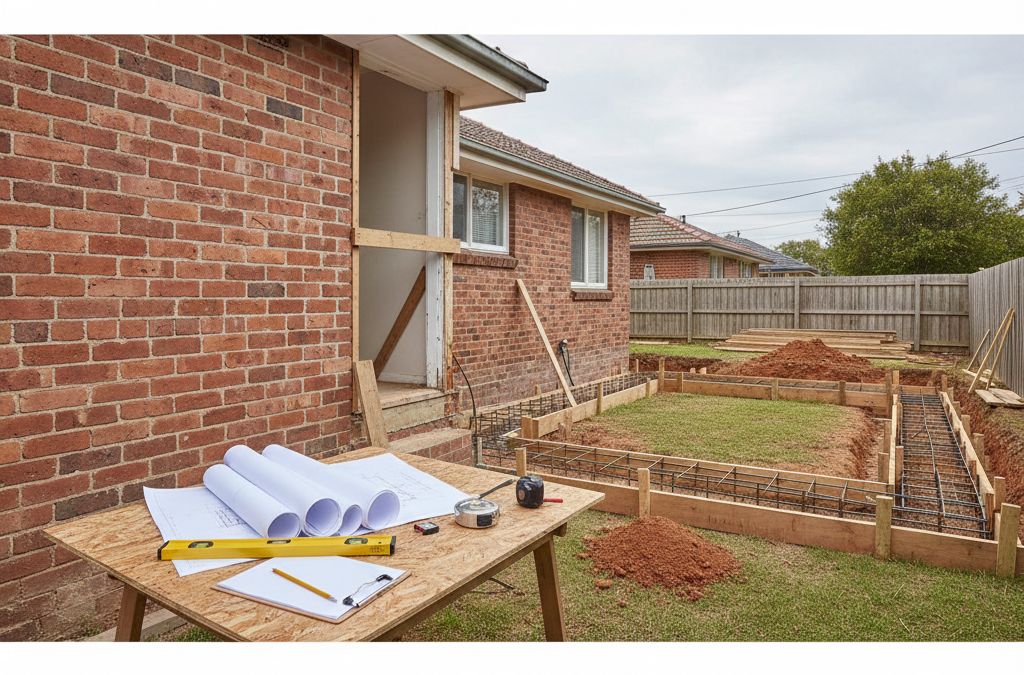
A home extension adds new floor space to your property. This could mean building outward at ground level, adding a second storey, or converting an attached structure like a garage into habitable rooms. The key characteristic is that you are creating space that did not previously exist.
A renovation, by contrast, works within the existing building envelope. Bathroom upgrades, kitchen remodels, and internal reconfigurations are renovations. They may require building permits, but they rarely involve the structural engineering, foundation work, or council development applications that extensions demand.
Understanding this difference early prevents budget confusion. Extensions carry higher base costs because they involve excavation, footings, structural steel, external cladding, roofing, and weatherproofing before any internal fit-out begins.
Why Sydney Homeowners Choose to Extend
Sydney’s property market makes extending an existing home financially attractive compared to selling and buying a larger property. Stamp duty alone on a Sydney house purchase can exceed $40,000 to $60,000, and that money delivers zero additional living space. An extension puts every dollar into your home.
The most common reasons Sydney homeowners extend include growing families needing extra bedrooms, outdated floor plans that waste space, the desire for open-plan living connected to outdoor areas, and the need for a dedicated home office or secondary dwelling for rental income.
For property investors, a well-designed extension can shift a property into a higher rental bracket or create a dual-income opportunity through a granny flat or secondary dwelling.
Types of Home Extensions in Sydney
Choosing the right extension type depends on your block size, existing floor plan, council zoning, budget, and what you need the new space to achieve. Each type carries different cost profiles, approval pathways, and design considerations.
Single-Storey Rear and Side Extensions
Rear extensions are the most common type across Sydney’s inner west, eastern suburbs, and northern suburbs. They typically push the living areas toward the back of the block, creating larger kitchens, open-plan living and dining spaces, or additional bedrooms at ground level.
Side extensions use the space between your home and the side boundary. These work well on wider blocks but require careful attention to setback rules, which vary by council area. In many Sydney local government areas, a minimum 900mm side setback applies, though some zones require more.
Single-storey extensions are generally the most cost-effective option because they avoid the structural complexity of building upward. They also cause less disruption during construction, and in many cases, you can continue living in the home while work progresses.
Second-Storey Additions
Adding a second storey is the go-to solution when your block is too small for a ground-level extension or when you want to preserve outdoor space. Second-storey additions are particularly popular across Sydney’s northern beaches, lower north shore, and inner west, where land values are high and blocks are compact.
The structural requirements are significant. Your existing foundations and load-bearing walls must support the additional weight, which often means underpinning or reinforcing the ground floor structure before any new construction begins. This adds cost and time but delivers a dramatic increase in liveable area without sacrificing your yard.
Second-storey additions also trigger height limit considerations. Most residential zones in Sydney cap building height at 8.5 to 9.5 metres, and your design must account for the existing ground floor height plus the new level, roof pitch, and any site slope.
Wraparound and Multi-Directional Extensions
Wraparound extensions combine rear and side additions into a single project. They are ideal for corner blocks or properties where a single-direction extension cannot deliver enough space. The design wraps new rooms around the existing structure, often creating an L-shaped or U-shaped floor plan.
These projects are more complex to design and build because they involve multiple external walls, additional roofing junctions, and more intricate structural connections. However, they can transform a small, compartmentalised home into a spacious, flowing layout in a single construction phase.
Garage and Granny Flat Conversions
Converting an existing garage or outbuilding into habitable space is a cost-effective alternative to a full extension. Because the external shell already exists, you save on foundations, framing, cladding, and roofing. The main costs involve insulation, internal lining, flooring, plumbing, electrical, and ensuring the space meets the Building Code of Australia for habitable rooms.
Granny flat construction, whether as a conversion or a new build, is governed by the State Environmental Planning Policy (Affordable Rental Housing) in NSW. Properties in certain zones with a minimum lot size of 450 square metres can build a secondary dwelling of up to 60 square metres without a full development application, using a complying development certificate instead.
How to Plan a Home Extension Step by Step
Successful extension projects follow a clear sequence. Skipping steps or rushing through the planning phase is the most common cause of budget blowouts and design regret.
Assessing Your Needs and Setting Priorities
Start by listing exactly what you need the extension to achieve. Be specific. “More space” is not a brief. “A fourth bedroom with built-in wardrobe, an ensuite, and a separate home office” is a brief your designer can work with.
Rank your priorities. If budget constraints force compromises, you need to know in advance whether the extra bathroom matters more than the larger kitchen or whether the home office can share space with a guest bedroom. This ranking directly shapes the design and prevents expensive mid-project changes.
Walk through your current home and identify what works and what does not. Note traffic flow problems, rooms that are too dark, storage shortfalls, and areas where the connection between indoor and outdoor spaces fails. These observations become design inputs.
Setting a Realistic Extension Budget
Your extension budget must account for far more than construction costs. A realistic budget includes design fees, engineering reports, survey costs, council application fees, construction, landscaping, and a contingency margin.
As a starting framework for Sydney in 2024 and 2025, expect to allocate roughly 8% to 12% of total project cost to professional fees (architect, engineer, surveyor, certifier), 75% to 85% to construction, and 10% to 15% to contingency and ancillary costs.
Get preliminary cost estimates before finalising your design. There is no value in designing a $400,000 extension when your budget is $250,000. A good designer will work within your budget parameters from the outset, not present a dream scheme and then value-engineer it down.
Choosing the Right Designer or Architect
For straightforward single-storey extensions, a building designer or draftsperson may be sufficient. For complex projects involving second storeys, heritage considerations, or challenging sites, a registered architect brings deeper design expertise and problem-solving capability.
Check that your designer has experience with residential extensions in your specific council area. Local experience matters because each Sydney council interprets planning controls slightly differently, and a designer who knows the local assessment officers and their expectations can save weeks on the approval process.
Review their portfolio for projects similar in scale and style to yours. Ask for references from past clients and follow up on them. The design phase sets the trajectory for your entire project, so investing in the right professional here pays dividends throughout construction.
Creating a Project Timeline
A realistic timeline for a Sydney home extension typically spans 8 to 14 months from initial design through to construction completion. The breakdown generally looks like this: design development takes 4 to 8 weeks, council approval takes 6 to 12 weeks for a DA or 2 to 4 weeks for a CDC, construction documentation takes 2 to 4 weeks, builder tendering and selection takes 2 to 4 weeks, and construction takes 12 to 24 weeks depending on scope.
Build buffer time into every phase. Council assessments can be delayed by requests for additional information. Builder availability fluctuates with market demand. Weather affects construction schedules, particularly for second-storey additions and roofing work.
Document your timeline in writing and share it with every professional involved. When everyone works from the same schedule, delays are identified and managed early rather than compounding silently.
Extension Design Principles That Add Long-Term Value
Good extension design does more than add square metres. It improves how your entire home functions, increases natural light, strengthens the connection between indoor and outdoor living, and ensures the new space feels like it belongs with the original building.
Matching the Extension to Your Existing Home
The most successful extensions look like they were always part of the house. This does not mean the extension must be an exact replica of the original architecture. It means the proportions, materials, roofline, and detailing should create a coherent whole.
For Federation and Californian bungalow homes common across Sydney’s inner suburbs, this often means maintaining the original front facade and period features while introducing a contemporary rear extension. The transition between old and new can be handled through a glass link, a change in ceiling height, or a material shift that acknowledges the different eras.
For post-war and mid-century homes, the design language is often simpler, and a seamless material match is more achievable. Brick extensions on brick homes, rendered additions on rendered homes, and consistent window proportions all contribute to visual cohesion.
Maximising Natural Light and Ventilation
Dark, poorly ventilated extensions are the hallmark of bad design. In Sydney’s climate, natural light and cross-ventilation are not luxuries. They reduce energy costs, improve comfort, and directly affect how much you enjoy the space.
Design strategies include north-facing glazing for passive solar gain in winter, highlight windows and clerestory glazing to bring light deep into floor plans, operable louvres and windows on opposite walls for cross-ventilation, and skylights in areas where wall windows are not possible.
The Building Code of Australia requires habitable rooms to have a minimum glazed area equal to 10% of the floor area and a minimum openable area for ventilation equal to 5% of the floor area. Good design exceeds these minimums significantly.
Open-Plan Layouts vs. Defined Rooms
Open-plan living remains the dominant preference for Sydney home extensions, particularly for kitchen, dining, and living areas that connect to an outdoor deck or courtyard. The appeal is clear: open plans feel larger, facilitate family interaction, and create flexible entertaining spaces.
However, the pandemic-era shift toward working from home has renewed demand for defined rooms. Home offices, study nooks, and media rooms that can be closed off from household noise are now high-priority inclusions in extension briefs.
The best designs balance both. A large open-plan living zone anchors the extension, while strategically placed sliding doors, pocket doors, or glazed partitions allow sections to be closed off when privacy or quiet is needed.
Future-Proofing Your Floor Plan
Design for how you will live in five to ten years, not just how you live today. If your children are young, they will eventually need separate bedrooms and study spaces. If you plan to age in place, consider ground-floor bedroom and bathroom access, wider doorways, and step-free thresholds now rather than retrofitting later.
Structural future-proofing is equally important. If there is any possibility you might add a second storey in the future, designing the ground-floor extension with foundations and framing capable of supporting an upper level costs relatively little now but saves enormously later.
Pre-wiring for technology, roughing in plumbing for a future bathroom, and designing roof structures that can accommodate solar panels are all low-cost inclusions during construction that become expensive retrofits after the fact.
Sydney Council Approvals and Regulations
Every home extension in Sydney requires some form of approval before construction begins. The type of approval depends on the scale of the project, your property’s zoning, and whether the design complies with specific development standards.
When You Need a Development Application (DA)
A development application is required when your extension does not meet the criteria for complying development. This includes projects that exceed height or floor space ratio limits, encroach on setback requirements, affect heritage-listed properties or conservation areas, or involve significant tree removal.
DAs are assessed by your local council. The process involves lodging architectural drawings, a statement of environmental effects, and various supporting reports. Council notifies adjoining neighbours, who can make submissions. An assessment officer evaluates the proposal against the Local Environmental Plan and Development Control Plan before making a determination.
DA processing times in Sydney vary significantly by council. Simple residential DAs may be determined in 6 to 8 weeks, while complex applications or those attracting neighbour objections can take 12 weeks or longer. Some councils offer pre-DA meetings where you can discuss your proposal informally before lodging, which can identify potential issues early and reduce assessment time.
Complying Development Certificates Explained
A complying development certificate (CDC) is a faster, more streamlined approval pathway available for extensions that meet all the prescribed standards in the State Environmental Planning Policy (Exempt and Complying Development Codes) 2008, commonly known as the Codes SEPP.
CDCs are issued by accredited private certifiers or council, typically within 10 to 20 business days. There is no neighbour notification requirement, and the assessment is a straightforward compliance check against numerical standards rather than a merit-based evaluation.
To qualify for a CDC, your extension must comply with specific setback distances, height limits, floor space ratios, landscaped area requirements, and other measurable criteria. Properties in heritage conservation areas, on flood-prone land, or in certain bushfire zones are generally excluded from the CDC pathway.
Setback Rules, Floor Space Ratios, and Height Limits
Setback rules dictate how close your extension can be built to each property boundary. Front setbacks are typically the most restrictive and are often determined by the existing building line of neighbouring properties. Side setbacks commonly range from 900mm to 1.5 metres depending on wall height and your council’s Development Control Plan. Rear setbacks vary but generally require a minimum percentage of the site to remain as landscaped open space.
Floor space ratio (FSR) controls the total amount of built floor area relative to your land area. If your property has an FSR of 0.5:1 and your land is 500 square metres, the maximum total floor area is 250 square metres. Your existing home’s floor area counts toward this limit, so the available extension size is the difference between the FSR cap and your current floor area.
Height limits in residential zones across Sydney typically range from 8.5 to 9.5 metres, measured from natural ground level to the highest point of the roof. On sloping sites, this measurement can significantly constrain second-storey additions on the high side of the block.
Working With Private Certifiers in NSW
Private certifiers, formally known as registered certifiers under the Building and Development Certifiers Act 2018, perform two key roles in the extension process. They can issue complying development certificates as an alternative to council, and they act as the principal certifying authority during construction, conducting inspections at critical stages and issuing the final occupation certificate.
Choosing a certifier early in the process is advisable. A good certifier can review your preliminary plans and advise whether the CDC pathway is achievable or whether a DA is necessary. This assessment can save weeks of wasted design time if the project is heading down the wrong approval path.
Certifier fees for residential extensions in Sydney typically range from $3,000 to $6,000 depending on project complexity and the number of inspections required. This is a mandatory cost regardless of whether you use a private certifier or council for the role.
Extension Costs and Budgeting in Sydney
Understanding extension costs in Sydney requires looking beyond headline per-square-metre figures. The true cost of your project depends on the extension type, site conditions, design complexity, material selections, and the current state of the construction market.
Average Cost Per Square Metre for Extensions
As a general guide for Sydney in 2024 and 2025, single-storey ground-floor extensions typically cost between $3,000 and $5,500 per square metre for a mid-range finish. Second-storey additions range from $4,000 to $7,000 per square metre because of the additional structural work, scaffolding, and temporary weatherproofing required.
These figures include construction costs but generally exclude professional fees, council charges, and landscaping. A 40-square-metre single-storey rear extension at a mid-range specification might cost $160,000 to $220,000 for construction alone, with total project costs reaching $190,000 to $260,000 once all fees and ancillary costs are included.
High-end extensions with premium finishes, custom joinery, stone benchtops, and architectural detailing can push costs above $7,000 per square metre for single-storey and above $9,000 per square metre for second-storey work.
Labour, Materials, and Structural Cost Breakdowns
Labour typically represents 40% to 50% of total construction costs for a residential extension in Sydney. This includes carpenters, bricklayers, concreters, plumbers, electricians, plasterers, tilers, painters, and the builder’s project management and supervision.
Materials account for 35% to 45% of construction costs. Structural materials like concrete, steel, and timber framing are relatively fixed in cost and difficult to economise on without compromising the building. The biggest material cost variables are in finishes: flooring, cabinetry, benchtops, tapware, tiles, and lighting. This is where budget-conscious homeowners have the most control.
Structural costs, including excavation, footings, slab or subfloor framing, and any underpinning or reinforcement of existing structures, typically represent 15% to 25% of total construction cost. On difficult sites with rock, high water tables, or significant slope, structural costs can exceed this range substantially.
Hidden Costs and Budget Contingencies
Hidden costs catch unprepared homeowners every time. The most common include asbestos removal in pre-1990 homes, which can cost $5,000 to $15,000 or more depending on extent. Stormwater drainage upgrades required by council, unexpected rock excavation, termite damage discovered during demolition, and temporary accommodation if the home becomes unliveable during construction are all frequent budget surprises.
Council contribution levies, known as Section 7.12 contributions, apply to most DAs and are typically calculated as a percentage of the project’s construction cost, commonly 1% for projects over $100,000.
A contingency allowance of 10% to 15% of total project cost is not optional. It is a fundamental part of responsible budgeting. Projects that proceed without contingency funding are the ones that stall mid-construction when an unexpected cost arises and there is no money to cover it.
How to Prioritise Spending for Maximum ROI
Not all extension spending delivers equal returns. Prioritise structural quality and weatherproofing above all else. A beautifully finished extension built on inadequate foundations or with poor waterproofing will cost far more to rectify than it cost to build correctly in the first place.
After structural integrity, invest in the spaces that drive property value and daily liveability. Kitchens and bathrooms consistently deliver the highest return on investment. Open-plan living areas connected to outdoor entertaining spaces are the next priority for Sydney properties.
Where budget is tight, choose quality construction with modest finishes over cheap construction with premium finishes. You can upgrade tapware, lighting, and surface materials over time. You cannot cost-effectively upgrade framing, insulation, waterproofing, or structural connections after the walls are closed.
Choosing the Right Builder for Your Extension
Your builder selection is the single most consequential decision after the design itself. The right builder delivers your project on time, on budget, and to the quality standard shown in the drawings. The wrong builder creates stress, cost overruns, and defects that can take years to resolve.
What to Look for in a Sydney Extension Builder
Verify that the builder holds a current NSW contractor licence appropriate for the value of your project. Builders undertaking residential work over $5,000 in NSW must be licensed through NSW Fair Trading. Check the licence online and confirm it covers the category of work your extension requires.
Look for demonstrated experience with residential extensions specifically, not just new home construction or commercial fit-outs. Extension work requires a different skill set because the builder must integrate new construction with an existing structure, manage the complexities of working on an occupied site, and coordinate trades in constrained spaces.
Request references from at least three recent extension projects of similar scale. Visit a completed project if possible. Speak to past clients about communication, problem-solving, adherence to budget, and how defects were handled during the defects liability period.
Fixed-Price Contracts vs. Cost-Plus Agreements
A fixed-price contract, also called a lump sum contract, sets a total price for the defined scope of work. The builder carries the risk of cost increases within that scope. This gives you budget certainty, which is why fixed-price contracts are the preferred option for most homeowner-funded extensions.
A cost-plus contract charges you the actual cost of labour and materials plus a builder’s margin, typically 15% to 25%. This arrangement offers flexibility for projects where the scope is difficult to define precisely upfront, but it transfers cost risk to you. Without a guaranteed maximum price clause, cost-plus contracts can exceed initial estimates significantly.
For most Sydney home extensions where the design is complete and the scope is well-defined, a fixed-price contract based on detailed construction drawings and a comprehensive specification provides the best balance of certainty and fairness for both parties.
Questions to Ask Before Signing a Contract
Before committing to a builder, clarify these critical points in writing. What is included in the contract price and what is excluded? How are variations (changes to scope) priced and approved? What is the estimated construction timeline, and are there liquidated damages for delays? What is the payment schedule, and does it align with the progress of work?
Ask about the builder’s insurance coverage, including home warranty insurance (mandatory in NSW for residential work over $20,000), public liability, and workers compensation. Request copies of certificates, not just verbal assurances.
Confirm who will be the site supervisor and how often they will be on site. Understand the communication process for day-to-day decisions and how issues will be escalated and resolved. A clear communication framework prevents the misunderstandings that cause most builder-client disputes.
Common Extension Planning Mistakes to Avoid
Learning from other homeowners’ mistakes is far cheaper than making your own. These are the errors that consistently cause the most damage to budgets, timelines, and outcomes.
Underestimating Structural and Site Costs
The most expensive surprises in extension projects come from below ground. Rock excavation, poor soil conditions requiring engineered footings, high water tables needing dewatering, and existing services (sewer, stormwater, gas, electrical) that must be relocated can each add $10,000 to $30,000 or more to your project.
Invest in a geotechnical report and a detailed site survey before finalising your design. These reports cost $2,000 to $4,000 combined but can prevent $20,000 or more in unexpected construction costs. They also give your structural engineer the data needed to design efficient, cost-effective foundations.
Skipping Professional Design Input
Attempting to design your own extension or relying solely on a builder’s basic plans almost always costs more in the long run. Professional designers optimise spatial efficiency, natural light, structural solutions, and material selections in ways that save construction costs and increase the value of the finished product.
The design fee, typically 5% to 10% of construction cost, is not an expense to be minimised. It is an investment that shapes every dollar spent during construction. A well-resolved design reduces variations during building, minimises waste, and delivers a result that functions better and is worth more.
Ignoring Neighbour and Council Requirements
Neighbour disputes are one of the most common causes of DA delays and refusals in Sydney. Overshadowing, privacy impacts, and bulk and scale objections can stall your project for months if not addressed proactively in the design phase.
Talk to your neighbours before lodging a DA. Show them the plans, explain the project, and listen to their concerns. Many objections can be resolved through minor design adjustments, such as relocating a window, adding a privacy screen, or stepping back an upper level. Addressing concerns before they become formal objections saves time and preserves neighbourhood relationships.
Equally, do not assume your project complies with council requirements without professional verification. Planning controls are complex, and misinterpreting a setback rule or FSR calculation can result in a refused application and wasted design fees.
Conclusion
Extension planning and design is a structured process that rewards thorough preparation. From choosing the right extension type and setting a realistic budget to navigating Sydney’s council approvals and selecting a qualified builder, every decision in the planning phase directly shapes your project’s outcome.
The difference between a successful extension and a stressful one almost always comes down to the quality of upfront planning. Investing time and professional expertise at the design stage protects your budget, your timeline, and the long-term value of your home.
At Sydney Home Renovation, we guide homeowners through every stage of extension planning, design, and construction with transparent pricing and practical expertise. Contact us today to discuss your extension project and take the first step toward a home that works for your life.
Frequently Asked Questions
How much does a home extension cost in Sydney?
Single-storey extensions in Sydney typically cost between $3,000 and $5,500 per square metre for mid-range finishes. Second-storey additions range from $4,000 to $7,000 per square metre. Total project costs include professional fees, council charges, and a 10% to 15% contingency.
Do I need council approval for an extension in NSW?
Yes. All home extensions in NSW require either a development application (DA) assessed by council or a complying development certificate (CDC) issued by a private certifier. The pathway depends on your property’s zoning, the extension’s size, and whether it meets prescribed development standards.
How long does it take to plan and build an extension?
Most Sydney home extensions take 8 to 14 months from initial design to construction completion. Design and approvals typically take 3 to 6 months, and construction takes 3 to 6 months depending on the project’s complexity and scale.
What is the difference between a DA and a CDC?
A development application is a merit-based assessment by council that involves neighbour notification and can take 6 to 12 weeks. A complying development certificate is a compliance-based check against numerical standards, issued by a private certifier in 10 to 20 business days with no neighbour notification.
Can I extend my home without an architect?
Yes, for straightforward single-storey extensions, a qualified building designer or draftsperson can prepare the necessary plans. For complex projects involving second storeys, heritage properties, or challenging sites, a registered architect provides deeper design expertise and better problem-solving capability.
What type of extension adds the most value?
Extensions that add functional living space connected to outdoor areas deliver the strongest returns. Open-plan kitchen, dining, and living areas with direct outdoor access consistently increase property values. Additional bathrooms and bedrooms that bring a home to the suburb’s expected standard also perform well.
How do I set a realistic budget for my extension?
Start with preliminary cost estimates based on your desired scope and finish level. Allocate 8% to 12% for professional fees, 75% to 85% for construction, and 10% to 15% for contingency. Get a geotechnical report and site survey early to identify potential hidden costs before finalising your design.