Bathroom design in 2026 is defined by sustainability, wellness, and smart technology—with homeowners prioritising eco-friendly materials, spa-inspired aesthetics, and personalised features that balance style with long-term value. Sydney renovators are moving away from cookie-cutter bathrooms toward spaces that reflect individual lifestyles, incorporate cutting-edge technology, and deliver measurable returns on investment through energy efficiency and timeless appeal.
This shift matters because bathroom renovations represent one of the highest-value home improvements, and choosing the right trends can mean the difference between a dated space in five years and a bathroom that remains functional, beautiful, and market-competitive for decades. Poor trend choices lead to costly re-renovations, while strategic design decisions enhance daily living and property resale potential.
This guide covers the ten defining bathroom trends for 2026—from sustainable fixtures and biophilic design to smart technology and cost-effective trend adoption—helping you make informed decisions that align with your budget, lifestyle, and long-term renovation goals.
Sustainable and Eco-Friendly Bathroom Design
Sustainability has moved from niche preference to mainstream expectation in bathroom design. Homeowners and investors now prioritise water conservation, energy efficiency, and environmentally responsible materials—not just for environmental impact, but for measurable cost savings and increased property appeal. Australian water usage data shows bathrooms account for 40% of household water consumption, making eco-friendly upgrades both financially and environmentally significant.
Water-Saving Fixtures and Smart Technology
Water-efficient fixtures deliver immediate utility savings while meeting WELS (Water Efficiency Labelling and Standards) requirements. Modern dual-flush toilets use as little as 3 litres per full flush compared to older models consuming 11+ litres. Low-flow showerheads maintain water pressure while reducing flow to 7-9 litres per minute versus traditional 15-20 litre outputs.
Smart water monitoring systems track usage in real-time, alerting homeowners to leaks and inefficiencies through smartphone apps. These systems integrate with digital shower controls that preset temperature and flow, eliminating water waste during temperature adjustment. Greywater recycling systems—though higher initial investment—reclaim shower and basin water for toilet flushing, reducing mains water dependency by up to 30% in typical households.
Installation costs for WELS-rated fixtures range $800-$2,500 depending on quality tier, with payback periods of 2-4 years through reduced water bills. Smart monitoring adds $400-$1,200 to renovation budgets but provides ongoing leak detection worth thousands in prevented damage.
Recycled and Natural Materials
Material selection in 2026 emphasises recycled content, renewable resources, and low-VOC (volatile organic compound) finishes. Recycled glass tiles, reclaimed timber vanities, and composite surfaces made from post-consumer materials reduce environmental impact without compromising aesthetics or durability.
Bamboo—a rapidly renewable resource—appears in vanities, shelving, and accessories, offering water resistance comparable to traditional hardwoods at 15-25% lower cost. Recycled porcelain and ceramic tiles provide identical performance to virgin-material products while diverting waste from landfills. Natural stone alternatives like engineered quartz with recycled content deliver the luxury appearance of marble or granite with improved stain resistance and lower maintenance.
Low-VOC paints, sealants, and adhesives improve indoor air quality—critical in bathrooms where moisture and ventilation challenges can concentrate airborne chemicals. These products cost marginally more (5-10% premium) but contribute to healthier living environments and meet green building certifications increasingly valued by buyers.
Budget allocation for sustainable materials typically adds $1,500-$4,000 to standard renovation costs, with premium natural materials at the higher end and recycled alternatives offering budget-friendly entry points.
Energy-Efficient Lighting and Heating
LED lighting has become the default standard, consuming 75% less energy than halogen equivalents while lasting 15-25 years. Dimmable LED downlights, backlit mirrors, and strip lighting under vanities create layered illumination that adapts to different times of day and tasks—from bright task lighting for grooming to soft ambient lighting for relaxation.
Heated flooring systems—particularly electric mat systems—provide comfort and energy efficiency when zoned correctly and paired with programmable thermostats. Hydronic (water-based) systems offer superior heat distribution for larger bathrooms but require higher installation investment. Electric systems cost $80-$120 per square metre installed, while hydronic systems range $150-$250 per square metre.
Heat lamp technology has evolved beyond basic infrared bulbs to integrated ceiling panels that provide instant warmth without the energy consumption of traditional bathroom heaters. Combined with exhaust fans featuring humidity sensors that activate automatically, these systems maintain optimal bathroom conditions while minimising energy waste.
Lighting and heating upgrades typically represent $2,000-$5,000 of renovation budgets, with smart controls and premium fixtures at the upper range. Energy savings of $150-$300 annually make these investments financially viable within 7-10 year timeframes.
Minimalist and Spa-Inspired Aesthetics
The spa bathroom aesthetic continues its dominance in 2026, evolving toward more personalised interpretations of minimalism that balance clean lines with warmth and functionality. This trend responds to homeowner desire for bathrooms that serve as retreat spaces—calm, uncluttered environments that support relaxation and mental wellbeing after demanding days.
Neutral Colour Palettes and Natural Textures
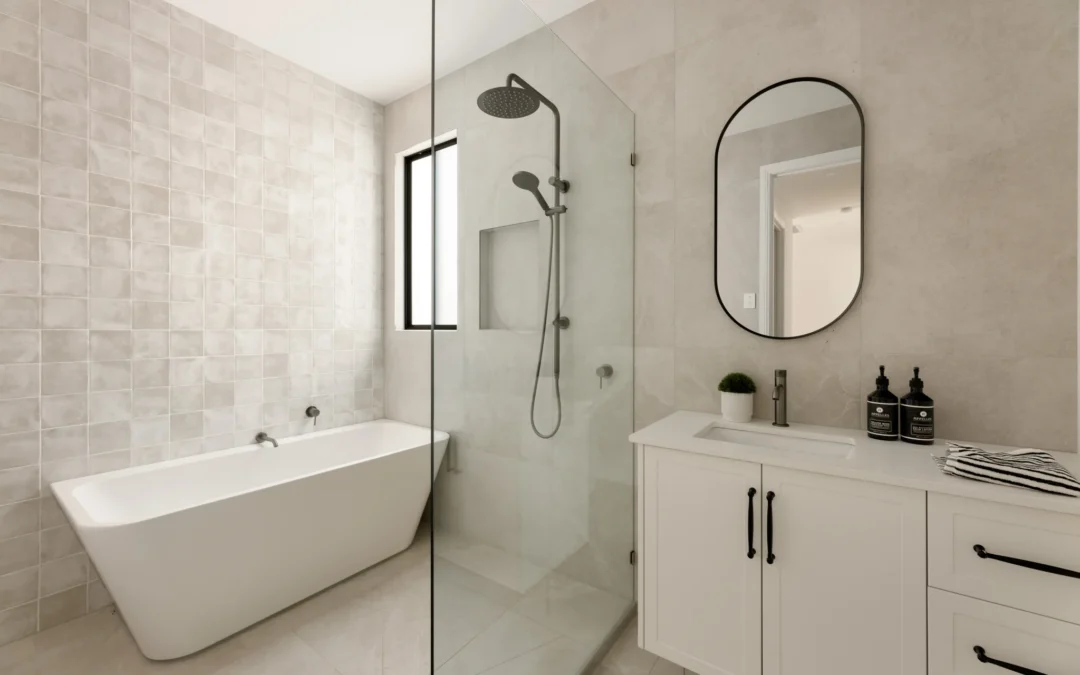
Neutral palettes anchored by whites, beiges, soft greys, and warm taupes create timeless foundations that won’t date quickly. These colours maximise natural light reflection—particularly valuable in Sydney’s inner-city homes where bathroom windows may be limited. Layering different textures within neutral schemes prevents sterility: matte tiles paired with polished stone, rough-hewn timber against smooth porcelain, woven baskets alongside sleek fixtures.
Natural texture integration extends to wall finishes, with lime wash, textured plaster, and stone-look tiles adding depth without visual clutter. These finishes work particularly well in wet areas where traditional wallpaper or fabric cannot, creating interest through tactile variation rather than colour contrast.
Accent colours appear sparingly—a single feature wall in sage green or terracotta, coloured grout in otherwise white tiling, or natural timber tones in vanities and shelving. This restraint allows homeowners to update accent elements inexpensively without full renovations as preferences evolve.
Material costs for neutral palettes vary widely based on tile and stone selection, ranging $60-$180 per square metre for quality porcelain tiles to $200-$400+ per square metre for natural stone. Textured finishes add $30-$80 per square metre in application costs beyond standard tiling.
Freestanding Bathtubs and Walk-In Showers
Freestanding baths remain aspirational centrepieces in 2026, though practical considerations increasingly influence selection. Modern freestanding tubs offer improved ergonomics, better heat retention, and space-efficient designs suitable for bathrooms as small as 8-10 square metres when positioned strategically.
Acrylic freestanding baths provide excellent heat retention at $1,200-$3,500 depending on size and design complexity. Cast iron and stone resin alternatives offer superior durability and luxury aesthetics at $3,000-$8,000+, with installation costs adding $800-$1,500 for plumbing modifications and floor reinforcement where required.
Walk-in showers with frameless glass, linear drains, and floor-to-ceiling tiles create seamless, spacious bathing environments. Curbless shower entries improve accessibility while maintaining clean visual lines. Rainfall showerheads, handheld wands, and body jets transform daily showers into spa experiences, with thermostatic mixing valves ensuring consistent temperature and safety.
Shower renovation costs range $4,000-$12,000 depending on size, tile selection, and fixture quality. Frameless glass screens add $1,200-$2,500, while premium shower systems with multiple outlets cost $1,500-$4,000 before installation.
Integrated Storage Solutions
Minimalist aesthetics demand invisible storage—recessed niches, wall-hung vanities with concealed drawers, and floor-to-ceiling cabinetry that maintains clean lines while maximising capacity. Medicine cabinets integrated into mirror designs, pull-out organisers within vanities, and custom joinery tailored to specific storage needs prevent countertop clutter that undermines spa-like calm.
Floating vanities create visual spaciousness by exposing floor area, making bathrooms feel larger while simplifying cleaning. Soft-close drawers, internal dividers, and pull-out hampers add functionality without visible hardware. Recessed shelving in shower areas eliminates protruding caddies and bottles, maintaining the seamless appearance of tiled surfaces.
Custom storage solutions cost $2,500-$8,000 depending on vanity size, materials, and internal fittings. Off-the-shelf floating vanities range $800-$2,500, offering budget-friendly alternatives with standard configurations. Recessed niches add $200-$400 per niche in tiling and waterproofing costs but eliminate ongoing expenses of shower caddies and organisers.
Smart Bathroom Technology
Technology integration in bathrooms has progressed from novelty to practical enhancement, with 2026 seeing widespread adoption of systems that genuinely improve daily routines, reduce water and energy consumption, and increase accessibility for aging-in-place homeowners.
Voice-Activated Controls and Digital Showers
Voice-controlled bathroom systems allow hands-free operation of lighting, ventilation, music, and shower settings—particularly valuable when hands are wet or occupied. Integration with home automation platforms like Google Home or Amazon Alexa enables preset routines: “morning shower” might activate specific lighting, start exhaust fans, and preset shower temperature and duration.
Digital shower systems with touchscreen or smartphone controls allow precise temperature setting (to 0.5°C accuracy), flow rate adjustment, and programmable user profiles. Multiple household members save preferred settings, eliminating daily temperature adjustment and reducing water waste. Some systems include pause functions that stop flow while soaping or shampooing, saving 15-30 litres per shower without compromising comfort.
Digital shower systems cost $1,800-$5,000 depending on features and brand, with installation adding $600-$1,200 for electrical and plumbing integration. Voice control integration adds $200-$600 for compatible devices and setup, though many homeowners already own smart speakers that simply require bathroom-specific programming.
Heated Floors and Towel Rails
Underfloor heating transforms cold tile floors into comfortable surfaces year-round, with programmable thermostats ensuring warmth when needed without continuous operation. Electric mat systems install directly under tiles during renovation, adding minimal floor height (3-5mm) and providing even heat distribution across entire floor areas.
Heated towel rails serve dual purposes: drying towels to prevent mildew and providing supplementary bathroom heating. Modern designs include programmable timers that activate before morning routines, ensuring warm towels without all-day operation. Hydronic towel rails connect to home hot water systems, while electric models offer installation flexibility and independent control.
Underfloor heating costs $80-$120 per square metre for electric systems, with $150-$250 per square metre for hydronic alternatives in larger bathrooms. Heated towel rails range $300-$1,200 depending on size and finish, with installation adding $200-$400 for electrical connection. Operating costs average $150-$300 annually when used strategically rather than continuously.
Smart Mirrors and Touchless Fixtures
Smart mirrors integrate LED lighting, demisting technology, and digital displays showing time, weather, and news feeds. Some models include magnification zones for detailed grooming, Bluetooth speakers for music or podcasts, and charging ports for electric toothbrushes and razors. Demisting functions eliminate post-shower fog without wiping, preserving mirror clarity.
Touchless taps and soap dispensers reduce surface contact and water waste, with infrared sensors activating flow only when hands are present. These fixtures prove particularly valuable in family bathrooms where hygiene and water conservation matter, and in accessible bathrooms where manual tap operation may be difficult.
Smart mirrors cost $600-$2,500 depending on size and features, with installation adding $200-$400 for electrical connection. Touchless taps range $350-$1,200, with sensor soap dispensers at $80-$250. Battery-powered touchless fixtures offer retrofit options without electrical work, though hardwired models provide more reliable long-term operation.
Bold Tiles and Statement Surfaces
While neutral palettes dominate overall bathroom design, 2026 sees strategic use of bold tiles and statement surfaces to create visual interest, define zones, and express personality without overwhelming spaces or dating quickly.
Large Format Tiles and Textured Finishes
Large format tiles—600x600mm, 600x1200mm, and even 1200x1200mm—reduce grout lines, create seamless appearances, and make bathrooms feel more expansive. Fewer grout lines mean easier cleaning and reduced mould risk in wet areas. Rectified edges allow minimal grout spacing (1-2mm), further enhancing the continuous surface effect.
Textured tiles add tactile interest and slip resistance in shower floors and wet areas. 3D wave patterns, geometric reliefs, and stone-look textures create feature walls that catch light and shadow throughout the day. Matte finishes on large format tiles reduce glare and water spotting compared to high-gloss alternatives, maintaining appearance with less frequent cleaning.
Large format tiles require skilled installation to ensure proper substrate preparation and levelling—uneven surfaces become more apparent with larger tiles. Installation costs run 15-25% higher than standard tiles due to handling difficulty and precision requirements. Material costs range $60-$150 per square metre for quality porcelain large format tiles, with premium natural stone alternatives at $150-$350 per square metre.
Terrazzo and Natural Stone Comeback
Terrazzo—composite material of marble, quartz, granite, or glass chips set in cement or resin—has returned as a statement surface for floors, vanity tops, and feature walls. Modern terrazzo offers more colour and chip size options than traditional versions, from subtle neutral blends to bold, colourful compositions. Terrazzo’s durability and unique appearance justify its $180-$350 per square metre installed cost for homeowners seeking distinctive, long-lasting surfaces.
Natural stone—particularly marble, travertine, and limestone—remains desirable for its inherent variation and luxury associations. Honed and brushed finishes provide slip resistance and hide water marks better than polished stone, making them practical for bathroom applications. Proper sealing and maintenance preserve stone appearance, though homeowners must accept natural patina development as part of stone’s character.
Stone costs vary dramatically by type and source: $120-$250 per square metre for travertine and limestone, $200-$450 per square metre for quality marble. Installation adds $80-$150 per square metre, with sealing and ongoing maintenance representing additional long-term costs.
Feature Walls and Accent Colours
Feature walls concentrate visual impact in single areas—behind freestanding baths, in shower enclosures, or on vanity walls—allowing bold colour or pattern without overwhelming entire bathrooms. Geometric tiles, encaustic patterns, or dramatic natural stone create focal points that anchor design schemes and express personality.
Accent colours in 2026 lean toward earthy tones—terracotta, sage green, deep navy, charcoal—that complement neutral bases without trending toward dated pastels or overly bright hues. Coloured grout provides subtle accent opportunities, with dark grout on white tiles or contrasting grout on neutral tiles adding definition and visual interest.
Feature wall costs depend on material selection: $80-$200 per square metre for decorative porcelain tiles, $150-$400 per square metre for natural stone or premium encaustic tiles. Labour costs increase 10-20% for pattern-intensive installations requiring precise alignment and cutting.
Wellness-Focused Bathroom Features
Bathroom design in 2026 increasingly incorporates wellness features that support physical health, mental relaxation, and overall wellbeing—reflecting broader lifestyle trends toward self-care and home-based wellness practices.
Steam Showers and Chromotherapy Lighting
Steam showers create spa experiences at home, offering respiratory benefits, muscle relaxation, and skin hydration. Modern steam generators integrate into standard shower enclosures, requiring only sealed glass doors and proper ventilation. Sessions of 15-20 minutes provide therapeutic benefits without excessive water consumption—steam showers use less water than traditional baths.
Chromotherapy (colour therapy) lighting systems cycle through colour spectrums believed to influence mood and energy levels. Blue tones promote calm and relaxation, while warmer colours energise and invigorate. LED systems allow user control of colour, intensity, and timing, creating customised bathing experiences.
Steam generator systems cost $2,500-$6,000 depending on bathroom size and features, with installation adding $1,500-$3,000 for electrical, plumbing, and waterproofing requirements. Chromotherapy lighting adds $400-$1,200 to shower systems. Operating costs remain modest—$30-$60 monthly for regular use—making steam showers accessible luxury features.
Aromatherapy and Air Purification Systems
Aromatherapy diffusers integrated into ventilation systems or standalone units disperse essential oils throughout bathrooms, creating sensory experiences that support relaxation, focus, or invigoration depending on oil selection. Built-in systems connect to exhaust fans, distributing scents evenly without visible devices cluttering surfaces.
Air purification systems with HEPA filters remove airborne particles, allergens, and odours—particularly valuable in bathrooms where moisture, cleaning products, and personal care items affect air quality. Some systems include UV-C light technology that neutralises bacteria and viruses, supporting healthier bathroom environments.
Integrated aromatherapy systems cost $300-$800 installed, with essential oils representing ongoing expenses of $15-$40 monthly depending on usage. Air purification systems range $400-$1,500 for quality units, with filter replacements costing $60-$150 annually. These features appeal particularly to health-conscious homeowners and those with respiratory sensitivities.
Ergonomic Design and Accessibility Features
Universal design principles create bathrooms that accommodate users of all ages and abilities without institutional appearance. Curbless showers with linear drains, grab bars integrated into design schemes, comfort-height toilets, and lever-handle taps improve accessibility while maintaining aesthetic appeal.
Adjustable-height vanities, handheld showerheads with slide bars, and non-slip flooring provide safety and convenience for aging-in-place homeowners. These features add minimal cost during initial renovation but prove invaluable as mobility needs change, avoiding costly retrofits later.
Accessibility features cost $1,500-$4,000 when integrated into initial renovations: curbless showers add $800-$1,500 over standard curbed designs, grab bars cost $150-$400 installed when structurally reinforced during construction, comfort-height toilets add $100-$300 over standard models. These investments support long-term home usability and broader market appeal when selling.
Matte Black and Mixed Metal Finishes
Fixture finishes in 2026 move decisively away from ubiquitous chrome toward matte black, brushed brass, and mixed metal combinations that add warmth, sophistication, and design distinction to bathrooms.
Matte Black Tapware and Fixtures
Matte black fixtures create striking contrast against white tiles and neutral palettes, offering modern sophistication without the coldness sometimes associated with chrome. The finish hides water spots and fingerprints better than polished alternatives, maintaining appearance with minimal maintenance. Quality matte black finishes resist scratching and wear, though cheaper alternatives may show damage over time.
Matte black works across design styles—from industrial and contemporary to traditional and transitional—making it versatile for various aesthetic preferences. The finish pairs particularly well with natural timber, concrete, and stone surfaces, creating balanced material palettes.
Matte black tapware costs $250-$800 for basin mixers, $350-$1,200 for shower systems, and $180-$500 for accessories like towel rails and toilet roll holders. Quality matters significantly with matte black—premium brands offer superior finish durability and warranty coverage worth the 20-40% price premium over budget alternatives.
Brass, Copper, and Brushed Nickel Accents
Warm metal finishes—brushed brass, aged copper, and brushed nickel—add richness and character to bathroom designs. These finishes complement both neutral and coloured palettes, working particularly well with earthy accent colours and natural materials. Brushed and aged finishes hide wear better than polished alternatives, developing attractive patinas over time.
Mixed metal combinations—matte black taps with brass cabinet hardware, brushed nickel shower fixtures with copper accessories—create layered, collected appearances that feel personalised rather than showroom-generic. Successful mixing requires consistent finish types (all brushed or all matte) and intentional distribution rather than random placement.
Brass and copper fixtures cost $300-$1,000 for tapware, with brushed nickel at $200-$700—generally 15-30% more than equivalent chrome fixtures. Hardware and accessories in these finishes add $400-$1,200 to renovation budgets depending on bathroom size and fixture quantity.
Coordinating Hardware and Accessories
Cohesive hardware selection—cabinet pulls, towel bars, toilet roll holders, robe hooks—creates polished, intentional design. Matching finish families (all matte black, all brushed brass) with consistent design language (modern linear, traditional curved) unifies bathroom aesthetics.
Quality hardware justifies cost through superior function and durability. Soft-close drawer slides, solid brass construction, and corrosion-resistant finishes outlast cheaper alternatives, avoiding premature replacement. Installation during renovation ensures proper backing and positioning, unlike retrofit additions that may compromise wall integrity.
Complete hardware packages cost $600-$2,000 depending on bathroom size, fixture quantity, and finish selection. Premium brands offer 10-15 year warranties versus 1-3 years for budget alternatives, supporting long-term value despite higher initial costs.
Biophilic Design and Natural Elements
Biophilic design—incorporating natural elements and connections to nature—addresses human psychological needs for natural environments, creating bathrooms that support mental wellbeing and stress reduction through organic materials, living plants, and natural light.
Indoor Plants and Living Walls
Bathroom plants thrive in humid environments, with species like pothos, ferns, orchids, and snake plants tolerating low light while improving air quality and adding organic visual interest. Hanging planters, wall-mounted pots, and vanity-top arrangements integrate greenery without consuming floor space.
Living walls—vertical gardens with integrated irrigation—create dramatic natural features in larger bathrooms. These systems require proper waterproofing, lighting, and maintenance but deliver significant visual impact and air purification benefits. Smaller-scale alternatives include framed moss panels and preserved plant installations requiring no watering or maintenance.
Plant integration costs vary from $50-$200 for individual potted plants and planters to $2,000-$8,000 for installed living wall systems. Maintenance requirements range from weekly watering for potted plants to monthly professional service for living walls, representing ongoing commitments homeowners must consider.
Natural Light Maximisation
Natural light transforms bathroom ambience, supporting circadian rhythms and reducing daytime artificial lighting needs. Skylights, larger windows, and glass block installations increase natural light while maintaining privacy. Frosted or textured glass, strategic window placement, and external screening provide privacy without sacrificing light.
Light wells and sun tunnels bring natural light into internal bathrooms without external walls, using reflective tubes to channel daylight from roof level. These systems cost less than traditional skylights while avoiding heat gain and loss issues.
Skylight installation costs $2,000-$5,000 depending on size and roof complexity, with sun tunnels at $800-$2,000. Window enlargement or addition costs $1,500-$4,000 per window including structural work and waterproofing. Energy savings from reduced artificial lighting use and improved ventilation provide modest ongoing returns.
Organic Shapes and Curved Fixtures
Curved fixtures—round mirrors, oval basins, curved shower screens—soften bathroom aesthetics and create visual flow. Organic shapes contrast with angular tiles and cabinetry, adding visual interest through form variation. Curved elements feel more natural and less institutional than purely rectilinear designs.
Pebble tile floors, river rock accents, and naturally shaped stone basins bring literal natural elements into bathrooms. These materials connect users to natural environments while providing unique, unrepeatable aesthetics—no two natural stone basins are identical.
Curved and organic fixtures typically cost 10-25% more than rectilinear equivalents due to manufacturing complexity: curved shower screens add $300-$800 over straight panels, natural stone basins cost $400-$1,500 versus $150-$600 for manufactured alternatives. The aesthetic impact and uniqueness justify premiums for homeowners prioritising distinctive design.
Compact and Multi-Functional Bathrooms
Sydney’s property market—characterised by smaller lot sizes and apartment living—drives demand for bathroom designs that maximise functionality within limited footprints. Smart space planning and multi-functional fixtures create capable bathrooms in areas as small as 3-4 square metres.
Space-Saving Fixtures for Small Bathrooms
Wall-hung toilets, compact vanities, and corner basins preserve floor space while maintaining full functionality. Toilets with concealed cisterns reduce visual bulk and allow flexible positioning. Narrow-depth vanities (300-400mm versus standard 450-600mm) provide storage and basin space without protruding into circulation areas.
Sliding shower doors eliminate swing clearance requirements, allowing showers in tighter spaces. Pivot and bi-fold doors offer alternatives where sliding tracks are impractical. Glass screens rather than full enclosures maintain visual openness, making small bathrooms feel larger.
Compact fixtures cost comparably to standard sizes—$400-$1,200 for wall-hung toilets, $600-$1,800 for narrow vanities—with installation sometimes higher due to precise fitting requirements. Space savings enable bathroom functionality in areas otherwise too small, adding significant value in space-constrained properties.
Wall-Hung Vanities and Toilets
Wall-hung fixtures create visual spaciousness by exposing floor area, making bathrooms feel larger while simplifying floor cleaning. Adjustable mounting heights accommodate user preferences and accessibility needs. Concealed plumbing and cisterns reduce visual clutter.
Structural requirements for wall-hung fixtures include reinforced framing or blocking during construction to support weight. Retrofit installations may require wall strengthening, adding cost and complexity. Proper installation ensures long-term stability and prevents sagging or failure.
Wall-hung vanities cost $800-$2,500 depending on size and materials, with installation adding $400-$800 for plumbing and mounting. Wall-hung toilets range $500-$1,500, with installation costs of $600-$1,200 including concealed cistern and frame systems. The visual and functional benefits justify costs in small and contemporary bathrooms.
Wet Rooms and Combined Shower-Bath Spaces
Wet rooms—fully waterproofed bathrooms with floor drains—eliminate shower enclosures entirely, creating seamless, accessible bathing spaces. Linear drains along walls or thresholds direct water flow while maintaining level floors. Wet rooms work particularly well in small bathrooms where separate shower enclosures consume disproportionate space.
Combined shower-bath configurations place showerheads over bathtubs, serving dual purposes within single footprints. Modern interpretations use frameless glass screens to contain spray while maintaining visual openness. This approach suits family bathrooms where both bathing options are valued but space is limited.
Wet room construction costs $8,000-$15,000 depending on size, requiring comprehensive waterproofing, proper floor grading (1:100 slope to drains), and quality drainage systems. Combined shower-bath installations cost $6,000-$12,000, less than separate shower and bath installations while providing both functions. These configurations maximise utility in space-constrained bathrooms.
Personalisation and Custom Design
Mass-produced bathroom products offer convenience and cost efficiency, but 2026 sees growing demand for personalised elements that reflect individual style, accommodate specific needs, and create distinctive spaces that feel custom rather than generic.
Bespoke Vanities and Custom Joinery
Custom vanities accommodate specific storage needs, unusual spaces, and personal aesthetic preferences. Tailored drawer configurations, integrated hampers, electrical outlets for styling tools, and precise height adjustments create vanities that function better than standard alternatives. Custom joinery extends to medicine cabinets, linen storage, and built-in seating.
Local joinery allows material selection, finish specification, and design collaboration that off-the-shelf products cannot match. Solid timber, quality hardware, and precise fitting justify custom costs through superior durability and perfect space utilisation. Custom work accommodates architectural irregularities—angled walls, exposed pipes, unusual dimensions—that standard products cannot address.
Custom vanities cost $2,500-$8,000 depending on size, materials, and complexity, representing 50-150% premiums over quality off-the-shelf alternatives. The investment delivers perfectly fitted, unique pieces that enhance daily function and property distinction. Custom joinery for additional storage adds $1,500-$5,000 depending on scope.
Unique Tile Patterns and Layouts
Custom tile layouts—herringbone, chevron, hexagonal, or completely unique patterns—create visual interest and personalisation. Mixing tile sizes, colours, or materials within single installations adds complexity and distinction. Border details, inset patterns, and feature panels transform standard tiles into custom designs.
Skilled tilers execute complex patterns, ensuring proper alignment, consistent spacing, and professional finishing. Pattern complexity increases labour time and costs but delivers unique results impossible with standard grid layouts. Digital design tools allow pattern visualisation before installation, ensuring satisfaction with final results.
Custom tile patterns add $40-$100 per square metre in labour costs over standard installations, with material waste increasing 10-20% due to cutting requirements. The visual impact and personalisation justify costs for homeowners seeking distinctive bathrooms that reflect individual style rather than builder-grade uniformity.
Tailored Lighting and Mirror Designs
Custom lighting design layers ambient, task, and accent lighting to create functional, atmospheric bathrooms. Recessed downlights provide general illumination, vanity lighting ensures shadow-free grooming, and accent lighting highlights architectural features or artwork. Dimming controls adjust lighting intensity for different times and activities.
Custom mirrors—unusual shapes, integrated lighting, bevelled or antiqued finishes—serve as focal points while providing essential function. Backlit mirrors create ambient glow, while side-mounted sconces provide task lighting. Mirror placement considers user heights, sight lines, and light reflection to maximise utility and visual impact.
Custom lighting design and installation costs $2,000-$5,000 depending on fixture quantity and complexity, with premium fixtures and controls at the upper range. Custom mirrors cost $600-$2,500 depending on size, shape, and features. These investments create personalised, well-lit bathrooms that function better and feel more luxurious than standard lighting approaches.
Cost Considerations for 2026 Bathroom Trends
Understanding cost implications of trending features helps homeowners make strategic decisions that balance aesthetic desires with budget realities and long-term value. Not all trends deliver equal returns, and some offer high visual impact at modest cost while others require significant investment.
Budget-Friendly Trend Adoption Strategies
Strategic trend adoption focuses investment on high-impact, visible elements while economising on hidden or less critical components. Splurging on statement tiles for feature walls while using cost-effective tiles elsewhere, investing in quality tapware while choosing mid-range accessories, or prioritising custom vanities while using standard toilets and baths balances trend participation with budget constraints.
DIY-friendly trend elements—painting, accessory updates, plant additions—allow homeowners to refresh bathrooms inexpensively between major renovations. Removable wallpaper, updated hardware, new mirrors, and textile changes create trend-current appearances without permanent commitments or significant costs.
Phased renovations spread costs over time: initial renovation establishes core infrastructure (plumbing, waterproofing, basic fixtures) with budget finishes, while subsequent updates replace tiles, upgrade fixtures, or add technology as budgets allow. This approach requires initial planning to avoid rework but makes trend adoption accessible to budget-conscious renovators.
Budget-conscious trend adoption costs $8,000-$15,000 for small bathrooms, $15,000-$25,000 for medium bathrooms, focusing on one or two key trend elements rather than comprehensive trend integration. Strategic choices deliver contemporary appearance without premium costs across all components.
High-Impact vs. High-Cost Trend Elements
High-impact, moderate-cost trends include matte black tapware ($800-$2,000 for complete bathroom), large format tiles ($2,500-$5,000 for typical bathroom), and floating vanities ($1,500-$3,500). These elements significantly update bathroom aesthetics at costs accessible to most renovation budgets.
High-cost trends include steam showers ($4,000-$9,000), custom joinery ($4,000-$12,000), and premium natural stone ($5,000-$12,000 for typical bathroom). These features deliver luxury and functionality but require substantial budget allocation, making them priorities for high-end renovations or specific user needs rather than universal inclusions.
Some trends offer minimal cost increases over standard alternatives: LED lighting costs marginally more than halogens, WELS-rated fixtures match standard fixture costs, and neutral colour schemes cost no more than any other colour choice. These trends offer easy adoption without budget impact.
Understanding cost-to-impact ratios helps prioritise trend adoption: floating vanities deliver significant visual impact for moderate cost, while chromotherapy lighting adds minimal functional value at notable expense. Strategic selection based on personal priorities and budget realities creates satisfying, trend-current bathrooms without overspending.
ROI and Resale Value of Trending Features
Bathroom renovations typically return 60-80% of costs in increased property value, with quality, trend-current bathrooms at the higher end. Features with broad appeal—neutral palettes, quality fixtures, good storage, effective lighting—deliver better returns than highly personalised or niche elements.
Sustainable features increasingly influence buyer decisions, with water-efficient fixtures, energy-efficient lighting, and quality ventilation viewed as standard expectations rather than premium features. Smart technology appeals to some buyers but may deter others unfamiliar with systems or concerned about obsolescence and maintenance.
Timeless trend elements—quality materials, good design, proper function—maintain value better than fashion-forward choices that may date quickly. Matte black fixtures, large format tiles, and floating vanities currently feel contemporary but have sufficient design longevity to remain acceptable for 10+ years. Highly specific colour schemes or very trendy patterns may require updating sooner.
Investment in proper waterproofing, quality installation, and durable materials delivers better long-term returns than spending on premium aesthetics with substandard construction. Buyers value well-executed, functional bathrooms over poorly constructed spaces with expensive finishes. Allocating 60-70% of budgets to structure, waterproofing, and installation with 30-40% to finishes and fixtures creates balanced renovations that perform well and look good.
Conclusion
Bathroom trends in 2026 reflect evolving priorities around sustainability, wellness, technology, and personalisation—moving beyond purely aesthetic considerations toward spaces that support healthier living, reduce environmental impact, and adapt to changing needs over time. Strategic trend adoption balances contemporary appeal with timeless design principles, creating bathrooms that remain functional and attractive for decades rather than requiring frequent updates.
The most successful bathroom renovations integrate trends selectively based on personal priorities, budget realities, and long-term value rather than attempting comprehensive trend adoption. Focusing investment on high-impact elements, quality materials, and proper construction delivers better outcomes than spreading budgets thinly across every trending feature. Understanding cost implications, maintenance requirements, and resale value helps homeowners make informed decisions that align with both immediate desires and future needs.
Whether you’re planning a complete bathroom renovation or strategic updates, Sydney Home Renovation provides transparent cost guidance, quality workmanship, and practical expertise to help you create a bathroom that balances trending design with lasting value. Contact us today to discuss how we can bring your bathroom vision to life within your budget and timeline.
Frequently Asked Questions
What are the biggest bathroom trends for 2026?
The dominant trends include sustainable fixtures and materials, spa-inspired minimalist aesthetics, smart technology integration, matte black and mixed metal finishes, and biophilic design elements. These trends reflect priorities around environmental responsibility, wellness, and personalisation.
Are sustainable bathroom features worth the investment?
Yes—water-efficient fixtures typically pay for themselves within 2-4 years through reduced utility bills, while energy-efficient lighting and heating deliver ongoing savings. Sustainable features also increase property appeal to environmentally conscious buyers, supporting resale value.
How much does it cost to incorporate smart technology in a bathroom?
Basic smart features like LED lighting and programmable thermostats add $500-$1,500 to renovation costs. Comprehensive smart integration including digital showers, heated floors, and smart mirrors costs $4,000-$10,000 depending on bathroom size and feature selection.
What colours will be popular in bathrooms in 2026?
Neutral palettes anchored by whites, beiges, soft greys, and warm taupes dominate, with earthy accent colours like sage green, terracotta, and deep navy appearing in feature walls and accessories. These colours offer timeless appeal while allowing easy updates through accessories.
Is matte black still trending in bathroom design?
Yes—matte black remains highly popular in 2026, valued for its modern sophistication, versatility across design styles, and practical benefits of hiding water spots and fingerprints. Quality matte black finishes offer excellent durability when properly manufactured.
How can I make a small bathroom feel more spacious?
Use large format tiles to reduce visual breaks, install wall-hung fixtures to expose floor area, incorporate frameless glass shower screens, maximise natural light, and choose light neutral colours. Floating vanities and good lighting also create spaciousness in compact bathrooms.
What is biophilic design in bathrooms?
Biophilic design incorporates natural elements—plants, natural light, organic materials, and nature-inspired colours and shapes—to create psychological connections to nature. This approach supports mental wellbeing and stress reduction through environmental design.
Are freestanding baths going out of style?
No—freestanding baths remain popular in 2026, though selections increasingly emphasise ergonomics, heat retention, and space efficiency over purely aesthetic considerations. Modern freestanding baths work well in bathrooms as small as 8-10 square metres when positioned strategically.
What bathroom trends add the most value to a home?
Quality fixtures, effective storage, good lighting, neutral colour schemes, and proper waterproofing deliver the strongest returns. Water-efficient features and accessibility elements increasingly influence buyer decisions. Well-executed, functional bathrooms outperform poorly constructed spaces with expensive finishes.
How do I choose between trends and timeless design?
Focus on timeless design for major structural elements and expensive permanent features, while incorporating trends through fixtures, finishes, and accessories that can be updated more easily. Neutral bases with trending accents offer flexibility and longevity while maintaining contemporary appeal.