Queensland’s 2026 granny flat laws represent the most significant shift in secondary dwelling policy the state has seen in over a decade. The Queensland Government has removed the owner-occupier restriction, relaxed minimum lot size requirements, and expanded complying development pathways — making it faster and more accessible for homeowners and investors to build a secondary dwelling on a residential property. These changes apply across most residential zones in Queensland and take effect progressively through 2026 under the updated Queensland Planning Act framework.
What the 2026 QLD Granny Flat Laws Actually Change
Queensland’s 2026 reforms fundamentally change who can build a granny flat, on what land, and under what approval process. The owner-occupier requirement — which previously forced the property owner to live on-site — has been abolished. Minimum lot sizes have been reduced, setback rules have been relaxed in many zones, and more applications now qualify as complying development, bypassing the full development application process entirely.
Relaxed Lot Size and Setback Requirements
Previously, most Queensland councils required a minimum lot size of 450 square metres before a secondary dwelling could be approved. Under the 2026 reforms, that threshold has been reduced in many residential zones, with some councils now permitting secondary dwellings on lots as small as 300 square metres, subject to site coverage and setback compliance.
Rear setback requirements have also been eased. Where a 900mm rear setback was standard, updated planning codes in several local government areas now permit reduced setbacks for single-storey secondary dwellings, provided the structure meets privacy screening and boundary clearance conditions. Homeowners should verify their specific council’s adopted planning scheme, as implementation varies by local government area.
Removal of the Owner-Occupier Restriction
This is the most consequential change in the 2026 reforms. Under the previous framework, Queensland law required the property owner to reside on the lot where a secondary dwelling was built. That restriction has been removed statewide.
Investors can now build a granny flat on an investment property and rent both the primary dwelling and the secondary dwelling independently. This opens a significant income opportunity for property investors across Queensland and aligns the state more closely with New South Wales, which removed its equivalent restriction in 2023.
Understanding what the law now permits is only part of the picture. Granny flat construction costs vary significantly depending on size, site conditions, and finish level — and knowing your budget before you engage a builder is essential to making the most of these new approvals.
Who Can Build a Granny Flat Under the New Rules
Any residential property owner in Queensland can now pursue a secondary dwelling, provided the lot meets the updated size and zoning requirements. Owner-occupiers, landlords, and investors all qualify. The property must sit within a residential zone that permits secondary dwellings under the relevant local government planning scheme — most standard residential zones now do.
Approval Pathways — Complying Development vs. DA
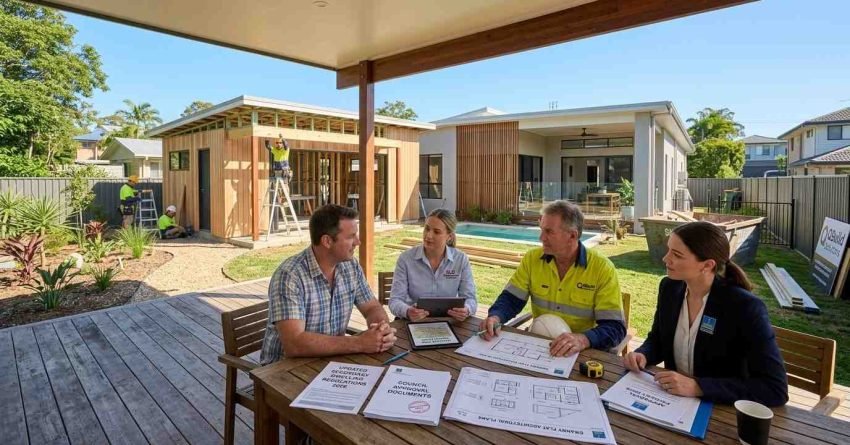
The 2026 reforms have expanded the range of projects that qualify under the complying development pathway, which allows approval to be granted by a private certifier rather than through a full council development application. This significantly reduces approval timeframes — from months to weeks in many cases.
Projects that exceed the complying development criteria — due to lot size, setbacks, or design complexity — still require a standard development application through the relevant local council. A certifier or town planner can assess which pathway applies to your specific site before any design work begins.
What Homeowners and Investors Need to Do Now
The 2026 law changes create a genuine opportunity, but acting without preparation leads to delays and cost overruns. The first step is confirming your lot’s zoning and whether your local council has adopted the updated planning code provisions. Not all councils have transitioned at the same pace.
Council Compliance, Design Standards, and Next Steps
Once zoning is confirmed, the key compliance requirements to address are site coverage limits, private open space allocation for the secondary dwelling, car parking provisions, and utility connection requirements. Most Queensland councils require the secondary dwelling to have a minimum floor area of 35 square metres and a maximum of 80 square metres, though some councils permit up to 100 square metres depending on the primary dwelling size.
Engaging a licensed builder early — before finalising a design — ensures the structure is planned within the complying development envelope from the start. Retrofitting a design to meet code after the fact adds cost and time that most projects cannot absorb.
Conclusion
Queensland’s 2026 granny flat reforms remove the barriers that previously made secondary dwellings impractical for most property owners and investors. The changes are real, the opportunity is immediate, and the approval process is now more accessible than it has ever been.
Homeowners and investors who move quickly — with the right design, the right approvals pathway, and a clear budget — are best positioned to capitalise on the rental income potential these reforms unlock.
At Sydney Home Renovation, we help you plan and build secondary dwellings that meet compliance requirements from day one. Contact our team to discuss your site and get a clear picture of what’s possible.
Frequently Asked Questions
Can I rent out a granny flat in QLD in 2026?
Yes. The 2026 reforms removed the owner-occupier restriction, meaning investors can now rent both the primary dwelling and the secondary dwelling independently on the same lot.
What is the maximum size for a granny flat in QLD?
Most Queensland councils permit secondary dwellings up to 80 square metres, with some allowing up to 100 square metres depending on the size of the primary dwelling and local planning rules.
Do I need council approval for a granny flat in QLD?
Not always. Many projects now qualify under the complying development pathway, which uses a private certifier instead of a full council development application, significantly reducing approval time.
Can I build a granny flat on a small block in QLD?
Yes, in many zones. The 2026 reforms reduced minimum lot size thresholds, with some councils now permitting secondary dwellings on lots as small as 300 square metres, subject to setback and site coverage rules.
How long does granny flat approval take in QLD?
Complying development approvals can be issued within two to four weeks. Full development applications through council typically take eight to sixteen weeks, depending on the local government area and application complexity.