
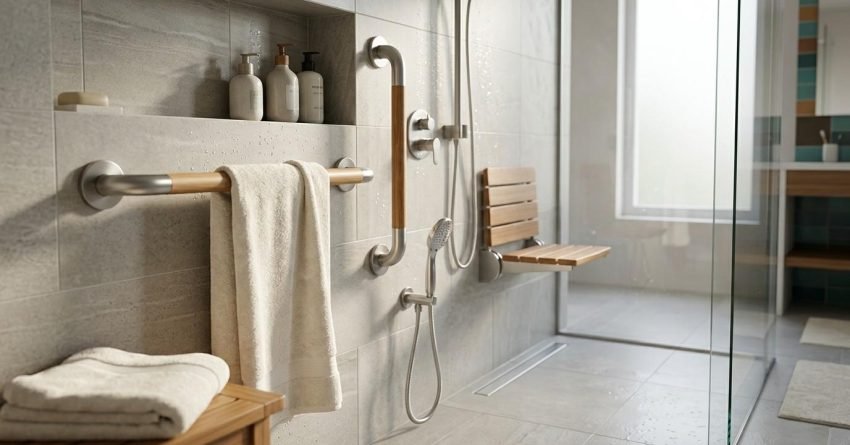
Accessible bathroom design uses universal design principles to create safe, comfortable, and visually appealing spaces that work for every user, regardless of age or mobility. The result is a bathroom that supports independence without sacrificing style.
For Sydney homeowners planning a renovation, building accessibility in now protects long-term property value, supports ageing in place, and reduces costly modifications across changing life stages. The earlier these principles are built in, the less they cost and the more seamlessly they integrate.
This guide explains universal design principles, accessible bathroom features, layout planning, compliant fixtures, safety standards, and budgeting to help you renovate confidently and with clarity.
What Is Universal Design in a Bathroom?
Universal design is the practice of creating environments that can be used by all people, to the greatest extent possible, without the need for adaptation. In a bathroom context, it means a space that works equally well for a young child, a pregnant parent, a wheelchair user, and an older adult with reduced mobility. The design feels intuitive rather than clinical, blending accessibility into the aesthetic.
Universal Design vs Accessible Design
Accessible design typically retrofits a space to meet a specific disability or compliance requirement. Universal design starts from a broader premise: every feature is chosen because it benefits everyone. A curbless shower, for example, removes a trip hazard for any user while remaining wheelchair accessible. The difference matters because universal design tends to look like a normal, well-finished bathroom, while purely accessible retrofits can feel institutional.
Who Benefits from an Accessible Bathroom
The audience is wider than most homeowners assume. Families with young children gain a safer wet area. Owner-occupiers planning to stay long-term protect their ability to age in place, a growing priority as Sydney’s population ages and the cost of future modifications rises. Property investors gain a feature that appeals to a growing share of renters and buyers. And anyone recovering from injury or surgery benefits immediately.
The Seven Core Principles of Universal Design
Universal design rests on seven established principles developed by a working group of architects, product designers, and engineers. Applied to a bathroom, they translate into clear, practical decisions.
Equitable use. The design is useful to people with diverse abilities. A lever tap works for arthritic hands and small children alike.
Flexibility in use. The space accommodates a wide range of preferences. A handheld shower on a sliding rail serves both standing and seated users.
Simple and intuitive use. Controls and layouts are easy to understand without instruction.
Perceptible information. Tap markings, contrasting tiles, and clear sightlines communicate effectively regardless of sensory ability.
Tolerance for error. Anti-scald valves and rounded edges minimise the consequences of accidents.
Low physical effort. Doors swing easily, taps turn with one hand, and storage sits within natural reach.
Size and space for approach and use. Adequate clear floor area allows comfortable movement for any user, including those using mobility aids.
Each principle informs concrete product and layout choices rather than remaining an abstract ideal.
Essential Features of an Accessible Bathroom
Certain features appear in nearly every well-designed universal bathroom. They form the practical core of the approach.
Step-Free Entry and Curbless Showers
A curbless or hobless shower removes the raised lip between the shower floor and the rest of the bathroom. Water is contained through a graded floor, a linear drain, and a glass screen. The result is a seamless wet area that any user enters without lifting a foot, stepping over a frame, or navigating a step. Sydney builders achieve this through a recessed bathroom slab or a fully waterproofed timber-framed substrate.
Grab Rails and Reinforced Walls
Grab rails are most effective when planned into the build rather than added later. Reinforcing walls with timber or steel noggins during framing means rails are installed exactly where needed at any point in the future. Modern grab rails come in finishes that match tapware, so they read as considered design features rather than medical equipment.
Slip-Resistant Flooring
Tile selection has the biggest single impact on bathroom safety. We specify tiles with an R10 or R11 slip-resistance rating for shower floors and an R10 rating for general bathroom flooring. Smaller tile formats increase the grout-to-tile ratio, which improves grip underfoot. Honed stone, textured porcelain, and slip-rated vinyl planks are all suitable options.
Colour Contrast and Visual Accessibility
Colour contrast is one of the most overlooked elements of universal bathroom design. A tonal difference between the floor, wall, and fixture surfaces helps users with low vision navigate the space confidently, and it also makes the bathroom feel more visually defined and considered. We recommend a minimum 30-point luminance contrast between floor tiles and wall tiles, and between sanitary ware and the surfaces behind it. Contrasting grab rails, tap handles, and toilet seats reinforce spatial orientation without adding clinical visual weight.
Layout and Space Planning for Accessibility
Layout drives whether a bathroom feels accessible or merely accessible-equipped. The two key measurements are clear floor space and approach zones for each fixture.
Clear Floor Space and Turning Circles
A wheelchair turning circle requires a clear floor diameter of 1,500 millimetres. Even households without current mobility needs benefit from generous floor space, which reduces collisions, supports two-person bathing for parents and children, and accommodates future change. Where space is tight, an open vanity with knee clearance contributes to the turning circle without adding overall room size.
Door Widths and Approach Zones
Standard internal doors in older Sydney homes are often 720 millimetres or narrower. Universal design favours a clear opening of at least 850 millimetres, achieved through a wider door, a cavity slider, or an outward-swinging door that does not consume internal floor space. Each fixture also needs a clear approach zone of approximately 800 by 1,300 millimetres in front of it.
Widening a doorway through a load-bearing wall is one of the larger cost items in an accessible home renovation; planning it during a bathroom renovation, rather than as a standalone project, reduces both disruption and cost significantly.
Fixtures, Fittings, and Tapware for Universal Use
Fixture selection determines how the bathroom performs day to day. The right products combine accessibility with finishes that suit modern Sydney homes.
Wall-hung toilets allow the seat height to be set during installation, with 460 to 480 millimetres recommended for accessible use. A vanity is wall-hung with at least 700 millimetres of knee clearance underneath and a counter height of around 800 to 850 millimetres. Tapware uses single-lever or sensor activation, with thermostatic mixing valves to prevent scalding.
A handheld shower on a vertical sliding rail serves both standing and seated bathers and removes the need for a separate fixed showerhead. For shower seating, we specify fold-down wall-mounted seats as the default; they occupy no floor space when raised, support a full range of users when lowered, and install flush against the wall in a finish that matches the rest of the bathroom. Fixed fold-flat and hinged tip-up seats are alternatives where wall structure or budget differs.
Mirrors extend low enough to be useful from a seated position, typically starting around 900 millimetres above floor level. Layered lighting that combines ambient, task, and accent fixtures reduces shadows, supports users with low vision, and makes the bathroom feel larger. Sensor-activated tapware and motion-triggered lighting are increasingly specified in Sydney accessible bathrooms both reduce the physical effort required and eliminate the need to locate controls in low-light conditions.
Australian Standards, Safety, and Compliance
Accessible bathroom design in Australia is shaped by AS 1428.1 (Design for access and mobility) and the National Construction Code. While AS 1428.1 is mandatory only for public and certain commercial buildings, its specifications form the practical benchmark for residential accessible design. Sydney builders working on private homes regularly use it as a quality reference even when full compliance is not legally required.
Waterproofing must meet AS 3740, which applies to every wet area regardless of accessibility features. Curbless showers require particularly careful waterproofing detailing because the membrane extends beyond the shower zone to manage water that escapes the immediate fall.
Households modifying a bathroom under the NDIS or My Aged Care Home Care Packages follow a structured process. An occupational therapist assessment comes first; it specifies exact rail positions, fixture heights, approach zones, and any structural modifications required. That assessment then becomes the construction brief the builder works from. NDIS funding covers reasonable and necessary home modifications, and My Aged Care packages at Level 3 and Level 4 commonly include bathroom accessibility upgrades. We work directly with OT reports and funding coordinators to ensure the build matches the approved scope.
Cost Considerations for Accessible Bathroom Renovations
Building universal design into a new renovation costs significantly less than retrofitting the same features later. The incremental cost over a standard mid-range Sydney bathroom renovation typically falls in the range of 5 to 15 percent, depending on the features selected and the structural changes required.
The largest cost drivers are structural. Recessing the slab for a curbless shower, widening a doorway through a load-bearing wall, or relocating plumbing all add meaningful expense. Fixture upgrades such as wall-hung toilets, thermostatic mixers, and quality grab rails add hundreds rather than thousands of dollars each. Slip-resistant tiles often cost no more than standard tiles when chosen at the specification stage.
The features that cost almost nothing to include during a renovation are the ones most commonly missed. Reinforcing walls for future grab rails, specifying lever taps, choosing R-rated tiles, and adding extra clear floor space all sit in this category. Each becomes prohibitively expensive once walls are closed and finishes are laid.
The contrast with retrofitting is stark. Adding a curbless shower to a completed bathroom means breaking up the existing slab or substrate, re-waterproofing the entire wet area, relaying tiles, and repairing surrounding finishes. That same outcome, built in from the start, adds a few hundred dollars to the waterproofing and drainage specification. Widening a doorway after a renovation is complete means cutting through finished walls, potentially engaging a structural engineer if the wall is load-bearing, and repainting or retiling the affected area. Planned during the renovation, it is a single line item in the builder’s scope.
We recommend treating universal design features as a tiered decision. Structural changes slab recessing, doorway widening, plumbing relocation are worth doing once, during the renovation, because the retrofit cost is two to three times higher. Fixture upgrades are low-cost additions at any stage. Wall reinforcement for grab rails costs almost nothing during framing and is the single highest-value accessibility decision a homeowner makes.
Conclusion
Universal design transforms a bathroom into a space that supports every user across every life stage, combining accessible features with the finishes and proportions of a modern Sydney bathroom. Done well, it is invisible as accessibility and visible only as good design.
Building these principles in during a renovation costs far less than retrofitting them later, protects long-term property value, and supports ageing in place without a future round of disruption and expense.
At Sydney Home Renovation, we help homeowners and investors plan accessible bathrooms with transparent pricing, practical advice, and skilled workmanship. Contact our team today to renovate with confidence.
Frequently Asked Questions
What is the difference between accessible bathroom design and universal design?
Accessible design adapts a bathroom to meet a specific disability or compliance need. We design universally; every feature works for every user without looking adapted or clinical.
How much extra does it cost to make a bathroom accessible during a renovation?
We typically add 5 to 15 percent to the overall cost. Retrofitting the same features later costs two to three times more due to structural and waterproofing rework.
What size does a fully accessible bathroom need to be?
A fully accessible bathroom needs a clear floor turning circle of 1,500 millimetres, plus approach zones in front of each fixture. Most Sydney bathrooms achieve this with a thoughtful layout rather than extra floor area.
Are grab rails required in residential bathrooms?
Grab rails are not legally required in private homes, but we strongly recommend reinforcing walls during framing. Adding noggins at that stage costs very little and makes future rail installation simple and inexpensive.
What slip-resistance rating should bathroom tiles have?
Shower floor tiles need an R10 or R11 rating. General bathroom floor tiles need at least R10. Smaller tile formats add grout lines that improve traction underfoot when wet.
Can a curbless shower work in an older Sydney home?
Yes. We build curbless showers into older homes by recessing the slab or using a fully waterproofed timber-framed substrate with a linear drain. Careful waterproofing under AS 3740 is essential.
Does an accessible bathroom add value to a Sydney property?
Yes. Accessible bathrooms appeal to a growing pool of buyers and renters, including older homeowners, families, and people with mobility needs. Well-designed universal features signal quality construction and future-proofing.


