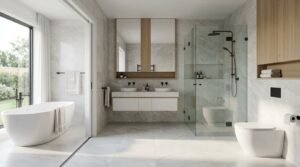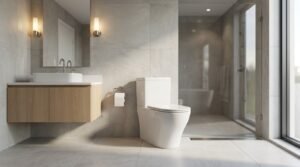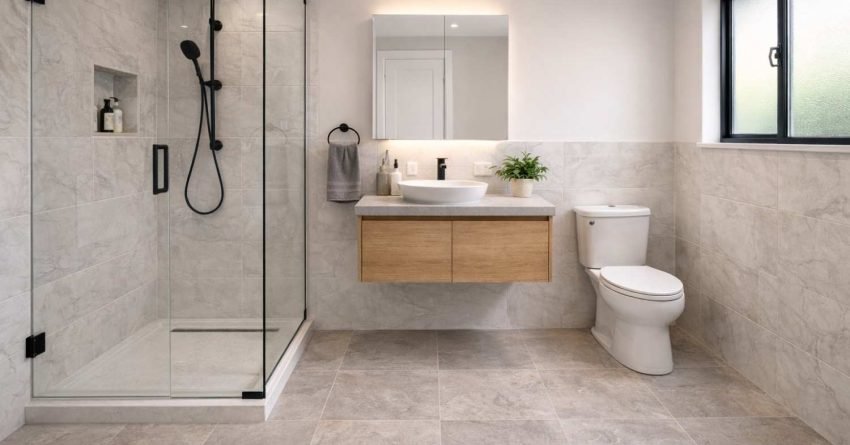
The golden rule for bathroom layouts is maintaining a minimum 1-metre clearance zone in front of all major fixtures—toilets, showers, vanities, and baths. This fundamental principle ensures comfortable movement, meets Australian building code requirements, and prevents costly layout mistakes that plague bathroom renovations across Sydney. Proper clearance isn’t just about comfort; it directly impacts functionality, safety, accessibility compliance, and resale value.

Understanding this rule before finalising your bathroom design saves thousands in rectification costs and prevents the frustration of cramped, non-compliant spaces. Whether you’re renovating a compact ensuite in Bondi or a spacious family bathroom in the Hills District, clearance requirements remain non-negotiable under the National Construction Code.

This guide breaks down exact clearance measurements, fixture placement strategies, building code requirements, and how layout decisions affect your renovation budget—giving you the knowledge to plan a functional, compliant, and cost-effective bathroom that works for your Sydney home.

What Is the Golden Rule for Bathroom Layouts?

The golden rule for bathroom layouts centres on maintaining adequate clearance zones around every fixture to ensure comfortable use, safe movement, and compliance with Australian building standards. This principle adapts the kitchen work triangle concept to bathroom-specific requirements, prioritising the relationship between the three primary fixtures: toilet, shower or bath, and vanity.

The Work Triangle Principle Adapted for Bathrooms

The bathroom work triangle connects the toilet, shower, and vanity in an efficient layout that minimises wasted movement while maximising usable space. Unlike kitchens where the triangle optimises workflow, bathroom triangles prioritise privacy, accessibility, and logical morning routines. Research from the National Kitchen & Bath Association shows that efficient bathroom layouts reduce morning congestion by 35% in shared bathrooms.

The ideal bathroom triangle maintains clear sightlines while providing visual separation between the toilet and other fixtures. In Sydney terrace renovations, this often means positioning the toilet behind a partial wall or at the far end of the room, with the vanity near the entry and shower along the opposite wall. The triangle shouldn’t exceed 7 metres in total perimeter for optimal efficiency, though smaller bathrooms naturally create tighter configurations.

Successful triangle layouts account for door swings, towel storage access, and natural light distribution. A vanity positioned near the window provides better lighting for grooming tasks, while toilets benefit from privacy screening. The shower or bath typically occupies the wettest zone, simplifying waterproofing and drainage requirements.

Minimum Clearance Requirements in Sydney Bathrooms

Australian Standard AS 1428.1 mandates specific clearance dimensions that apply to all bathroom renovations in Sydney, regardless of whether you’re targeting accessibility compliance. A minimum 1,000mm clearance must exist in front of toilets, measured from the front edge of the bowl to any opposing wall, fixture, or obstruction. This measurement isn’t negotiable—it’s embedded in the National Construction Code and enforced by Sydney council building certifiers.

Shower entries require 900mm minimum clearance from the shower screen or curtain to the nearest obstruction when the door is closed. For hinged shower screens, you must account for the full swing arc—a 900mm door requires approximately 1,100mm total clearance to open comfortably without hitting the vanity or toilet. Sliding screens reduce this requirement but introduce cleaning challenges in tight spaces.

Vanity clearances demand 1,000mm of standing space directly in front of the basin, though 1,200mm provides noticeably better comfort for couples sharing morning routines. Side clearances of 200mm minimum from walls or adjacent fixtures prevent elbow collisions during handwashing and teeth brushing. In practice, Sydney renovators targeting quality outcomes typically provide 300-400mm side clearances where space permits.

Door swings represent a frequently overlooked clearance requirement. Bathroom doors must open without striking fixtures, and Building Code of Australia regulations require 850mm minimum clear opening width for accessibility. In renovations where space is tight, outward-swinging doors or cavity sliders often provide the only compliant solution without sacrificing fixture clearances.

Why the 1-Metre Rule Matters for Functionality

The 1-metre clearance rule directly correlates with human ergonomics and movement patterns studied extensively in residential design research. Studies from the University of Sydney’s Built Environment faculty demonstrate that 95% of adults require 900-1,000mm of space to comfortably stand, turn, and perform typical bathroom tasks without feeling cramped or restricted.

Insufficient clearance creates cascading functionality problems. Toilets with less than 1,000mm front clearance force users into awkward positions, particularly problematic for elderly residents or anyone with mobility limitations. Showers with inadequate entry clearance become difficult to clean, prone to mould accumulation in tight corners, and genuinely dangerous when wet surfaces meet restricted movement space.

The rule also accounts for towel drying, dressing, and assistance scenarios. Parents bathing young children need space to kneel beside the bath. Couples sharing bathroom space require clearance to pass each other safely. Emergency situations—slips, falls, medical events—demand sufficient room for assistance or emergency responder access.

From a property value perspective, bathrooms that violate clearance standards face disclosure requirements during sales and often trigger buyer concerns about renovation quality. Domain’s 2024 renovation impact study found that non-compliant bathroom layouts reduce property values by 3-7% compared to code-compliant equivalents, with buyers specifically citing cramped layouts as deal-breakers in competitive markets.

Essential Clearance Zones in Bathroom Design

Clearance zones define the invisible boundaries around each fixture that must remain obstacle-free for safe, comfortable use. These zones overlap in most bathroom layouts, requiring careful planning to satisfy all requirements simultaneously while maximising usable floor space. Understanding each fixture’s specific clearance needs prevents the common mistake of fitting everything in without considering how people actually move through and use the space.

Toilet Clearance: Front and Side Requirements

Toilet clearance requirements are the most strictly regulated in bathroom design, reflecting both functionality needs and accessibility standards. The 1,000mm front clearance measured from the bowl’s front edge must remain completely clear—no vanity overhangs, no storage units, no decorative elements. This zone accommodates standing, sitting, and the forward lean required when using the fixture.

Side clearances require 400mm minimum from the toilet centreline to any side wall or obstruction, creating an 800mm total width clearance zone. This measurement allows comfortable positioning and prevents the cramped feeling common in poorly planned powder rooms. For bathrooms targeting accessibility compliance or aging-in-place functionality, side clearances increase to 500mm from centreline, providing 1,000mm total width for transfer from wheelchairs or walking aids.

The toilet’s relationship to the bathroom door deserves special attention. Positioning toilets directly opposite the entry door creates privacy concerns and violates the visual separation principle. Ideally, toilets should sit perpendicular to the entry or behind a partial wall, maintaining the required clearances while providing psychological comfort. In compact ensuites where options are limited, frosted glass doors or strategic vanity placement can provide visual screening.

Ceiling height above toilets must meet the 2,100mm minimum specified in the NCC, though standard 2,400mm ceiling heights provide better proportions. Bulkheads, downlights, or ventilation fans positioned directly above toilets can create an oppressive feeling—distribute these elements across the broader ceiling area instead.

Shower and Bath Access Zones

Shower clearance zones begin at the entry point and extend into the shower space itself. The 900mm minimum entry clearance applies to the area immediately outside the shower screen or curtain, measured when the door is in its closed position. For hinged screens, calculate clearance based on the door’s full swing arc—a door that swings outward requires significantly more floor space than sliding or pivot designs.

Inside the shower, Australian Standard AS 3740 recommends 900mm x 900mm minimum internal dimensions for comfortable use, though 1,000mm x 1,000mm provides noticeably better comfort and easier cleaning access. Shower niches, built-in seating, and grab bars must fit within these dimensions without encroaching on the usable standing space. Corner showers can reduce to 800mm x 800mm in extremely tight renovations, but this represents the absolute minimum for functionality.

Freestanding bath clearances demand 1,000mm minimum on the entry side—the side where users step in and out. This clearance accommodates the stepping motion, towel drying, and the space needed to safely exit a wet, slippery surface. The remaining three sides can reduce to 200mm for wall-mounted taps or 400mm for floor-mounted filler positions, though generous clearances improve the luxury feel that justifies freestanding bath installation costs.

Built-in baths require 1,000mm clearance along the full length of the entry side, with 800mm minimum at the tap end for comfortable access during filling and temperature adjustment. The clearance zone must account for any bath deck or tile surrounds—measure from the actual bath edge, not the wall behind it.

Vanity and Basin Working Space

Vanity clearances directly impact daily usability more than any other fixture because this is where multiple household members congregate during peak morning and evening periods. The 1,000mm front clearance from the vanity edge to the opposing wall or fixture provides barely adequate space for one person—1,200mm allows two people to use the space simultaneously without constant negotiation.

Side clearances of 200mm minimum from the basin centreline to walls or adjacent fixtures prevent elbow collisions during handwashing, teeth brushing, and face washing. Double vanities require 300mm minimum between basin centrelines, though 400-450mm provides genuinely comfortable shared use. In practice, 900mm between basin centres creates the luxury spacing found in high-end Sydney renovations.

Vanity height standards have evolved significantly in recent years. Traditional 850mm heights suit children and shorter adults but cause back strain for taller users. Contemporary renovations typically install vanities at 900-950mm for improved ergonomics, with some custom installations reaching 1,000mm for particularly tall households. The height decision should consider all regular users, not just current occupants—future buyers may have different needs.

Mirror and storage clearances above vanities require 200mm minimum from the basin’s back edge to any overhead cabinet or shelf. This prevents head strikes when leaning over the basin and provides clearance for tap operation. Medicine cabinets should recess into the wall rather than projecting forward, maintaining clean sightlines and preventing collisions.

Door Swing and Entry Clearances

Bathroom door clearances represent one of the most frequently violated building code requirements in Sydney renovations. Doors must open without striking any fixture, and the clear opening width must meet 850mm minimum for accessibility compliance. Standard 820mm door leaves in 870mm frames barely satisfy this requirement—920mm leaves in 970mm frames provide noticeably better access.

Inward-swinging doors require careful clearance planning. The door’s full swing arc must clear the toilet, vanity, and any other fixtures by 50mm minimum to prevent damage and allow comfortable entry. In tight layouts, this often proves impossible without relocating fixtures or switching to alternative door solutions. Sydney council building certifiers regularly reject renovation plans where door swings encroach on required fixture clearances.

Outward-swinging doors solve many clearance problems but create hallway obstruction issues and violate the psychological expectation that bathroom doors swing inward for privacy. Cavity sliders eliminate swing clearance requirements entirely but add $800-1,500 to renovation costs and require wall cavity space that may not exist in older homes with structural walls.

Pocket doors and barn-style sliding doors offer middle-ground solutions. Pocket doors disappear completely into the wall cavity, providing maximum clear opening width without swing clearance requirements. Barn doors slide along the exterior wall, maintaining the inward-privacy feel while eliminating swing clearance needs. Both options cost more than standard hinged doors but often represent the only compliant solution in challenging layouts.

Common Bathroom Layout Mistakes Sydney Renovators Make

Layout mistakes in bathroom renovations typically stem from prioritising aesthetics over functionality or attempting to fit too many features into insufficient space. These errors often aren’t apparent until construction is complete and the bathroom enters daily use, making them expensive to rectify and frustrating to live with. Understanding common pitfalls helps you avoid them during the planning phase when changes cost nothing.

Ignoring Minimum Clearance Standards

The most prevalent layout mistake involves treating clearance requirements as suggestions rather than mandatory minimums. Renovators frequently sacrifice 50-100mm of clearance to fit a larger vanity or avoid relocating plumbing, creating bathrooms that technically function but feel cramped and uncomfortable. This penny-wise, pound-foolish approach saves minor costs during construction while permanently degrading daily usability.

Shower clearances suffer particularly frequent violations. Renovators install 1,800mm vanities in 2,700mm wide bathrooms, leaving only 900mm for the shower entry clearance when the door swings open. This meets the absolute minimum but provides zero margin for error and creates a genuinely tight feeling when entering or exiting the shower. Adding 100-200mm to the shower clearance zone dramatically improves the space’s feel without significantly impacting the vanity size.

Toilet clearances face similar compromises. Positioning toilets 950mm from the opposing wall instead of the required 1,000mm might seem insignificant on paper, but that 50mm represents the difference between comfortable use and feeling cramped. The savings from avoiding plumbing relocation—typically $400-800—pale compared to the permanent functionality compromise.

The clearance mistake compounds in small bathrooms where every millimetre counts. Renovators attempt to fit standard-sized fixtures into undersized spaces rather than selecting compact alternatives or accepting that some features simply won’t fit. A 600mm vanity provides better functionality than a 750mm vanity that violates clearance requirements, even though the larger option seems more desirable.

Poor Door Placement and Swing Direction

Door placement decisions made early in the design process create cascading effects throughout the layout. Positioning the door on the wrong wall forces fixture arrangements that violate clearance requirements or create awkward traffic patterns. The door should enter the bathroom at a location that allows logical fixture placement while maintaining required clearances and providing visual privacy for the toilet.

Inward-swinging doors that strike fixtures represent a building code violation that somehow persists in completed renovations across Sydney. The door’s swing arc must clear all fixtures by 50mm minimum, yet renovators regularly install doors that graze toilet tanks, vanity edges, or towel rails. This occurs when door positions are finalised before fixture locations are confirmed, or when renovators assume they can “make it work” during installation.

The door-toilet relationship deserves particular attention. Doors that open directly onto the toilet create privacy concerns and violate the visual separation principle. Even when clearances technically comply, this arrangement feels uncomfortable and reduces the bathroom’s perceived quality. Positioning the toilet perpendicular to the door or behind a partial wall solves this problem while maintaining efficient space usage.

Hallway clearances outside bathroom doors frequently get overlooked. The door must open without blocking hallway traffic or striking opposing walls, requiring 900mm minimum hallway width for comfortable passage. In narrow hallways, outward-swinging doors or cavity sliders become necessary, adding cost but ensuring compliant, functional access.

Inadequate Shower Screen Clearance

Shower screen clearance mistakes manifest in multiple ways, all stemming from inadequate planning for how screens actually operate in three-dimensional space. Hinged screens require clearance for the full swing arc, not just the closed position. A 900mm screen door swinging outward needs approximately 1,100mm total clearance to open fully without striking the vanity, toilet, or opposing wall.

Frameless glass screens amplify clearance requirements because the glass thickness and hinge hardware add 50-80mm to the door’s swing radius. Renovators who calculate clearances based on the glass panel alone discover too late that the hardware encroaches on fixture clearances or prevents the door from opening fully. This mistake typically requires expensive screen replacement or fixture relocation to rectify.

Pivot screens create unique clearance challenges because they swing both inward and outward from a central pivot point. The inward swing must clear any built-in seating, niches, or grab bars inside the shower, while the outward swing must maintain clearances to external fixtures. Pivot screens work beautifully in generous bathrooms but often prove problematic in compact spaces where every millimetre matters.

Sliding screens eliminate swing clearance requirements but introduce their own complications. The track system requires 100-150mm of wall space beyond the shower opening for the door to slide completely open. Renovators who position the shower opening tight against a corner wall discover the door can’t slide fully open, creating a permanent 300-400mm restricted entry that makes cleaning difficult and feels claustrophobic during use.

Overlooking Accessibility Requirements

Accessibility requirements apply to all bathrooms in new construction and substantially renovated spaces, not just those specifically designed for wheelchair users. The National Construction Code mandates that at least one bathroom in every dwelling must meet accessibility standards, yet Sydney renovators routinely ignore these requirements until building certifiers reject their plans.

The 1,200mm diameter turning circle required for wheelchair access rarely fits in standard bathroom layouts without careful planning. This circle must exist in a clear floor space, not overlapping with fixture clearances or door swings. In practice, this requirement often necessitates larger bathroom footprints or creative fixture arrangements that differ significantly from traditional layouts.

Grab bar blocking—installing structural backing during construction for future grab bar installation—costs $200-400 during renovation but $2,000-3,000 to retrofit later. Yet renovators frequently skip this step, assuming current occupants don’t need accessibility features. This short-sighted approach ignores aging-in-place considerations and reduces the home’s appeal to future buyers who may have different needs.

Hobless shower entries that meet accessibility standards require careful waterproofing and drainage design to prevent water escape. The floor must slope 1:100 toward the drain across the entire bathroom, not just within the shower area. This seemingly minor detail affects tile selection, substrate preparation, and waterproofing methodology—decisions that must be made during early planning, not discovered during construction.

Applying the Golden Rule to Different Bathroom Sizes

Bathroom size dramatically affects how clearance requirements can be satisfied while still achieving desired functionality and aesthetics. Small bathrooms demand creative solutions and careful fixture selection, while large bathrooms offer flexibility that can actually create new challenges. Understanding size-specific strategies helps you optimise your layout regardless of the space you’re working with.

Small Bathrooms (Under 3m²): Space-Saving Layouts

Small bathrooms under 3m²—common in Sydney apartments, terraces, and older homes—require ruthless prioritisation and strategic fixture selection. Standard-sized fixtures simply won’t fit while maintaining required clearances, necessitating compact alternatives that sacrifice some comfort for code compliance. A typical 2.5m² bathroom might measure 1,500mm x 1,700mm, barely accommodating a toilet, shower, and small vanity.

Wall-hung toilets save 150-200mm of floor space compared to back-to-wall models, creating the clearance needed for comfortable use in tight layouts. The concealed cistern adds $600-1,200 to installation costs but often represents the difference between a compliant and non-compliant layout. Compact toilet models with 600mm total projection instead of standard 700-750mm provide additional clearance without sacrificing functionality.

Corner showers maximise usable floor space in small bathrooms by utilising the typically dead corner area. A 900mm x 900mm corner shower with a quadrant screen provides adequate showering space while leaving more central floor area for toilet and vanity clearances. Alternatively, 800mm x 1,200mm rectangular showers positioned along one wall can work if the bathroom’s proportions favour this arrangement.

Vanity selection in small bathrooms requires balancing storage needs against clearance requirements. A 450mm depth vanity instead of standard 550mm provides an extra 100mm of clearance that dramatically improves the space’s feel. Wall-hung vanities create visual spaciousness and simplify floor cleaning, though they require structural wall backing that adds $300-500 to installation costs.

Standard Bathrooms (3-5m²): Optimal Configurations

Standard bathrooms between 3-5m² offer sufficient space for comfortable fixture placement while maintaining all required clearances without extreme compromises. A typical 4m² bathroom measuring 2,000mm x 2,000mm accommodates a full-sized shower, toilet, and 750-900mm vanity with comfortable clearances throughout.

The classic three-wall layout positions fixtures along three walls with the fourth wall containing the entry door. Toilet on one short wall, shower on the opposing short wall, and vanity along one long wall creates an efficient triangle with clear circulation space in the centre. This arrangement provides 1,200-1,400mm central clearance that allows comfortable movement and simultaneous use by multiple people.

L-shaped configurations work well in rectangular bathrooms, positioning the shower and toilet along one long wall with the vanity on the perpendicular short wall. This arrangement concentrates plumbing along one wall, reducing installation costs while creating a generous clearance zone in front of all fixtures. The layout naturally separates the toilet from the entry door, providing visual privacy without requiring partial walls or screens.

Double vanity installations become feasible in 4.5-5m² bathrooms, particularly in rectangular layouts where one long wall can accommodate 1,800-2,100mm of vanity length. Positioning the double vanity opposite the shower and toilet creates a hotel-like symmetry that feels luxurious while maintaining 1,200mm+ clearances throughout. This configuration suits master ensuites where couples share morning routines.

Large Bathrooms (5m²+): Luxury Layout Options

Large bathrooms exceeding 5m² introduce new design challenges—too much space can feel cold and inefficient without careful planning. The goal shifts from fitting everything in to creating purposeful zones that feel intimate despite generous dimensions. A 7m² bathroom offers space for freestanding baths, separate shower and toilet zones, and expansive vanity areas, but requires thoughtful layout to avoid feeling empty.

Freestanding bath placement becomes the focal point in large bathrooms, positioned to capture natural light and create visual drama. Placing the bath centrally or against a feature wall with 1,000mm+ clearances on all sides creates a spa-like atmosphere that justifies the space allocation. The bath should relate to the shower and vanity zones without dominating the entire room—aim for balanced proportions rather than pushing everything to the perimeter.

Separate toilet compartments make sense in large bathrooms, providing privacy in shared spaces without sacrificing openness. A 1,200mm x 1,500mm toilet compartment with its own door creates a powder room feel within the main bathroom, ideal for master ensuites where one partner may be showering while the other needs toilet access. This arrangement adds $1,500-2,500 in construction costs for the additional wall framing and door but significantly improves functionality.

Dual shower heads, rainfall systems, and steam shower features become practical in large bathrooms where shower enclosures can expand to 1,200mm x 1,500mm or larger. These generous dimensions accommodate built-in seating, multiple shower heads, and body jets while maintaining comfortable clearances. The additional space also simplifies waterproofing and tile installation, potentially reducing labour costs despite the larger area.

Ensuite Bathrooms: Compact Design Strategies

Ensuite bathrooms face unique constraints—they must fit within the master bedroom’s footprint while providing full bathroom functionality in typically limited space. Most Sydney ensuites measure 2.5-4m², requiring the same space-saving strategies as small bathrooms but with higher finish expectations that match the master bedroom’s quality level.

The toilet-shower-vanity linear arrangement works well in narrow ensuites, positioning all three fixtures along one wall with the entry door on the opposite wall. This layout concentrates plumbing in one wall cavity, reducing installation costs while creating a clear circulation path. A 1,500mm wide ensuite can accommodate this arrangement with 900mm clearances if compact fixtures are selected carefully.

Sliding door entries save space in ensuites where traditional hinged doors would encroach on bedroom or bathroom clearances. Cavity sliders disappear into the wall, providing maximum clear opening width without swing clearance requirements. The $800-1,500 additional cost for slider hardware and installation often proves worthwhile in tight ensuite layouts where every millimetre counts.

Combined shower-bath units suit ensuites where space limitations prevent separate shower and bath installation. A 1,500-1,700mm bath with overhead shower provides both functions in the footprint of a single fixture, though the compromise sacrifices the luxury feel of separate fixtures. This solution works better in secondary ensuites or children’s bathrooms than in master ensuites where homeowners typically expect higher-end features.

Building Code Compliance and Clearance Standards

Building code compliance isn’t optional—it’s legally required for all bathroom renovations in Sydney, enforced through the development application and construction certificate process. Understanding the specific codes and standards that govern bathroom layouts helps you plan compliant designs from the outset, avoiding costly redesigns when certifiers reject non-compliant plans.

National Construction Code (NCC) Requirements

The National Construction Code (NCC) establishes minimum performance requirements for bathroom design, covering structural integrity, waterproofing, ventilation, and accessibility. Volume 2 of the NCC applies to residential bathroom renovations, setting mandatory standards that all Sydney renovations must meet regardless of the property’s age or existing conditions.

Waterproofing requirements under NCC Section 3.8.1 mandate that shower areas, bath surrounds, and floors must be waterproofed to prevent moisture penetration into structural elements. The waterproofing must extend 150mm beyond the shower screen or curtain, 100mm up walls around baths, and across the entire bathroom floor in wet area bathrooms. These requirements directly affect layout decisions—larger waterproofed areas cost more but provide better long-term protection.

Ventilation standards require either natural ventilation through windows with 5% of floor area minimum opening, or mechanical ventilation providing 25 litres per second air exchange. This requirement affects window placement and exhaust fan positioning, which in turn influences fixture layouts to maintain clearances while accommodating ventilation needs. Bathrooms without external walls must use mechanical ventilation, adding $400-800 to renovation costs.

Ceiling height minimums of 2,100mm apply throughout bathrooms, with 2,400mm standard in contemporary construction. Bulkheads, beams, or services that reduce ceiling height below 2,100mm violate code requirements and must be redesigned. This particularly affects renovations in older homes where ceiling heights may already be marginal before adding new services or structural elements.

Australian Standards for Bathroom Design (AS 1428.1)

Australian Standard AS 1428.1 specifies design requirements for access and mobility in buildings, establishing the accessibility standards that apply to residential bathrooms. While full compliance is mandatory only for one bathroom in each dwelling, the standards provide best-practice guidance for all bathroom designs, particularly for aging-in-place considerations.

The 1,200mm diameter turning circle requirement ensures wheelchair users can turn around within the bathroom. This circle must exist in clear floor space, not overlapping with fixture clearances or door swings. In practice, achieving this requirement in bathrooms under 4m² proves extremely difficult without creative fixture arrangements or accepting larger bathroom footprints.

Grab bar requirements specify locations, heights, and load-bearing capacity for bars around toilets, showers, and baths. Toilet grab bars must be positioned 800-810mm above the floor, 250mm forward of the toilet pan, and capable of supporting 1.1kN vertical load. Even if grab bars aren’t installed immediately, structural blocking should be installed during construction to enable future installation without wall demolition.

Accessible shower requirements mandate hobless entries with 1:100 floor slope, 900mm x 900mm minimum internal dimensions, and grab bar blocking on at least two walls. The shower controls must be positioned 900-1,100mm above the floor and operable with one hand without tight grasping or twisting. These requirements significantly affect shower design and waterproofing methodology, necessitating early planning rather than late-stage accommodation.

Sydney Council-Specific Regulations

Sydney councils enforce additional requirements beyond the NCC, varying by local government area. The City of Sydney, Inner West Council, and Northern Beaches Council each maintain specific development control plans that affect bathroom renovations, particularly in heritage conservation areas or apartment buildings with strata requirements.

Heritage-listed properties face additional restrictions on bathroom modifications, particularly regarding window alterations, external wall changes, and structural modifications. Renovations must maintain the property’s heritage character while achieving code compliance—a challenging balance that often requires specialist heritage architect involvement. These projects typically cost 20-30% more than equivalent non-heritage renovations due to additional approval requirements and constrained design options.

Strata buildings require approval from the owners corporation for bathroom renovations affecting common property, including plumbing in shared walls, waterproofing that extends into common areas, and structural modifications. The approval process adds 4-8 weeks to project timelines and may impose additional requirements beyond building code minimums, such as specific waterproofing systems or noise-reduction measures.

Water efficiency requirements under Sydney Water regulations mandate 3-star minimum WELS-rated fixtures for toilets, taps, and showerheads. Dual-flush toilets must provide 4.5/3 litre maximum flush volumes, showerheads must limit flow to 9 litres per minute, and taps must not exceed 7.5 litres per minute. These requirements affect fixture selection but don’t directly impact layout decisions beyond ensuring adequate space for compliant fixtures.

Accessibility and Universal Design Standards

Universal design principles extend beyond minimum accessibility compliance to create bathrooms that work for users of all ages and abilities. While not legally mandated, universal design features increase property value, improve long-term usability, and future-proof bathrooms against changing household needs. Research from the Australian Network for Universal Housing Design shows that universally designed bathrooms add 4-6% to property values in Sydney’s competitive market.

Lever-style tap handles instead of twist knobs improve usability for people with arthritis, limited hand strength, or wet hands. The cost difference is negligible—typically $0-50 per fixture—yet the functionality improvement is significant. Similarly, thermostatic mixing valves that prevent scalding cost $200-400 more than standard mixers but provide safety benefits that justify the investment, particularly in households with young children or elderly residents.

Curbless shower entries benefit everyone, not just wheelchair users. Parents bathing young children, people carrying laundry baskets, and anyone who might eventually face mobility limitations all benefit from step-free shower access. The additional waterproofing and drainage requirements add $800-1,500 to construction costs but create a more versatile, future-proof bathroom that appeals to broader buyer demographics.

Adjustable-height shower heads on sliding rails accommodate users of different heights without requiring separate shower head installations. A quality sliding rail system costs $150-300 but provides flexibility that fixed-height installations can’t match. Combined with handheld shower wands, these systems support various showering preferences and accessibility needs without compromising aesthetics.

Fixture Placement and the Golden Rule

Fixture placement decisions determine whether your bathroom layout succeeds or fails at providing comfortable, code-compliant functionality. Each fixture has specific positioning requirements based on plumbing constraints, clearance needs, and ergonomic considerations. Understanding these requirements helps you create layouts that work in practice, not just on paper.

Toilet Positioning: Wall Distances and Clearances

Toilet positioning starts with the waste outlet location—the single most expensive element to relocate in bathroom renovations. Standard toilet waste outlets sit 180mm from the finished wall, though this varies with toilet models. Wall-faced toilets require 150-160mm setback, while back-to-wall models need 180-200mm. Confirming the exact setback requirement before finalising the layout prevents costly adjustments during installation.

Side wall clearances of 400mm minimum from the toilet centreline to any wall or obstruction create the 800mm total width clearance zone required by building codes. In practice, 450-500mm side clearances provide noticeably better comfort without significantly impacting the overall layout. Corner toilet installations should avoid placing the toilet tight into the corner—maintain the 400mm minimum clearance from both walls.

The toilet’s relationship to other fixtures affects both functionality and aesthetics. Positioning the toilet directly opposite the vanity creates an awkward visual relationship and makes the toilet the first thing visible when entering the bathroom. Perpendicular arrangements or offset positions provide better visual separation while maintaining required clearances. The toilet should never be positioned where the door swing could strike it, even when the door is fully open.

Toilet paper holder placement seems minor but affects daily usability significantly. The holder should be positioned 600-700mm forward of the toilet tank, 900mm above the floor, on the side matching the user’s dominant hand. In practice, right-side placement suits 85-90% of users. The holder must not encroach on the 400mm side clearance or interfere with standing and sitting movements.

Shower Layout: Entry, Screen, and Drainage

Shower entry positioning determines the entire shower layout, affecting screen selection, drainage placement, and clearance compliance. The entry should face the bathroom’s main circulation space, not a wall or corner, providing clear access and visual openness. Corner entries work in tight layouts but create awkward access angles that make cleaning difficult and feel cramped during use.

Screen selection directly impacts clearance requirements and installation costs. Frameless glass screens cost $1,200-2,500 for standard sizes but provide superior aesthetics and easier cleaning compared to framed alternatives at $600-1,200. Sliding screens eliminate swing clearance requirements but introduce track cleaning challenges. Hinged screens provide wide openings but demand careful clearance planning for the full swing arc.

Drainage placement affects the shower floor’s slope direction and waterproofing complexity. Centre drains allow water to flow from all directions, simplifying floor slope design and providing better drainage performance. Wall drains create a single-direction slope that can feel uneven underfoot and may pool water in corners. Linear drains along one edge provide contemporary aesthetics and excellent drainage but cost $400-800 more than standard centre drains.

Built-in niches for toiletries should be planned during framing, not cut into tiles after installation. Niches positioned 1,200-1,400mm above the shower floor provide convenient access without requiring excessive reaching. The niche should sit between wall studs to avoid structural complications, typically creating 350-400mm wide storage. Waterproofing must extend completely through the niche to prevent moisture penetration into wall cavities.

Vanity Installation: Height and Spacing

Vanity height significantly affects daily comfort but receives insufficient attention in many renovations. Traditional 850mm heights suit children and shorter adults but cause back strain for taller users who must bend excessively during handwashing and grooming. Contemporary renovations typically install vanities at 900-950mm, with some custom installations reaching 1,000mm for particularly tall households.

The height decision should consider all regular users, including children who may need step stools regardless of vanity height. In family bathrooms, 900mm provides a reasonable compromise between adult comfort and child accessibility. Master ensuites can optimise for adult users exclusively, justifying 950-1,000mm heights that would be impractical in shared spaces.

Vanity depth affects both storage capacity and clearance compliance. Standard 550mm depth vanities provide adequate storage and comfortable basin positioning, but 450mm depth vanities may be necessary in tight layouts to maintain required clearances. Wall-hung vanities can reduce depth to 400mm without sacrificing functionality, though storage capacity decreases proportionally.

Double vanity spacing requires 900mm minimum between basin centres for comfortable simultaneous use, though 1,000-1,200mm provides genuinely luxurious spacing. The vanity’s total length must account for 100mm minimum clearance from side walls to prevent elbow collisions and allow comfortable access to drawers and cabinets. In practice, 150-200mm end clearances improve usability without significantly impacting the layout.

Bath Placement: Access and Surrounding Space

Freestanding bath placement creates a focal point that defines the entire bathroom’s aesthetic, but requires generous clearances that many bathrooms can’t accommodate. The entry side—where users step in and out—demands 1,000mm minimum clearance, with 1,200-1,500mm providing the comfortable access that justifies freestanding bath installation. The remaining sides can reduce to 400mm for floor-mounted fillers or 200mm for wall-mounted taps.

Built-in baths require 1,000mm clearance along the full entry length, measured from the bath’s edge including any tile deck or surround. The tap end needs 800mm minimum clearance for comfortable access during filling and temperature adjustment. In tight layouts, positioning the bath along one wall with the entry side facing the room’s centre maximises usable clearance while minimising the bath’s footprint impact.

Bath-shower combinations require careful screen planning to maintain clearances while containing water spray. Shower screens over baths should extend 150mm beyond the showerhead to prevent water escape, typically requiring 1,200-1,400mm screen length for standard 1,700mm baths. The screen must not encroach on the 1,000mm entry clearance when closed, necessitating careful measurement during planning.

Filler tap positioning affects both aesthetics and functionality. Floor-mounted fillers create dramatic visual impact but require 400mm minimum clearance around the tap for comfortable operation and maintenance access. Wall-mounted fillers save floor space and simplify cleaning but require precise positioning during rough-in—typically 700-800mm above the floor, centred on the bath’s width. Deck-mounted fillers offer the most installation flexibility but require waterproofing the penetrations through the bath deck.

How Layout Affects Bathroom Renovation Costs

Layout decisions ripple through every aspect of bathroom renovation costs, from initial plumbing rough-in to final fixture installation. Understanding these cost relationships helps you make informed trade-offs between ideal layouts and budget realities, identifying where layout changes save money and where they create expensive complications.

Plumbing Relocation: When Moving Fixtures Adds Cost

Plumbing relocation represents the single largest cost variable in bathroom layout decisions. Moving a toilet 500mm from its existing location costs $800-1,500 for waste pipe relocation, floor penetration sealing, and waterproofing adjustments. Moving it 2,000mm to the opposite wall costs $2,500-4,000 due to additional pipe runs, potential floor joist modifications, and increased waterproofing complexity.

Shower relocations cost $1,200-2,500 depending on distance and whether the move requires new floor penetrations. Moving a shower 1,000mm along the same wall costs less than moving it to an adjacent wall because the waste pipe can often be extended without new floor penetrations. Moves that require new floor penetrations in concrete slabs add $800-1,500 for core drilling, pipe installation, and penetration waterproofing.

Vanity relocations prove least expensive because basin waste pipes are smaller and more flexible than toilet or shower waste. Moving a vanity 1,500mm typically costs $400-800 for new waste and water supply lines. However, moves that require relocating the main waste stack or significantly extending hot water lines can escalate to $1,500-2,500 in plumbing costs alone.

The cost-benefit analysis of plumbing relocation should weigh the expense against the layout improvement. Spending $2,000 to relocate a toilet that creates a compliant, comfortable layout makes sense. Spending $2,000 to move a toilet 300mm for purely aesthetic reasons rarely justifies the cost. Focus plumbing relocation budget on moves that solve clearance violations or significantly improve functionality.

Structural Changes Required for Proper Clearances

Structural modifications to achieve proper clearances add significant costs but may be unavoidable in tight layouts or when correcting previous non-compliant renovations. Removing a non-structural wall to expand a cramped bathroom costs $1,500-3,000 including demolition, waste removal, and making good adjacent spaces. Removing structural walls requires engineering assessment, temporary support installation, and beam installation, escalating costs to $8,000-15,000 or more.

Door relocations to improve fixture clearances cost $1,200-2,500 including new framing, door hardware, and making good the old opening. Converting to cavity sliders adds $800-1,500 to these costs for slider hardware and wall cavity preparation. In masonry walls, door relocations require structural lintels and cost $3,000-5,000 due to cutting, lintel installation, and making good the masonry.

Floor level changes to achieve hobless shower entries in existing bathrooms require careful structural assessment. Lowering the shower floor 100mm to create proper drainage slope costs $2,500-4,500 including floor removal, substrate modification, waterproofing, and tile installation. In upper-floor bathrooms, floor lowering may be impossible without affecting ceiling heights in rooms below, necessitating alternative solutions like linear drains with minimal floor slope.

Ceiling height modifications to meet the 2,100mm minimum rarely make economic sense in existing bathrooms. Raising ceilings requires roof structure modifications costing $15,000-30,000 or more—far exceeding the value of the bathroom renovation itself. In these situations, accepting the existing ceiling height or redesigning the layout to avoid low-ceiling areas proves more practical than structural modifications.

Waterproofing Implications of Layout Decisions

Waterproofing costs scale with the area requiring treatment, making layout decisions that minimise waterproofed area potentially cost-effective. A 3m² shower area costs $1,200-1,800 to waterproof, while a 4.5m² shower costs $1,800-2,700—the 50% size increase creates a 50% cost increase. However, undersizing showers to save waterproofing costs often proves penny-wise and pound-foolish, creating cramped spaces that fail to meet clearance requirements.

Wet area bathrooms where the entire floor is waterproofed cost $2,500-4,500 for a 4m² bathroom compared to $1,500-2,500 for waterproofing only the shower and bath surrounds. The additional cost buys superior moisture protection and eliminates the risk of water damage from shower screen leaks or bath overflows. In upper-floor bathrooms or apartments where water damage affects neighbours, wet area waterproofing often justifies the additional expense.

Complex layouts with multiple corners, niches, and penetrations increase waterproofing labour costs by 20-40% compared to simple rectangular layouts. Each corner requires careful membrane folding and sealing, each niche needs complete internal waterproofing, and each penetration demands specialised sealing details. Simplifying the layout by minimising corners and penetrations reduces waterproofing costs while improving long-term reliability.

Waterproofing warranties depend on proper installation and approved system usage. AS 3740 waterproofing standards require licensed waterproofers to install systems according to manufacturer specifications. Layout decisions that create waterproofing challenges—tight corners, complex floor slopes, numerous penetrations—increase the risk of installation errors that void warranties and create future leak risks.

Cost-Effective Layout Solutions for Tight Budgets

Budget-conscious layouts prioritise fixture placement that minimises plumbing relocation while maintaining code compliance. Keeping fixtures on existing plumbing walls saves $3,000-6,000 in relocation costs that can be redirected toward higher-quality fixtures, better tiles, or improved waterproofing. This strategy requires accepting layout constraints but often produces better overall outcomes than expensive plumbing moves that consume the budget.

Compact fixture selection enables code-compliant layouts in tight spaces without expensive structural modifications. A 600mm projection toilet instead of 750mm standard saves 100-150mm of clearance space, potentially eliminating the need for wall relocation costing $2,000-4,000. Similarly, 450mm depth vanities instead of 550mm standard save 100mm that might make the difference between compliant and non-compliant clearances.

Prefabricated shower bases cost $400-800 compared to $1,500-2,500 for custom-tiled shower floors, offering significant savings in tight-budget renovations. Quality prefab bases provide reliable waterproofing and proper drainage slope without the labour intensity of custom tile work. The aesthetic compromise is minimal with contemporary prefab options that closely mimic custom tile appearances.

Phased renovation approaches allow spreading costs across multiple budget cycles while maintaining code compliance. Phase one might address critical clearance violations and waterproofing, using budget fixtures temporarily. Phase two upgrades fixtures and finishes once budget allows. This strategy ensures the bathroom functions safely and legally while deferring aesthetic improvements to future budgets.

Planning Your Bathroom Layout: Step-by-Step Process

Successful bathroom layouts emerge from systematic planning that addresses clearances, code compliance, and functionality before committing to construction. Following a structured process prevents costly mistakes and ensures the final layout works in practice, not just on paper. This step-by-step approach applies whether you’re working with a designer or planning the layout yourself.

Measuring Your Existing Space Accurately

Accurate measurements form the foundation of successful bathroom planning. Measure wall lengths at multiple heights—100mm above the floor, 1,000mm mid-height, and 2,100mm near the ceiling—because walls in older homes often aren’t perfectly straight or plumb. Record the smallest measurement for each wall to ensure fixtures fit in the tightest spots, not just the widest.

Door and window locations require precise measurement including frame dimensions, swing directions, and clearances. Measure from multiple reference points—adjacent walls, floor, ceiling—to create redundant measurements that catch errors. A 10mm measurement error in door location can create clearance violations that aren’t apparent until construction begins and fixtures are positioned.

Ceiling heights should be measured at multiple points across the bathroom because floors and ceilings often aren’t level in existing homes. The lowest ceiling point determines compliance with the 2,100mm minimum height requirement. Bulkheads, beams, and services that reduce ceiling height must be measured and documented because they affect fixture placement and lighting design.

Existing plumbing locations—waste outlets, water supply lines, floor drains—must be measured precisely because relocating them adds significant cost. Measure from multiple reference points and photograph the locations for reference during planning. Note the pipe sizes and materials because these affect relocation costs and may require upgrades to meet current code requirements.

Identifying Fixed Elements (Plumbing, Windows, Doors)

Fixed elements that can’t be moved or are expensive to relocate should be identified early in the planning process. Structural walls, main waste stacks, and external windows typically represent immovable constraints that the layout must accommodate. Understanding these constraints prevents designing ideal layouts that prove impossible or prohibitively expensive to construct.

Main waste stacks—the large vertical pipes that carry waste from upper floors—cannot be relocated without affecting multiple levels and costing $10,000-20,000 or more. Bathrooms should be planned around existing waste stack locations, positioning toilets within 3,000mm of the stack to maintain proper drainage slope without expensive floor modifications.

External windows provide natural light and ventilation but constrain fixture placement. Positioning toilets directly under windows creates privacy concerns and complicates window treatment installation. Vanities work well under windows, providing natural light for grooming tasks, though the window sill height must allow adequate mirror space above the vanity.

Structural elements—load-bearing walls, beams, columns—cannot be removed without expensive engineering and temporary support installation. These elements should be identified through building plans or professional assessment before finalising layouts. In many cases, working around structural constraints proves more cost-effective than removing them, even when removal would create a superior layout.

Creating a Scaled Floor Plan

Scaled floor plans transform measurements into visual layouts that reveal clearance relationships and spatial proportions. Use 1:20 or 1:25 scale for bathroom plans—large enough to show detail but small enough to fit on standard paper. Graph paper simplifies scaling, with each square representing 100mm or 200mm depending on the scale chosen.

Draw the bathroom’s perimeter walls first, then add fixed elements—doors, windows, structural walls, plumbing locations. Use different line weights or colours to distinguish between movable and immovable elements. This visual distinction helps during layout development when you’re evaluating which elements can be relocated and which must be accommodated.

Add fixture templates at the correct scale, including clearance zones around each fixture. Toilet templates should show the 1,000mm front clearance and 800mm width clearance. Shower templates should include the entry clearance and door swing arc. Vanity templates should show the 1,000mm front clearance. These clearance zones quickly reveal whether proposed layouts comply with code requirements.

Test multiple layout options on separate plan copies or using digital tools that allow easy fixture repositioning. Evaluate each option against clearance requirements, plumbing relocation costs, and functionality goals. The best layout balances code compliance, budget constraints, and user needs—rarely the first option considered.

Testing Clearances and Movement Patterns

Paper plans reveal clearance compliance but don’t fully communicate how the space feels during use. Mock up the layout in the existing bathroom using painter’s tape on the floor to represent fixture locations and clearance zones. This physical mockup reveals movement patterns, visual relationships, and spatial proportions that aren’t apparent on paper.

Walk through typical bathroom routines in the mocked-up space—entering, using the toilet, showering, using the vanity, exiting. Note where movements feel cramped or awkward, where clearances feel tight, and where the layout creates conflicts between simultaneous users. These real-world tests often reveal problems that compliant paper plans miss.

Test door swings using cardboard templates or the actual door if it’s being reused. Ensure the door opens without striking fixtures and provides adequate clear opening width. Test from both inside and outside the bathroom because the experience differs depending on entry direction. Doors that feel fine when entering may feel cramped when exiting, particularly in tight layouts.

Consider accessibility scenarios even if current users don’t have mobility limitations. Can someone using a walking frame navigate the space? Is there room for assistance if needed? Could a wheelchair user access the toilet if future needs change? These considerations future-proof the layout and increase the home’s appeal to broader buyer demographics.

Professional Layout Review and Approval

Professional review by licensed plumbers, builders, or bathroom designers catches errors and code violations before construction begins. A $500-1,000 design review investment prevents $5,000-15,000 in rectification costs when non-compliant layouts are discovered during construction or certification. Professionals bring experience with code requirements, construction realities, and common pitfalls that homeowners often miss.

Licensed plumbers should review layouts for plumbing feasibility, identifying potential drainage problems, water pressure issues, or code violations. They can estimate relocation costs accurately and suggest alternative fixture positions that reduce plumbing complexity. This review should occur before finalising the layout, when changes cost nothing rather than during construction when changes are expensive.

Building certifiers review layouts for code compliance, identifying clearance violations, waterproofing issues, or structural concerns that would prevent certification. Early certifier involvement prevents designing layouts that can’t be approved, saving the time and cost of redesigning non-compliant plans. Some certifiers offer pre-lodgement consultations that provide informal feedback before formal application submission.

Bathroom designers bring aesthetic expertise and product knowledge that complements technical compliance. They can suggest fixture selections that meet clearance requirements while achieving desired aesthetics, identify tile layouts that simplify waterproofing, and recommend lighting positions that enhance functionality. Designer fees of $1,500-4,000 often prove worthwhile for complex renovations or when homeowners lack confidence in their own design abilities.

Working with Professionals for Compliant Layouts

Professional involvement ensures bathroom layouts meet code requirements, function effectively, and avoid costly mistakes that plague DIY planning efforts. Different professionals bring specialised expertise—knowing when to engage each type and what to expect from their involvement helps you build an effective project team.

When to Hire a Bathroom Designer

Bathroom designers specialise in space planning, fixture selection, and aesthetic coordination—skills that prove particularly valuable in challenging layouts or when homeowners want high-end results. Engage a designer when the bathroom is under 4m² and requires creative solutions to fit all desired fixtures while maintaining clearances. Designers excel at maximising tight spaces through clever fixture selection and innovative layout approaches.

Complex renovations involving structural changes, plumbing relocations, or accessibility requirements benefit from designer involvement. Designers coordinate with engineers, plumbers, and builders to ensure aesthetic goals align with technical realities. They can visualise how layout decisions affect the final space and suggest alternatives when initial concepts prove impractical or too expensive.

Designer fees typically range $1,500-4,000 for complete bathroom design including floor plans, elevations, fixture schedules, and tile layouts. Some designers charge hourly rates of $100-200 for consultation-only services where homeowners want professional input without full design services. The investment often pays for itself through better fixture selection, reduced construction errors, and layouts that maximise the space’s potential.

Expect designers to provide scaled floor plans showing fixture locations and clearances, elevations showing tile layouts and fixture heights, and detailed specifications for all fixtures and finishes. Quality designers also provide 3D renderings that help visualise the finished space—particularly valuable when making decisions about layouts that differ significantly from the existing configuration.

The Role of Licensed Plumbers in Layout Planning

Licensed plumbers bring technical expertise about drainage, water supply, and code compliance that’s essential for functional bathroom layouts. Engage a plumber during early planning to review proposed fixture locations and identify potential problems before finalising the layout. Plumbers can confirm whether proposed toilet positions will drain properly, whether water pressure is adequate for multiple fixtures, and whether the layout complies with plumbing code requirements.

Plumbers should provide written quotes that itemise costs for each fixture installation and any required relocations. Detailed quotes reveal the cost impact of layout decisions—moving a toilet 1,000mm might cost $1,200 while moving it 2,000mm costs $3,500. This information helps you make informed trade-offs between ideal layouts and budget realities.

Expect plumbers to identify code violations in proposed layouts, such as inadequate drainage slope, improper vent sizing, or fixture positions that violate clearance requirements. Quality plumbers suggest alternative positions that solve problems while minimising costs. They should explain why certain positions work better than others, helping you understand the technical constraints that affect layout decisions.

Plumber involvement should continue through construction, not just planning. The plumber who reviewed the layout should perform the rough-in work to ensure the installation matches the approved plan. Changes during construction should be reviewed by the plumber to confirm they don’t create drainage problems or code violations that emerge only after walls are closed and fixtures are installed.

Building Certifier Requirements for Layout Changes

Building certifiers ensure renovations comply with the National Construction Code and local council requirements, reviewing plans before issuing construction certificates that authorise work to proceed. Certifier involvement is mandatory for bathroom renovations that involve structural changes, plumbing alterations, or waterproofing work—essentially all bathroom renovations beyond simple fixture replacement.

Submit detailed floor plans showing fixture locations, clearances, door swings, and waterproofing extents. Certifiers review these plans against code requirements, identifying violations that must be corrected before approval. Common issues include inadequate clearances, missing accessibility features, improper waterproofing extents, or ventilation deficiencies. Addressing these issues during planning costs nothing; addressing them during construction costs thousands.

Certifier fees typically range $800-1,500 for standard bathroom renovations, covering plan review, construction inspections, and final certification. Private certifiers often provide faster service than council certifiers, though fees may be slightly higher. Choose certifiers based on responsiveness and expertise rather than lowest cost—delays in certification extend project timelines and increase holding costs.

Expect multiple inspections during construction—typically after rough-in plumbing, after waterproofing, and before final fixture installation. The certifier confirms work complies with approved plans and code requirements at each stage. Final certification is issued only when all work meets requirements, enabling connection of water and sewer services and legal occupation of the renovated bathroom.

How Sydney Home Renovation Ensures Code-Compliant Designs

Sydney Home Renovation integrates code compliance into every stage of bathroom planning and construction, eliminating the stress and uncertainty that plague renovations when compliance is treated as an afterthought. Our process begins with detailed site measurement and existing condition assessment, identifying constraints and opportunities before any design work begins.

We provide scaled floor plans showing all fixture locations, clearance zones, and door swings, with clearances clearly marked to demonstrate code compliance. Our plans include plumbing layouts showing waste and water supply routing, helping you understand the cost implications of different fixture positions. This transparency enables informed decision-making about layout trade-offs between ideal configurations and budget realities.

Our licensed plumbers review all layouts before finalising designs, confirming drainage adequacy, water pressure sufficiency, and code compliance. This integrated approach prevents the common problem where designers create layouts that plumbers later deem impractical or non-compliant. When plumbing constraints require layout adjustments, we present alternatives that maintain functionality while solving technical problems.

We coordinate building certifier involvement from project inception, ensuring layouts meet approval requirements before construction begins. Our experience with Sydney council requirements and certifier expectations streamlines the approval process, reducing delays and preventing the costly redesigns that occur when non-compliant plans are submitted. We handle all certifier communications and inspections, keeping your project on schedule while ensuring full compliance with all applicable codes and standards.

Conclusion

The golden rule for bathroom layouts—maintaining minimum 1-metre clearances around all fixtures—forms the foundation of functional, code-compliant, and comfortable bathroom design. Understanding clearance requirements, building code standards, and how layout decisions affect renovation costs empowers you to plan bathrooms that work beautifully in practice, not just on paper. Proper planning prevents the costly mistakes and compliance violations that plague poorly planned renovations.

Successful bathroom layouts balance clearance requirements, fixture functionality, aesthetic goals, and budget realities through systematic planning and professional expertise. Whether you’re renovating a compact ensuite or a spacious master bathroom, the principles remain constant—adequate clearances, logical fixture relationships, code compliance, and thoughtful consideration of how people actually use the space. These fundamentals create bathrooms that enhance daily life and add lasting value to your Sydney home.

Sydney Home Renovation brings the expertise, experience, and integrated approach that transforms bathroom layout challenges into successful renovations. Our team handles every aspect from initial measurement and code-compliant design through licensed construction and final certification, ensuring your bathroom renovation delivers the functionality, quality, and value you deserve. Contact us today to discuss your bathroom renovation and discover how proper layout planning creates spaces that work perfectly for your needs.

Frequently Asked Questions

What is the minimum clearance required in front of a toilet in Sydney bathrooms?

The minimum clearance required in front of a toilet is 1,000mm measured from the front edge of the bowl to any opposing wall, fixture, or obstruction. This requirement is mandated by Australian Standard AS 1428.1 and enforced through the National Construction Code. The clearance ensures comfortable use and meets accessibility standards that apply to all bathroom renovations in Sydney.

Can I reduce bathroom clearances to fit a larger vanity?

No, you cannot reduce clearances below code-required minimums to accommodate larger fixtures. The 1,000mm front clearances and 400mm side clearances for toilets are mandatory minimums, not suggestions. Violating these requirements creates non-compliant bathrooms that won’t pass building certification and may require expensive rectification. Choose appropriately sized fixtures that fit within available space while maintaining required clearances.

How much does it cost to relocate bathroom plumbing in Sydney?

Plumbing relocation costs vary significantly based on distance and complexity. Moving a toilet 500mm typically costs $800-1,500, while moving it 2,000mm to a different wall costs $2,500-4,000. Shower relocations cost $1,200-2,500, and vanity moves cost $400-800. Relocations requiring new floor penetrations in concrete slabs add $800-1,500 for core drilling and waterproofing.

Do all bathrooms need to meet accessibility standards?

At least one bathroom in every dwelling must meet accessibility standards under the National Construction Code, though full wheelchair accessibility isn’t required for all bathrooms. However, basic clearance requirements—1,000mm front clearances, 400mm side clearances, 850mm door openings—apply to all bathrooms regardless of accessibility designation. These standards ensure functional, code-compliant spaces for all users.

What’s the best layout for a small bathroom under 3m²?

Small bathrooms under 3m² work best with compact fixtures positioned along three walls—toilet on one short wall, shower on the opposing short wall, and vanity along one long wall. Wall-hung toilets save 150-200mm of floor space, 900mm x 900mm corner showers maximise usable floor area, and 450mm depth vanities maintain clearances in tight spaces. This configuration provides required clearances while fitting all essential fixtures.

How do I know if my bathroom layout complies with building codes?

Engage a licensed plumber or building certifier to review your proposed layout against National Construction Code requirements and Australian Standards. They’ll verify clearances, waterproofing extents, ventilation adequacy, and accessibility compliance. Professional review costs $500-1,000 but prevents expensive rectification when non-compliant layouts are discovered during construction or certification. Sydney Home Renovation includes code compliance review in all bathroom design services.

What clearance is needed for shower doors to open properly?

Hinged shower doors require clearance for the full swing arc—a 900mm door needs approximately 1,100mm total clearance to open fully without striking fixtures. Sliding doors eliminate swing clearance requirements but need 100-150mm of wall space beyond the opening for the door to slide completely open. Pivot doors require clearance both inside and outside the shower for their dual-direction swing. Measure carefully and account for door hardware thickness when calculating clearances.