
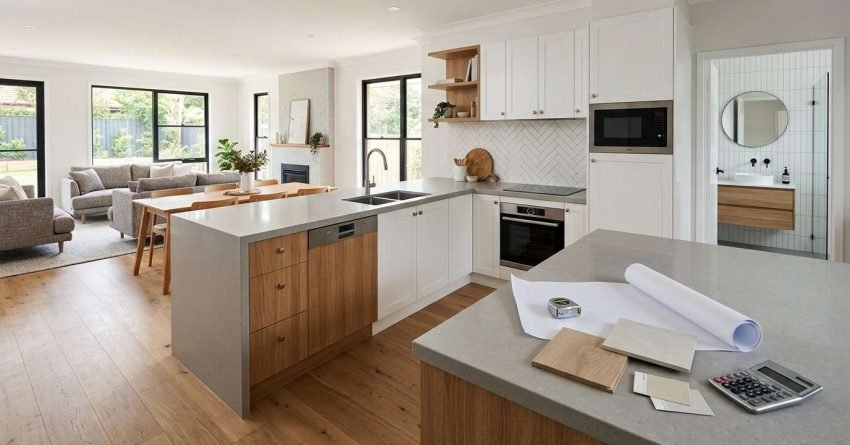
With a $100,000 renovation budget in Sydney, we see homeowners complete full bathroom overhauls, kitchen upgrades, or a combination of high-impact cosmetic improvements across multiple rooms. This budget sits firmly in the mid-range for Sydney renovations, enough for one major transformation or several targeted updates that meaningfully lift a property’s value and liveability.
For homeowners and property investors, $100,000 is a serious commitment. Every decision carries weight in Sydney’s current construction environment, where labour costs are high and material prices remain elevated.
Poor planning leads to budget blowouts.
Smart allocation builds equity and lifestyle value simultaneously. I put this guide together with our project team to give you an honest, detailed picture of what $100,000 actually buys in Sydney, room by room and trade by trade. We cover cost breakdowns, per-square-metre benchmarks, approval requirements, timelines, and the strategic decisions that separate renovations that pay off from those that don’t.
What Determines the Cost of Home Renovations in Sydney?
Sydney renovation costs depend on several interconnected factors that we assess on every project. Labour rates across Sydney typically range from $50 to $85 per hour for qualified tradespeople, with specialist trades like electricians and plumbers sitting at the higher end.
Material costs fluctuate based on supply chains and quality selections. Your property’s age and condition shape the final number more than most homeowners expect, and Australian construction input costs have stayed elevated through recent years according to Australian Bureau of Statistics producer price data.
Location within Sydney affects costs significantly. Inner-city projects often face access restrictions, limited parking, and tight site conditions that add time and expense to every trade.
That geography carries a real premium. Inner-ring suburbs such as Balmain, Paddington, and Surry Hills typically run 10% to 20% above middle-ring equivalents on the same scope, driven by access, parking, heritage overlays, and skip placement. Middle-ring suburbs sit closest to the benchmark rates, and outer-ring projects sometimes attract travel loadings from specialist trades who are based closer to the CBD.
Older homes in those inner suburbs frequently hide structural surprises behind walls, surprises that only reveal themselves once demolition begins.
The scope of work drives your budget more than any single line item. Structural changes require engineering assessments and council approvals, which add both cost and time before a single tool is lifted.
Cosmetic updates skip these requirements entirely. That is why a well-planned cosmetic renovation often delivers better value per dollar than a structural one.
Hidden costs catch many first-time renovators off guard, and we see this regularly on site. Asbestos removal in pre-1990 homes adds $5,000 to $15,000 to your budget depending on the extent of contamination, and SafeWork NSW requires a licensed removalist for more than 10 square metres of bonded material.
Electrical rewiring in older properties often becomes necessary once walls open up. Plumbing that looked functional from the outside frequently needs full replacement once exposed.
We always recommend building a contingency fund of 10% to 15% into your budget. For older homes, we push that to 15% to 20%.
What Does Renovation Cost Per Square Metre in Sydney?
Per-square-metre rates are the fastest way to sanity-check a quote before you get into line items. We use these bands as our starting point on every Sydney enquiry, then adjust for access, age, and finish level.
| Renovation Level | Cost per m² (Sydney) | What It Covers |
| Cosmetic refresh | $500 – $1,200 | Paint, flooring, lighting, fixture swaps, no trades in walls |
| Mid-range renovation | $1,500 – $2,500 | New kitchen or bathroom fitout, some services relocated |
| High-end renovation | $2,500 – $4,000 | Premium finishes, custom joinery, full services replacement |
| Structural / extension | $3,000 – $5,000 | New footings, framing, roofing, full compliance pathway |
Apply the arithmetic to your own home and the budget gets clear fast. A 150-square-metre house at cosmetic level lands around $75,000 to $180,000, which tells you immediately that a whole-home cosmetic refresh sits at the edge of a $100,000 budget rather than comfortably inside it.
What Are the Biggest Expenses of a Home Remodel?
Labour consistently represents the largest renovation expense. In Sydney, labour typically accounts for 40% to 50% of total project costs, and that figure holds across almost every project type we manage.
Skilled trades command premium rates because their expertise ensures compliance with Australian building standards. Cutting corners here creates liability, not savings.
Structural modifications rank second in expense. Moving walls, adding windows, or changing rooflines requires engineering input, council approval, and coordination across multiple trades.
These changes trigger development application processes that add weeks to your timeline and thousands to your budget before construction even begins.
The distinction between structural and cosmetic work matters enormously for budget planning. Structural work is anything that touches load-bearing elements, changes the building envelope, or requires a building permit, and it carries approval costs, engineering fees, and compliance inspections on top of the construction cost itself.
Cosmetic work, by contrast, moves fast and stays on budget because it sidesteps the approval layer entirely. In my experience, knowing which category your project falls into before you commit is one of the most valuable things a good builder does at the quoting stage.
Wet areas demand significant investment regardless of scope. Bathrooms and kitchens require waterproofing, plumbing, and electrical work that must coordinate precisely.
Mistakes in wet areas don’t just look bad. They cause structural damage that costs multiples of the original saving to fix.
Fixtures and fittings vary dramatically in price. A basic toilet costs around $300, while designer options exceed $2,000, and tapware ranges from $150 to $1,500 per set.
These selections are where budget discipline either holds or breaks down. We help clients make these calls based on their specific goals, whether that is selling, renting, or staying long-term.
Project management and coordination consume real resources. Someone must schedule trades, order materials, manage inspections, and solve the daily problems that arise on every site.
Professional project management typically costs 10% to 15% of the build value. In our experience it saves more than it costs through efficiency gains and avoided mistakes.
Do You Need Council Approval for a $100,000 Renovation in Sydney?
This is one of the most common questions we field, and the answer shapes your entire project timeline and budget.
In New South Wales, most renovations fall under one of two approval pathways. A Development Application is required for structural changes, additions, or work that affects the building envelope, including adding a room, moving a load-bearing wall, or changing the roofline.
DA approval typically takes 4 to 12 weeks and costs $500 to $2,000 in council fees, plus the cost of architectural drawings and engineering reports where required.
A Complying Development Certificate is a faster pathway for work that meets pre-set standards under the State Environmental Planning Policy. Many bathroom and kitchen renovations, internal alterations, and deck additions qualify for complying development under the NSW Planning framework, which a private certifier issues in 10 to 20 business days.
CDC fees typically run $800 to $2,500 depending on project value.
Purely cosmetic work such as painting, flooring, cabinetry replacement, and fixture swaps requires no approval at all. This is why cosmetic renovations move quickly and stay on budget.
We assess every project’s approval requirements upfront so there are no timeline surprises once work begins.
How Long Does a $100,000 Renovation Take in Sydney?
Timeline varies significantly by project type, and setting realistic expectations here prevents a lot of frustration.
A bathroom renovation at the $25,000 to $45,000 level typically takes 4 to 8 weeks on site, assuming no hidden structural issues. Two bathrooms back-to-back run 8 to 14 weeks.
A kitchen renovation in the $30,000 to $60,000 range takes 6 to 10 weeks depending on cabinetry lead times, which currently run 4 to 8 weeks from order to delivery.
A whole-home cosmetic renovation covering flooring, paint, lighting, and fixtures throughout takes 6 to 10 weeks for an average Sydney home. Multi-room structural renovations with council approval run 16 to 24 weeks from approval to completion.
The timeline killers we see most often are delayed material orders, trades booked too loosely, and approval processes that weren’t factored into the schedule.
We build all of these into our project plans from day one, which is why our projects finish when we say they will.
Major Room Overhauls You Can Do with a $100,000 Renovation Budget
A $100,000 budget opens doors to significant transformations. We tackle multiple rooms or invest deeply in one area depending on the client’s goals, and the choice always comes back to priorities and the property’s position in the market.
Bathrooms
Bathroom renovations deliver strong returns in Sydney’s property market. A mid-range bathroom renovation costs between $25,000 and $45,000 in Sydney, covering demolition, waterproofing, tiling, fixtures, and finishes.
With $100,000, we renovate two bathrooms comprehensively, or create one luxury main bathroom and update a second cosmetically.
Waterproofing is a non-negotiable expense and one we never compromise on. Sydney regulations require certified waterproofing in all wet areas, and this typically costs $1,500 to $3,000 per bathroom.
Cutting corners here creates expensive structural damage within a few years.
Tile selection significantly impacts the bathroom budget. Basic tiles start around $30 per square metre, while designer options exceed $150 per square metre, and labour for tiling adds another $60 to $100 per square metre on top of the tile cost itself.
Adding Space
Room additions stretch a $100,000 budget considerably. Basic ground-floor extensions cost approximately $2,500 to $4,000 per square metre in Sydney, meaning a modest 20-square-metre addition consumes the entire budget before finishes are selected.
We often recommend alternatives that maximise existing space instead. Converting a garage into living space costs less than building new and frequently avoids complex council approvals.
Enclosing a covered outdoor area creates usable square metres at a fraction of the extension cost. Attic conversions are another option, and Sydney’s older homes often have unused roof cavities that convert at $2,000 to $3,000 per square metre, subject to a structural feasibility assessment.
It helps to know where $100,000 sits against the bigger space options. A detached granny flat in Sydney typically costs $150,000 to $250,000 complete, and a second-storey addition runs $300,000 to $500,000 once engineering, roofing, and internal reconfiguration are counted.
Both sit well beyond this budget. Reclaiming existing footprint is almost always the better move at $100,000.
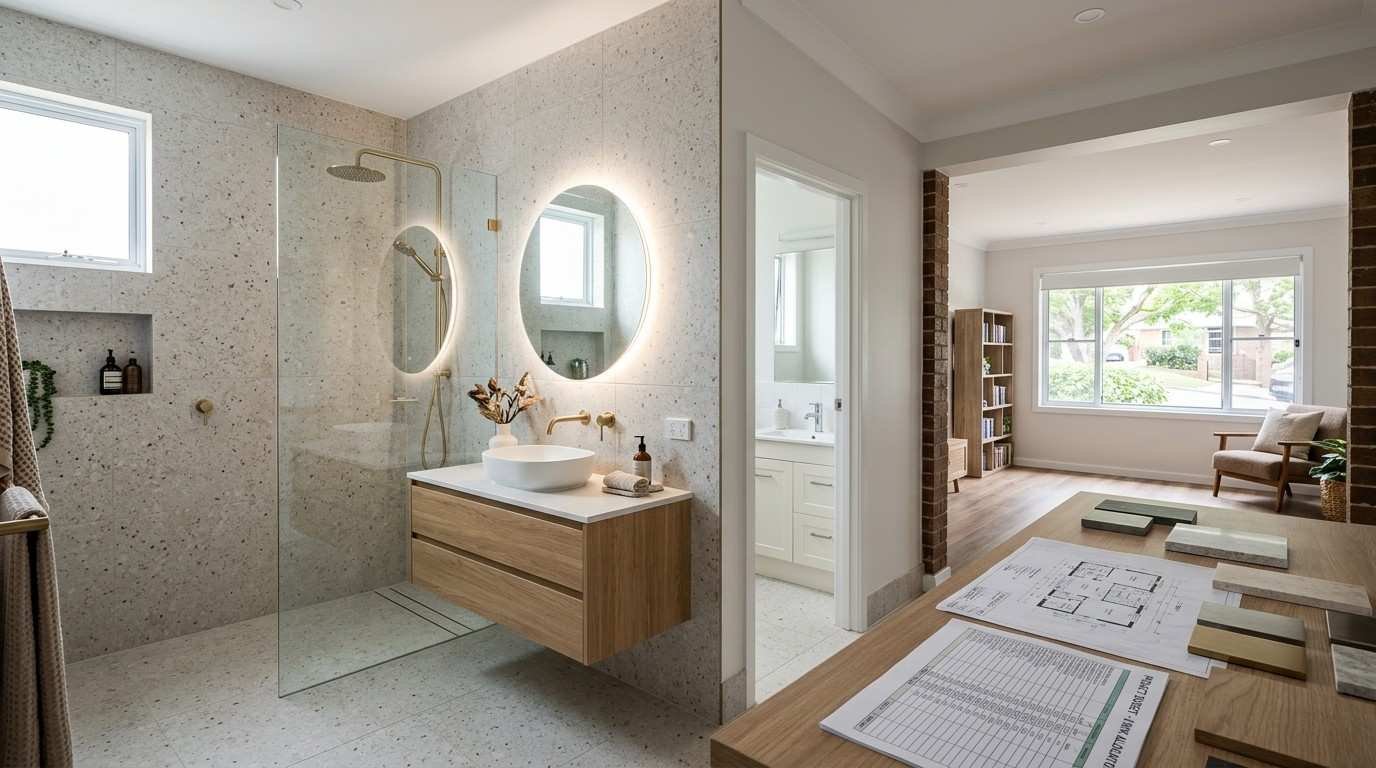
Renovation Costs for Different Home Areas in Sydney
Understanding area-specific costs helps allocate a $100,000 budget wisely. Each room type carries a different cost profile and a different return potential.
Kitchen renovations in Sydney range from $20,000 to $60,000 for mid-range projects. Cabinetry represents the largest expense, typically 30% to 40% of the kitchen budget.
Appliances, benchtops, and splashbacks consume the remainder, and the quality of these selections is where the budget either holds or blows out.
Living area updates cost considerably less than wet areas. Painting, flooring, and lighting upgrades transform spaces affordably, and a complete living room refresh runs $10,000 to $20,000 depending on size and finish level.
Bedroom renovations focus primarily on cosmetic improvements. Built-in wardrobes cost $3,000 to $8,000 per room, and we budget $8,000 to $15,000 per bedroom for comprehensive updates including new flooring, paint, and lighting.
Laundry renovations are frequently overlooked but create real trade efficiencies when combined with bathroom work. A functional laundry upgrade costs $10,000 to $20,000 in Sydney, covering cabinetry, benchtops, tiling, and appliance connections.
Sample Budget Allocation for a $100,000 Renovation
| Area | Allocation | Estimated Spend |
| Main bathroom (full renovation) | 30% | $30,000 |
| Kitchen (mid-range update) | 25% | $25,000 |
| Living areas (flooring + paint) | 15% | $15,000 |
| Laundry (functional upgrade) | 8% | $8,000 |
| Contingency (hidden costs) | 12% | $12,000 |
| Project management | 10% | $10,000 |
| Total | 100% | $100,000 |
This allocation suits a property being prepared for sale or rental. Owner-occupiers often shift more toward the kitchen and living areas based on personal priorities.
Cosmetic & High-ROI Updates for a $100,000 Renovation in Sydney
Strategic cosmetic updates stretch a budget further than almost any structural work. These improvements deliver the highest return on investment because they transform appearance without the approval costs, engineering fees, and extended timelines that structural changes require.
Flooring & Paint
Fresh paint delivers the highest ROI of any single renovation activity. Professional painting for an average Sydney home costs $8,000 to $15,000 and transforms every room simultaneously.
Neutral colours such as warm whites, soft greys, and greige tones appeal to the broadest buyer pool and photograph well for listings.
Flooring replacement creates immediate visual impact. Timber flooring costs $120 to $200 per square metre installed, and hybrid flooring offers durability at $80 to $150 per square metre.
Hybrid is our most recommended option for investment properties because it handles tenants, pets, and moisture better than timber. Quality carpet runs $60 to $120 per square metre including installation.
Combining paint and flooring creates a cohesive transformation. We budget $25,000 to $40,000 for whole-home flooring and paint, which leaves substantial funds for wet area work within a $100,000 budget.
Curb Appeal
First impressions influence property value significantly, and buyers form opinions before they step through the front door. Front facade updates cost $5,000 to $20,000 depending on scope, and a new front door, updated house numbers, and fresh landscaping create immediate impact at the lower end of that range.
Driveway resurfacing costs $50 to $150 per square metre in Sydney, and a typical driveway refresh runs $3,000 to $8,000.
Fencing updates define property boundaries attractively. Timber fencing costs $150 to $300 per linear metre installed, while Colorbond options range from $100 to $200 per linear metre.
Outdoor Living
Sydney’s climate makes outdoor spaces genuinely valuable, and buyers price them accordingly. Deck construction costs $300 to $800 per square metre depending on materials, and a 30-square-metre deck runs $15,000 to $25,000 complete.
Pergola additions extend outdoor usability. Basic structures start around $5,000, while insulated roof options with lighting and fans reach $15,000 to $30,000.
Professional landscaping costs $5,000 to $20,000 for average Sydney properties. Native plantings reduce ongoing maintenance costs, and irrigation systems add $2,000 to $5,000 but protect the landscaping investment long-term.
What a $100,000 Budget Will Not Cover in Sydney
Every guide tells you what your money buys. Fewer tell you where it stops, and that boundary matters more when you are about to commit.
A $100,000 budget does not deliver a full-home structural renovation in Sydney. Once you reconfigure load-bearing walls, replace services throughout, and refinish every room, the realistic figure for an average three-bedroom home sits between $250,000 and $400,000.
It does not cover a ground-floor extension to completion either. At $2,500 to $4,000 per square metre, the budget buys roughly 25 to 40 square metres of shell before you have paid for a single tile, tap, or coat of paint.
Second-storey additions and detached granny flats sit further out again, both starting well above this budget once engineering and compliance are counted.
It also will not stretch to a premium kitchen and two premium bathrooms in the same project. One of those three rooms takes a mid-range specification, or the budget breaks.
There is a DIY question worth answering honestly here. Demolition, painting, landscaping, and fixture removal are genuinely owner-manageable and save real money, often $5,000 to $12,000 across a project of this size.
Waterproofing, electrical, plumbing, gas, and structural work are not. NSW Fair Trading requires licensed tradespeople for those trades, and unlicensed work voids insurance and creates disclosure problems at sale.
The homeowners who get the most out of $100,000 are the ones who accepted the ceiling early and spent inside it deliberately.
Energy Efficiency Upgrades Worth Including in Your $100,000 Budget
Energy efficiency upgrades have moved from a nice-to-have to a genuine value driver in Sydney’s property market. Buyers and tenants increasingly factor running costs into their decisions, and the right upgrades pay for themselves over time.
LED lighting throughout a home costs $2,000 to $5,000 installed and cuts lighting energy consumption substantially against halogen fittings, with energy.gov.au reporting LEDs use around 75% less energy and last far longer.
Ceiling insulation in an uninsulated Sydney home costs $1,500 to $3,500 and delivers immediate reductions in heating and cooling costs. Double-glazed windows cost $800 to $1,500 per window installed and make a measurable difference in both comfort and energy bills.
A solar panel system in the 6.6kW range costs approximately $5,000 to $8,000 after the Small-scale Renewable Energy Scheme rebate administered by the Clean Energy Regulator, and generates enough power to significantly offset electricity costs for an average Sydney household.
Heat pump hot water systems replace gas or electric storage systems at a cost of $2,000 to $4,000 installed and cut hot water energy costs by up to 65%.
Payback periods are what make these decisions concrete. Ceiling insulation typically pays for itself in 3 to 5 years, LED lighting in 1 to 2 years, and a solar system in 4 to 7 years depending on daytime usage patterns.
Double glazing is the slow one at 10 to 15 years on energy savings alone, which is why we position it as a comfort and acoustic upgrade rather than a financial one.
We recommend allocating $8,000 to $15,000 of a $100,000 budget to energy efficiency if the property is being retained as an investment or owner-occupied long-term. For properties being sold immediately, focus on LED lighting and insulation, the visible and documentable upgrades that support a higher asking price.
Key Considerations When Planning a $100,000 Home Renovation
Successful renovations require careful planning before construction begins. The approach taken in the planning stage determines whether the budget delivers maximum value or disappears into avoidable problems.
Prioritise
We identify the primary renovation goal first on every project. Renovating to sell, to stay, or to rent each demands a different allocation strategy.
Investment properties need durable, neutral finishes that hold up to tenants and appeal to the widest rental market. Owner-occupied homes reflect personal preferences more freely.
The discipline of separating needs from wants is where most renovation budgets are saved or lost. Structural issues and safety concerns come first, always, and cosmetic preferences wait when budget constraints emerge during construction.
Kitchens and bathrooms drive property value in Sydney more than any other rooms. We allocate 50% to 60% of the budget to these areas for clients who are renovating to sell.
How Homeowners Fund a $100,000 Renovation
Three funding routes cover almost every $100,000 project we manage. Each suits a different situation, and the wrong structure adds cost without adding capability.
Home equity redraw is the simplest option for owners with sufficient equity, and it usually carries the lowest rate because it sits against the existing mortgage. Funds are available immediately, which suits phased work.
Construction loans release funds in stages tied to build milestones, which suits larger structural projects with a fixed-price contract. Lenders require progress inspections at each drawdown.
Unsecured renovation loans are faster to arrange but carry materially higher rates, so we generally see them used for smaller cosmetic scopes rather than full $100,000 programs.
Investors should note that the ATO distinguishes repairs from capital improvements, and the two are treated very differently at tax time. Speak to your accountant before finalising scope.
Phased Approach
Breaking large projects into phases manages cash flow and improves decision-making. We complete one area fully before starting another, which prevents half-finished rooms and keeps the project psychologically manageable.
Phase one addresses urgent repairs and wet areas. Phase two tackles living spaces and bedrooms, and phase three focuses on outdoor improvements.
Each phase delivers complete, usable results rather than a whole home in partial states of completion.
Phasing also allows learning between stages. First-phase lessons improve second-phase decisions, material selections become more confident, and trade coordination becomes more efficient.
What to Avoid Spending On
Three areas consistently waste renovation budget without delivering proportional value. Over-specified appliances in a mid-range kitchen, such as a $15,000 range in a home that sells for $1.2 million, rarely return their cost at sale.
Luxury fixtures in a second bathroom that buyers treat as a guest bathroom deliver far less return than the same spend in the main bathroom. Landscaping that requires ongoing professional maintenance adds cost to the property’s running expenses without lifting its value proportionally.
The honest answer is that restraint in the wrong places costs money. Spend where buyers look first and notice most, which is the main bathroom, the kitchen, and the street frontage.
How to Choose the Right Builder for Your $100,000 Renovation
Choosing the right builder is the single decision that most determines whether a $100,000 renovation delivers its potential or falls short.
In New South Wales, any builder undertaking residential work valued above $5,000 must hold a valid NSW Fair Trading contractor licence. We recommend verifying this licence directly on the Fair Trading website before signing any contract, and the licence number should appear on every quote and contract document.
Insurance is equally non-negotiable. Home Building Compensation Fund cover is required for residential work above $20,000 in NSW, and public liability insurance protects against property damage and injury during construction.
Ask for certificates of currency for both before work begins.
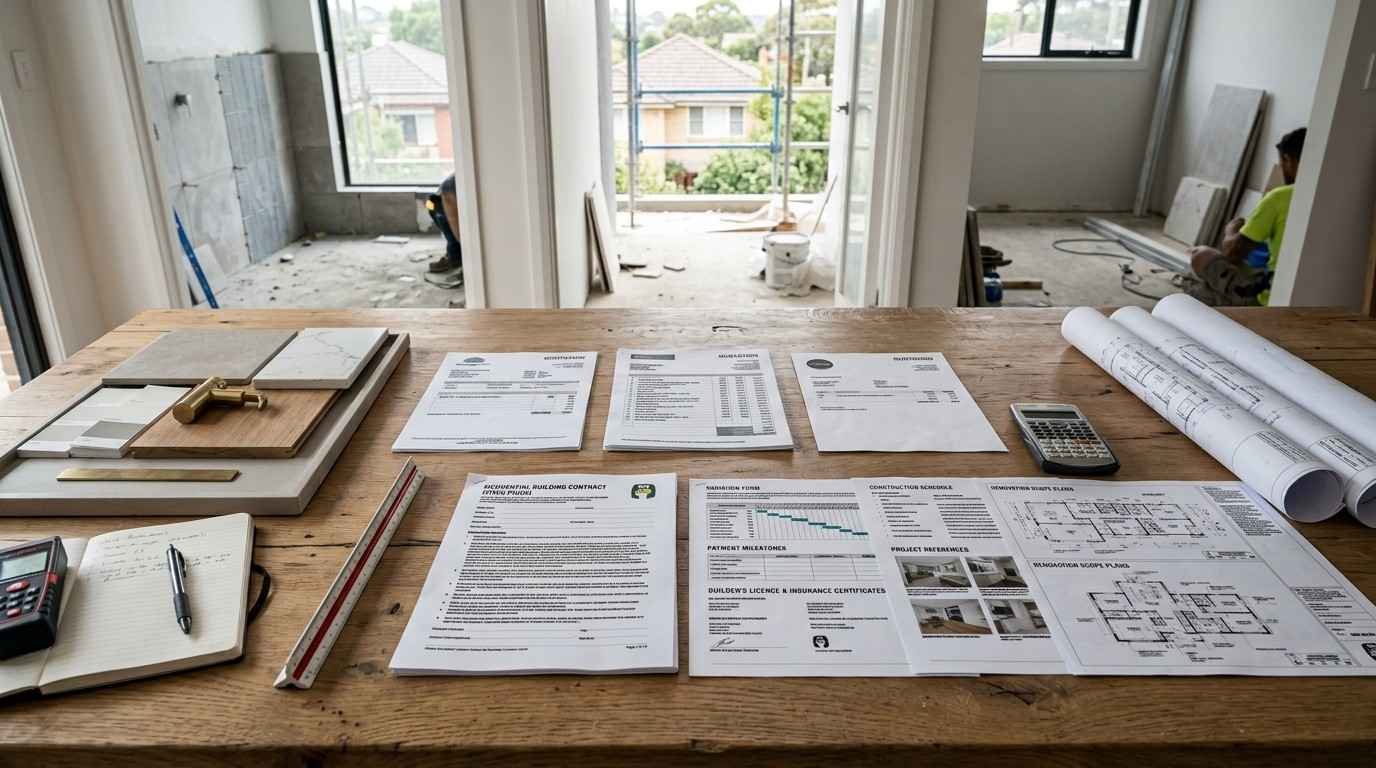
Get a minimum of three detailed quotes for any project above $20,000. A quality quote itemises labour and materials separately, specifies the brands and grades of materials being used, and includes a clear payment schedule tied to construction milestones rather than arbitrary dates.
A quote significantly lower than the others without explanation is a red flag, not a bargain.
Red flags we see regularly include requests for large upfront deposits, and anything above 10% is unusual for residential work. Others are reluctance to provide a written contract, vague scope descriptions that leave room for variations, and no references from recent comparable projects.
Contract Types and How Variations Affect Your Budget
Contract structure decides who carries the risk when costs move, and most homeowners sign without understanding that.
A fixed-price contract locks the scope and the number. It suits $100,000 projects with a well-defined scope, and it is what we recommend for most renovations at this budget because it protects the client.
A cost-plus contract charges actual costs plus a builder’s margin, typically 15% to 20%. It suits genuinely unknown scopes such as heritage restorations, but the final figure is not knowable at signing.
Variations are where fixed-price budgets still move. A variation is any change to the agreed scope, whether it is client-requested or triggered by a genuine site condition such as rotted subfloor timber discovered at demolition.
Every variation must be documented and priced in writing before the work proceeds. We see variations add 5% to 15% on typical projects, which is exactly why the contingency line exists in the budget allocation above.
How Can You Maximise Your Return on Investment with $100,000 in Sydney?
Maximising ROI requires understanding Sydney’s property market at the suburb level, not just the city level. Buyer preferences vary significantly by suburb and price point, and the renovation that returns 120% of its cost in one area returns 80% in another.
Updated bathrooms consistently attract premium offers across Sydney’s market. Modern kitchens reduce buyer hesitation at inspection because they remove the mental calculation buyers make about what they need to spend after purchase.
Fresh presentation throughout creates the emotional connection that turns interest into offers.
Over-capitalisation is a real risk, and we see it most often in mid-range suburbs where the ceiling price limits what renovations return. A $100,000 renovation in a suburb where comparable homes sell for $900,000 must lift the sale price by more than $100,000 to justify the spend, and that is before holding costs and agent fees.
The same investment in a suburb where comparable homes sell for $2,000,000 has far more room to generate a positive return.
Specific ROI estimates by room type, based on industry data, are worth holding in mind. Bathroom renovations return 60% to 80% of their cost at sale on average, kitchen renovations return 50% to 70%, and cosmetic whole-home updates such as paint and flooring return 100% to 150% because the cost is low relative to the perceived value lift.
Energy efficiency upgrades return 50% to 80% at sale but deliver ongoing savings when the property is retained.
Quality workmanship protects the investment long-term. Cheap finishes deteriorate quickly and signal to buyers that corners were cut elsewhere, proper waterproofing prevents structural damage, and licensed trades ensure compliance with Australian standards.
Document everything for future sale. Keep receipts, warranties, and compliance certificates organised, because buyers appreciate transparency about recent improvements and this documentation supports the asking price during negotiation.
Key Takeaways
- A $100,000 budget covers two full bathroom renovations, or one major room plus comprehensive cosmetic updates across the home
- Labour represents 40% to 50% of Sydney renovation costs and is always the largest line item
- Sydney renovation rates run $500 to $1,200 per m² cosmetic, $1,500 to $2,500 per m² mid-range, and $3,000 to $5,000 per m² structural
- Always include 10% to 15% contingency for hidden costs, pushed to 15% to 20% for pre-1990 homes
- Kitchens and bathrooms deliver the strongest ROI in Sydney, so allocate 50% to 60% of the budget here when selling
- Council approval via DA or CDC is required for structural work and adds 4 to 12 weeks to the timeline
- A $100,000 budget does not cover a full structural renovation, a completed ground-floor extension, a granny flat, or a second storey
- Fixed-price contracts protect homeowners at this budget, and variations typically add 5% to 15%
- Phased approaches help manage cash flow and improve decision-making between stages
- Avoid over-capitalising beyond neighbourhood price ceilings
Conclusion
A $100,000 renovation budget delivers genuine transformation potential for Sydney homes when the money is allocated strategically. The difference between a renovation that pays off and one that disappoints almost always comes down to planning, meaning which rooms to prioritise, which approvals to factor in, and which decisions to make before the first trade sets foot on site.
The cost landscape in Sydney rewards homeowners who understand where their dollars work hardest. Wet areas, cosmetic updates, and energy efficiency upgrades consistently outperform structural changes on a return-per-dollar basis, and knowing the ceiling of this budget is as valuable as knowing its reach.
At Sydney Home Renovation, we guide clients through every stage of this process, from honest budget planning and approval navigation to skilled trade coordination and quality finishes that hold their value. We combine transparent pricing with real construction expertise so your $100,000 delivers exactly what it should. Contact us today to discuss your renovation goals and receive a detailed cost assessment tailored to your property.
Frequently Asked Questions
How long does a $100,000 renovation take in Sydney?
Most $100,000 renovations take 8 to 16 weeks on site. Bathroom-focused projects finish faster than multi-room renovations, and council approvals add 4 to 12 weeks beforehand.
What can’t I do with a $100,000 renovation budget?
A $100,000 budget does not cover a full structural renovation, a completed ground-floor extension, a granny flat, or a second storey. Those projects start at $150,000 and climb.
Do I need council approval for my renovation?
Cosmetic updates proceed without approval. Structural changes and additions require a DA or CDC, and we assess approval requirements upfront on every project so there are no timeline surprises.
What is the best room to renovate for resale value?
Bathrooms and kitchens consistently deliver the strongest returns in Sydney. Updated wet areas reduce buyer objections at inspection and influence purchase decisions more than any other spaces.
How much contingency should I include in my budget?
Include 10% to 15% contingency for unexpected costs. Pre-1990 homes warrant 15% to 20% due to higher rates of hidden issues, protecting the project from blowouts when surprises emerge.
Can I live in my home during renovations?
Most renovations allow continued occupancy with some inconvenience. Bathroom renovations require alternative facilities temporarily, and kitchen work limits cooking options for several weeks.
Should I renovate before selling or sell as-is?
Strategic renovations typically increase sale prices beyond their cost, while over-capitalising wastes money. We recommend consulting a local agent about buyer expectations in your suburb first.
How do I find reliable tradespeople in Sydney?
Verify the NSW Fair Trading contractor licence before signing anything and check references from recent comparable projects. We coordinate all licensed trades through our project management team.
What renovation mistakes waste the most budget?
Over-specified appliances in mid-range kitchens, luxury fixtures in secondary bathrooms, and high-maintenance landscaping consistently fail to return their cost at sale. Spend where buyers look first.
Can I finance a $100,000 renovation in Sydney?
Renovation loans, construction loans, and home equity redraw facilities are the three common options. Construction loans release funds in stages tied to milestones, which suits larger projects.
How do I read a builder’s quote accurately?
A reliable quote separates labour and materials, specifies brands and grades, and ties payment to construction milestones. Vague scope descriptions and large upfront deposits are the main red flags.


